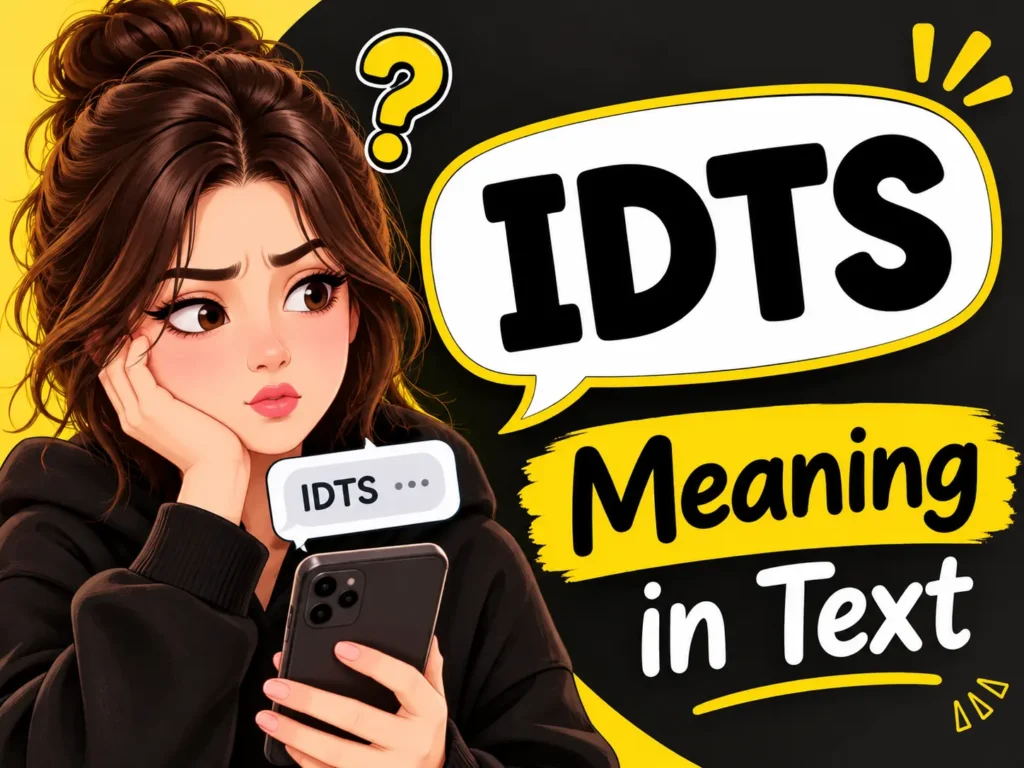
IDTS means “I Don’t Think So” in text messages and online conversations. People use this abbreviation when they disagree, express doubt, or believe something is unlikely to happen. If someone texts you “IDTS,” they are usually saying they don’t think something is true, possible, or a good idea.
What Does IDTS Mean in Text Messages?
IDTS stands for I Don’t Think So. It is an abbreviation commonly used in casual digital communication, especially when someone wants to respond quickly without typing the complete phrase.
For example:
- A: “Do you think he’ll come today?”
- B: “IDTS.”
Here, the person means they don’t believe he will come.
IDTS can communicate several intentions depending on the conversation:
- Disagreement: You don’t agree with someone’s statement.
- Doubt: You aren’t convinced something is true.
- Uncertainty: You think something probably won’t happen.
- Polite refusal: You want to say no without sounding too direct.
READ MORE: CGPT Meaning in Text – What Does CGPT Stand For?
Where Is IDTS Used?
IDTS appears in different types of digital conversations.
| Platform | Typical Usage |
|---|---|
| SMS/iMessage | Quick replies and everyday conversations |
| Disagreeing with friends or family | |
| Instagram DMs | Responding to questions and opinions |
| Snapchat | Casual conversations and quick reactions |
| Discord | Discussions among gaming friends |
| TikTok DMs | Informal private conversations |
The standard spelling is IDTS. However, people may also type it in lowercase as “idts.” Both versions have the same meaning.
Different Tones of IDTS in Conversations
One interesting thing about IDTS is that it can sound completely different depending on the relationship between the people texting.
1. Funny Tone
Friends may use IDTS to disagree jokingly.
A: “I’m definitely winning the match today.”
B: “IDTS 😂”
A: “Why are you doubting me?”
B: “Because I’ve seen you play!”
2. Sarcastic Tone
It can also express playful sarcasm when someone makes an unrealistic claim.
A: “I think I’ll finish all my assignments tonight.”
B: “IDTS.”
A: “Have some faith in me!”
B: “I’ll believe it when I see it.”
3. Playful Tone
In friendly conversations, IDTS can be used without making the other person feel bad.
A: “Do you think I can guess your surprise?”
B: “IDTS 😂”
A: “That’s not very encouraging!”
B: “Okay, give it a try.”
4. Serious Tone
When discussing plans or important decisions, IDTS can communicate genuine doubt.
A: “Do you think we can finish this project by Friday?”
B: “IDTS. We still have too much work.”
A: “Should we ask for another day?”
B: “Yes, that would be better.”
10 Realistic IDTS Text Conversation Examples
Here are 10 examples showing how IDTS naturally fits into different relationships and situations.
1. Between Best Friends
A: “Do you think Sarah likes my new haircut?”
B: “IDTS, she hasn’t even noticed 😂”
A: “Seriously?”
B: “I’m just being honest!”
2. Between a Couple
A: “Are you still upset with me?”
B: “IDTS, I’m just tired.”
A: “Want to talk about it?”
B: “Maybe after some rest.”
3. Between Siblings
A: “Mom will let us order pizza tonight.”
B: “IDTS.”
A: “Why not?”
B: “You forgot to finish your chores!”
4. Between Coworkers
A: “Do you think the manager will approve this proposal?”
B: “IDTS without some changes.”
A: “Which part needs improvement?”
B: “The budget section mainly.”
5. Between Classmates
A: “Will the teacher cancel tomorrow’s test?”
B: “IDTS.”
A: “I was hoping she would.”
B: “Better start studying!”
6. Between Online Friends
A: “Do you think we’ll ever meet in person?”
B: “IDTS anytime soon.”
A: “That’s disappointing.”
B: “Maybe when we both have time.”
7. Between a Parent and Child
A: “Can I stay up late tonight?”
B: “IDTS. You have school tomorrow.”
A: “Just thirty more minutes?”
B: “No, it’s bedtime.”
8. Between Gaming Friends
A: “Think we can win this round?”
B: “IDTS with this team 😂”
A: “You’re supposed to motivate us!”
B: “Fine, let’s prove me wrong.”
9. Between Two Friends Making Plans
A: “Is the restaurant open on Monday?”
B: “IDTS.”
A: “Should we check before leaving?”
B: “Definitely.”
10. Between People Getting to Know Each Other
A: “Do you think we’ve met before?”
B: “IDTS, I would’ve remembered.”
A: “Haha, fair enough.”
B: “Maybe we should introduce ourselves properly.”
Grammar and Language Role of IDTS
IDTS is an informal abbreviation that functions as a complete conversational response.
| Feature | Explanation |
|---|---|
| Full form | I Don’t Think So |
| Type | Abbreviation |
| Part of speech | Conversational expression |
| Register | Informal |
| Sentence position | Usually used as a standalone reply |
| Capitalization | IDTS or idts |
| Formal writing | Not recommended |
| Can replace a sentence? | Yes |
Can IDTS Be Used Alone?
Yes. IDTS can work as a complete response when the question is already clear.
For example:
A: “Do you think it’s going to rain?”
B: “IDTS.”
It can also appear in a longer sentence:
- “IDTS, we should wait.”
- “Honestly, idts.”
- “IDTS that’s a good idea.”
The last example is casual texting grammar. A more natural version would be “IDTS. That’s a good idea.”
Does Capitalization Change Its Meaning?
No. Both IDTS and idts mean “I Don’t Think So.”
However, uppercase letters can sometimes make a response feel more emphatic, while lowercase often looks relaxed and conversational.
How to Reply When Someone Texts IDTS
Your response depends on whether you agree, disagree, or want to keep the conversation going.
| Situation | Possible Reply |
|---|---|
| Funny | “Wow, so much confidence in me 😂” |
| Serious | “Why do you think that?” |
| Flirty | “You never know, maybe I’ll surprise you 😉” |
| Neutral | “Okay, fair enough.” |
| Disagreeing | “I actually think it’s possible.” |
| Curious | “What makes you say that?” |
IDTS vs Similar Texting Abbreviations
However, IDTS is sometimes confused with other short expressions used to agree, disagree, or express uncertainty.
| Term | Meaning | Usage Context | Tone | Popularity | Confusion Risk |
|---|---|---|---|---|---|
| IDTS | I Don’t Think So | Expressing doubt | Casual | Common | Low |
| IDK | I Don’t Know | Expressing uncertainty | Neutral | Very high | High |
| IMO | In My Opinion | Sharing an opinion | Casual | Common | Low |
| TBH | To Be Honest | Expressing honesty | Casual | Very high | Low |
| NGL | Not Gonna Lie | Giving an honest reaction | Casual | Common | Low |
| IKR | I Know, Right? | Agreeing with someone | Casual | Common | Medium |
| IHTS | I Hope That So | Expressing hope | Casual | Less common | Medium |
IDTS vs IDK: IDTS means you don’t think something is true or likely, while IDK means you don’t know the answer. For example, “IDTS he’ll come” expresses doubt, whereas “IDK if he’ll come” expresses uncertainty.
Who Uses IDTS?
IDTS is used by people who communicate through informal digital messages. Its meaning is straightforward, although how frequently someone uses it depends on their personal texting habits.
Age Group Breakdown
- Teenagers: May use IDTS in quick conversations with classmates and friends.
- Gen Z: Often uses abbreviations to keep casual messages short.
- Millennials: May use IDTS when discussing plans, opinions, and everyday situations.
- Older adults: May understand it through regular exposure to internet and texting language.
Gen Z vs Millennials
Gen Z often combines short abbreviations with emojis, reactions, and lowercase typing. Millennials may use the same abbreviation but sometimes prefer writing the complete phrase.
These are general tendencies rather than fixed rules.
Regional Usage
IDTS is understandable in English-language texting across the United States, United Kingdom, and other English-speaking communities. Its core meaning does not change significantly between these regions.
Platforms and Usage
IDTS is mainly useful in private messages, including SMS, WhatsApp, Instagram DMs, Snapchat, and Discord. It is not restricted to one social media platform.
Origin of IDTS and Internet Culture
IDTS comes directly from the everyday English phrase “I Don’t Think So.”
Unlike expressions created around a particular meme or social media trend, IDTS is a shortened form of an ordinary sentence. Its structure follows the broader tradition of internet and SMS abbreviations, where people shorten familiar phrases to make communication quicker.
The abbreviation is useful because it preserves the original meaning while making a response shorter.
It also works particularly well in conversations where the question already provides enough context to understand the answer.
Is IDTS Rude or Offensive?
No. IDTS is not a swear word, insult, or offensive expression.
However, it can sound dismissive depending on how it is used.
| Situation | Appropriate? | Explanation |
|---|---|---|
| Texting friends | Yes | Normal casual abbreviation |
| Talking to a partner | Yes | Depends on the conversation |
| School group chat | Yes | Fine in informal discussions |
| Texting a teacher | Better to avoid | Use the complete phrase |
| Messaging a boss | Better to avoid | A professional response is clearer |
| Serious disagreement | Use carefully | It may sound dismissive without explanation |
For example, replying only “IDTS” to someone sharing an important concern may seem uninterested. Adding a short explanation makes the response more considerate.
Real-World Observation: Why IDTS Works So Well in Texting
IDTS is interesting because it communicates disagreement without necessarily creating an argument. Unlike a direct “No,” which can sound final, “I don’t think so” leaves some room for discussion. For example, when someone asks whether a plan will work, replying “IDTS” expresses doubt rather than completely rejecting the idea. Its usefulness comes from that small difference: it lets people disagree while keeping the conversation open. The abbreviation is especially convenient when the other person already understands what is being discussed.
Frequently Asked Questions About IDTS
1. What does IDTS mean when someone texts you?
IDTS means “I Don’t Think So.” Someone may send it when they disagree with you or believe something is unlikely to happen. It is commonly used in casual text conversations. The exact tone depends on the topic and relationship.
2. Is IDTS rude to reply with just one word in a text?
No, IDTS is not automatically rude. However, a one-word response can sometimes feel dismissive if the other person is discussing something important. With close friends, it is usually understood as a casual disagreement. Adding an explanation can make your message sound friendlier.
3. What is the difference between IDTS and IDK?
IDTS means “I Don’t Think So,” while IDK means “I Don’t Know.” IDTS expresses doubt or disagreement, whereas IDK communicates a lack of knowledge. For example, “IDTS she’ll come” suggests you don’t believe she will come. “IDK if she’ll come” means you are unsure.
4. What does IDTS mean from a girl?
When a girl texts IDTS, it generally means “I Don’t Think So.” She might be disagreeing with your suggestion, expressing doubt, or responding negatively to a question. It does not automatically indicate anger or disinterest. Read the surrounding messages to understand her intention.
5. What does IDTS mean from a guy?
When a guy uses IDTS, it has the same standard meaning: “I Don’t Think So.” He may be expressing an opinion, questioning a possibility, or casually disagreeing. It is not a gender-specific abbreviation. The conversation determines whether the response is serious, playful, or sarcastic.
6. Does IDTS mean the same thing on Snapchat and WhatsApp?
Yes. IDTS generally means “I Don’t Think So” on both platforms. On Snapchat, it may appear in quick exchanges between friends. On WhatsApp, people may use it when discussing plans, family matters, or everyday questions.
7. What’s the difference between texting IDTS and saying it out loud?
The meaning is essentially identical. In a text, people usually type the three letters instead of the full phrase. When speaking, they generally say “I don’t think so” rather than pronounce the abbreviation. Facial expressions and voice can also make spoken disagreement easier to interpret.
8. Does IDTS mean the same thing in a group chat and a private message?
Yes, the standard meaning stays the same. In a group chat, someone might use it to disagree with a shared plan or suggestion. In a private message, it may express a personal opinion or response to a question. The context helps determine how strongly the person disagrees.
Conclusion
IDTS stands for I Don’t Think So. It is a casual texting abbreviation used to express doubt, disagreement, or the belief that something is unlikely.
Quick usage tips:
- Use IDTS when you want to express doubt.
- Use lowercase or uppercase depending on your typing style.
- Add an explanation when discussing something important.
- Keep it for casual conversations rather than formal communication.
Common mistakes to avoid:
- Don’t confuse IDTS with IDK.
- Don’t assume it always means someone is angry.
- Don’t interpret it as an offensive expression.
- Don’t use it when you actually mean “I know, right?”
Use IDTS when a short, informal disagreement is appropriate. Avoid it in professional conversations where a complete and polite response communicates your meaning more clearly.
1 thought on “IDTS Meaning in Text: What Does IDTS Stand For?”