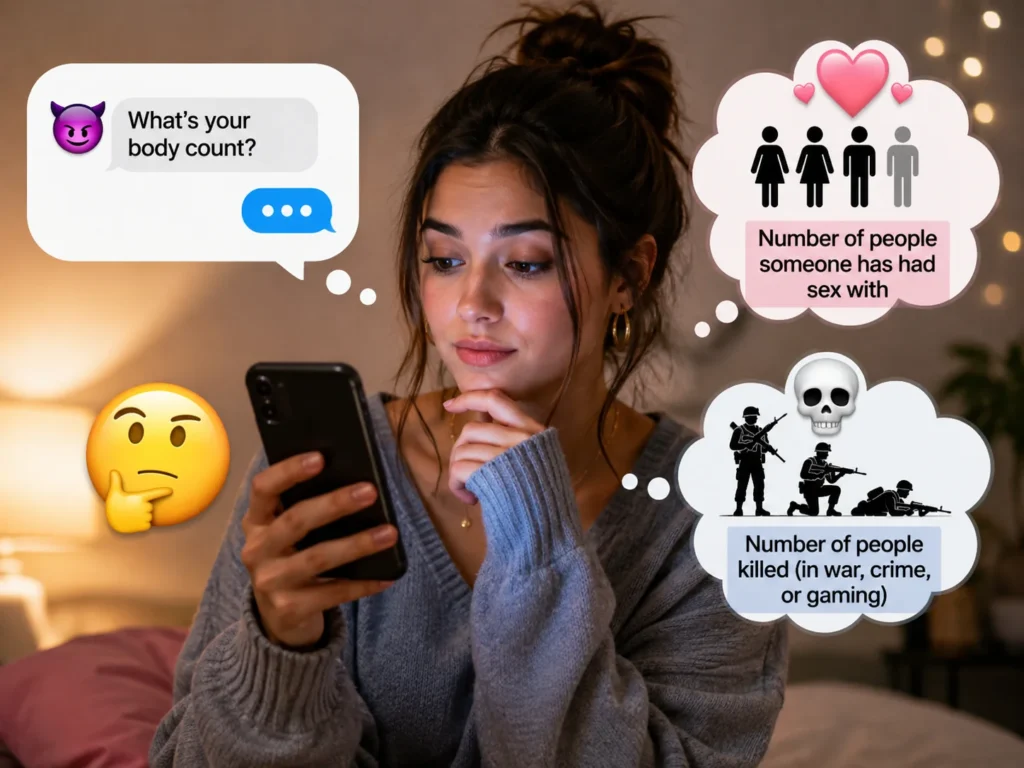
body count meaning in text usually means the number of people someone has had sex with. In some contexts, however, it can mean the number of people killed in a violent event, or simply a death toll. The surrounding conversation tells you which meaning applies.
What Does Body Count Mean in Text?
When someone asks:
“What’s your body count?”
they are usually asking about the number of people you have had sexual relationships or encounters with.
This is the meaning most commonly associated with casual social-media and texting conversations today.
For example:
A: What’s your body count?
B: I’d rather not share that.
In this context, the person is asking about sexual history.
However, body count has another genuine meaning:
the number of people who have died in a particular event, conflict, disaster, or attack.
For example:
“The body count from the accident was reported later.”
Here, the phrase has nothing to do with someone’s dating or sexual history.
Is “Body Count” Slang?
In the dating and texting sense, body count is informal slang.
It is a phrase rather than an acronym or abbreviation.
The words do not stand for separate letters.
In casual conversations, “body count” has become a common way of referring to someone’s number of previous sexual partners.
The phrase can sound blunt, intrusive, judgmental, or casual depending on who uses it and how they ask.
The Two Main Meanings of Body Count
1. Body Count = Number of Sexual Partners
This is the meaning you’re most likely to encounter in a dating-related text.
For example:
“Do you know her body count?”
The sender is asking how many sexual partners she has had.
Similarly:
“He asked me my body count.”
means that someone asked about the number of previous sexual partners.
The phrase doesn’t necessarily tell you whether those relationships were serious, casual, current, or in the past. It simply refers to a person’s sexual history in terms of a number.
2. Body Count = Number of Deaths
The older and literal meaning relates to the number of people killed in an event.
For example:
“The body count continued to rise.”
This can refer to deaths caused by a disaster, war, accident, or violent incident.
This meaning is more likely in news reporting, historical discussions, crime-related conversations, or discussions of fictional violence.
The context is therefore extremely important.
Why Do People Search “Body Count Meaning in Text”?
People often search this phrase because “body count” can sound confusing when someone suddenly uses it in a personal conversation.
If someone texts:
“What’s your body count?”
you may wonder:
- Are they asking about dating?
- Are they asking about sexual history?
- Is it an insult?
- Are they joking?
- Is there another meaning?
In a dating or social-media conversation, the sexual-history meaning is usually intended.
If the conversation is about a war, accident, crime, or fictional battle, the death-toll meaning is more likely.
What Does “What’s Your Body Count?” Mean?
When someone asks:
“What’s your body count?”
they are usually asking:
“How many people have you had sex with?”
This is a direct and informal question.
It can be asked:
- Out of curiosity
- During dating conversations
- Among friends
- As a joke
- During discussions about relationships
- In online conversations
The question can also feel quite personal because it asks about someone’s sexual history.
You are not obligated to give a number if you don’t want to.
A simple response can be:
“I don’t really discuss that.”
Does Body Count Mean Number of Relationships?
Not necessarily.
This is an important distinction.
Body count usually refers to sexual partners, not the total number of romantic relationships.
Someone could have had several relationships without having sex in every relationship.
Likewise, someone could have had sexual partners without those people being romantic partners.
Therefore:
Body count ≠ number of relationships
The exact definition can vary between people, so if the distinction matters, clarification is reasonable.
Does Body Count Mean Number of Dates?
No.
Going on dates does not automatically increase someone’s body count.
The phrase generally refers to sexual partners, not people someone has gone on dates with.
For example:
“I’ve dated 10 people.”
does not automatically mean:
“My body count is 10.”
Those are different concepts.
Body Count Tone and Context Variations
Funny Conversation
A: What’s your body count?
B: I don’t know, my calculator isn’t that advanced 😂
A: I’m asking a serious question.
B: And I’m giving you a serious non-answer.
Here, the topic is sexual history, but the response is intentionally humorous.
Sarcastic Conversation
A: What’s your body count?
B: Why, are you conducting a survey?
A: Maybe.
B: Then I’m declining to participate 😂
The question is treated sarcastically rather than answered directly.
Playful Conversation
A: Can I ask you something?
B: Depends what it is.
A: What’s your body count?
B: That’s a bold question 👀
Here, the playful tone doesn’t change the basic meaning.
Serious Conversation
A: Can I ask about your past relationships?
B: Sure.
A: What’s your body count?
B: I’d rather talk about our relationship than numbers.
Here, the phrase refers to sexual history, but the conversation is more serious.
10 Real Text Message Examples
1. Dating Conversation
A: Can I ask you something personal?
B: Sure.
A: What’s your body count?
B: I’d rather not put a number on that.
Here, it clearly refers to sexual history.
2. Friend Conversation
A: Everyone was talking about body counts yesterday.
B: Seriously?
A: Yeah, it got awkward fast.
B: I can imagine 😂
Here, the topic is sexual history.
3. New Dating Situation
A: Do you care about body count?
B: Not really. I care more about honesty and compatibility.
A: That’s fair.
B: Everyone has a past.
4. Setting a Boundary
A: What’s your body count?
B: I don’t share that information.
A: Fair enough.
B: Thanks for understanding.
This shows that you can decline to answer.
5. Sibling Conversation
A: Why is everyone using the phrase body count?
B: They’re talking about dating history.
A: Oh, that’s what it means?
B: Usually, yeah.
6. Social Media Conversation
A: Someone asked my body count in the comments.
B: Did you answer?
A: No way 😂
B: Good choice if you weren’t comfortable.
7. Flirty Conversation
A: I have a question for you.
B: Go ahead.
A: What’s your body count?
B: You’re getting personal already 😏
A: Maybe I’m curious.
The phrase still refers to sexual history; the surrounding conversation makes the tone flirtatious.
8. Serious Relationship Conversation
A: Do you think body count matters?
B: I think honesty matters more.
A: I agree.
B: Everyone deserves respect regardless of their past.
9. Death-Toll Context
A: Did you see the report about the disaster?
B: Yes.
A: They said the body count was higher than expected.
B: That’s heartbreaking.
Here, body count means the number of deaths, not sexual partners.
10. Gaming/Fiction Context
A: What’s your body count in the game?
B: 27.
A: Nice.
B: I’m finally getting better.
Here, body count refers to characters or opponents defeated, depending on the game.
Grammar and Language Role
Is Body Count a Noun?
Yes.
“Body count” is a noun phrase.
Examples:
“What’s your body count?”
“He has a high body count.”
“They were discussing body count.”
The phrase can function as the subject or object of a sentence.
Can It Stand Alone?
Yes, in casual conversation.
Someone might text:
“Body count?”
This can mean:
“What’s your body count?”
The exact meaning still depends on context.
Can It Appear Mid-Sentence?
Yes.
Examples:
“Does body count matter to you?”
“She asked about my body count.”
“I don’t judge people by body count.”
Capitalization
The normal form is:
body count
Writing:
BODY COUNT
can make it look more emphatic or dramatic, but capitalization doesn’t create a new meaning.
Formal vs. Informal Use
The dating-related meaning is informal.
It commonly appears in:
- Text messages
- Dating conversations
- Snapchat
- Instagram DMs
- TikTok discussions
- Casual conversations
It is generally not appropriate wording for formal or professional communication.
The death-related meaning is different. Body count can appear in journalism, historical writing, crime reporting, and other serious contexts, although writers may choose more precise terms such as death toll.
How to Reply to “What’s Your Body Count?”
Funny Reply
“Nice try 😂 I’m keeping that information classified.”
Serious Reply
“I’d rather keep my sexual history private.”
Neutral Reply
“I don’t really keep track of it that way.”
Flirty Reply
“That’s a pretty personal question for this early in the conversation 😉”
A response doesn’t have to include a number. You can choose what you’re comfortable sharing.
Body Count vs. Related Terms
| Term | Meaning | Usage Context | Tone | Popularity | Confusion Risk |
|---|---|---|---|---|---|
| Body count | Number of sexual partners; sometimes number of deaths | Dating, texting, news | Informal to serious | High | High |
| Body count in dating | Number of sexual partners | Relationships | Informal | High | Medium |
| Past partners | Previous romantic/sexual partners | Dating | Neutral | High | Low |
| Sexual history | A person’s past sexual experiences | Dating/health discussions | Neutral | High | Low |
| Body count in war | Number of people killed | Conflict/history | Serious | Medium | Medium |
| Death toll | Number of people who died | News/disasters | Formal | Very high | Low |
The phrase is unusually confusing because the same expression has both a dating meaning and a death-related meaning.
Who Uses the Term?
“Body count” is used across different age groups, especially in informal online and dating conversations.
Gen Z
You may see it in short questions such as:
“What’s your body count?”
or:
“Does body count matter?”
It has become especially visible in online discussions about dating and relationships.
Millennials
Millennials also understand and use the phrase, particularly in informal conversations.
However, individual preferences vary, and some people may prefer phrases such as “number of partners” or “sexual history.”
Regional Usage
The dating-related expression is used in English-language online conversations across different regions.
It shouldn’t be treated as exclusive to one country or generation.
The older death-related meaning is also internationally recognizable in English.
Origin and Internet Culture
The phrase “body count” predates modern social media.
Its older meaning refers to the number of people killed in an event.
The sexual meaning developed as informal slang for the number of sexual partners and later became highly visible in dating discussions, social media, and online relationship culture.
It is therefore inaccurate to claim that TikTok or Snapchat invented the phrase.
Modern social media did, however, help popularize conversations about “body count,” particularly debates about dating preferences, relationships, and sexual history.
Is Body Count Rude or Offensive?
The phrase is not profanity, but it can be considered blunt or insensitive depending on how it is used.
Asking a stranger:
“What’s your body count?”
can feel intrusive.
Among close friends who regularly discuss dating, it may be treated casually.
The key issue is context and consent to the conversation.
Is Body Count Appropriate at School?
The phrase is generally too personal for formal school communication.
Students may encounter it online, but that doesn’t mean it’s appropriate to use with teachers or in academic writing.
Is Body Count Appropriate at Work?
No, the sexual-history meaning is generally inappropriate for workplace conversation unless there is an exceptional personal context where such a discussion is clearly welcome.
For professional communication, avoid the term.
Cultural Sensitivity
Body count discussions can easily become judgmental.
A person’s number of previous sexual partners doesn’t automatically tell you whether someone is trustworthy, compatible, respectful, or suitable for a relationship.
If the topic comes up, avoid assuming that a particular number tells you everything about a person’s character.
It’s also useful to distinguish between asking about someone’s sexual history for a genuine relationship or health conversation and asking simply to judge or embarrass them.
Real-World Observation
“Body count” is culturally interesting because it turns a complicated part of someone’s personal history into a single number. In texting, that makes the phrase easy to ask about but also easy to misunderstand or misuse. Some people treat the question casually, while others consider it deeply private. The phrase is also unusual because it carries two very different meanings: an older meaning connected with deaths and a newer informal dating meaning connected with sexual partners. Context is therefore essential whenever you encounter it.
Frequently Asked Questions
What does body count mean in a text message?
In dating or casual texting, body count usually means the number of people someone has had sex with. It is an informal phrase rather than a formal medical or relationship term. In discussions about disasters, wars, or violence, it can instead mean the number of people who died.
Is body count a bad word?
No, “body count” isn’t a swear word or profanity. However, the dating-related use can be considered blunt or intrusive because it asks about someone’s sexual history. Whether it is appropriate depends on the relationship and context.
What does “what’s your body count?” mean?
In a dating conversation, it usually means “How many people have you had sex with?” It’s a direct question about sexual history. You can answer it, decline to answer, or explain that you don’t think in terms of a body count.
Does body count mean number of relationships?
Usually, no. Body count generally refers to sexual partners, while relationship count refers to romantic relationships. Those numbers don’t necessarily match.
Is body count the same as number of partners?
In casual dating conversations, “body count” is generally used to mean the number of sexual partners. However, people may define the phrase differently, so clarification can be useful if the distinction matters.
Is it rude to ask someone their body count?
It can be, especially if you barely know the person or ask without considering their privacy. Some people are comfortable discussing sexual history, while others aren’t. A respectful conversation allows the other person to decline.
What does body count mean in a non-dating conversation?
In a non-dating context, body count can refer to the number of people who died in an event. For example, a discussion about a disaster or war might use the phrase to describe fatalities. In gaming, it can also sometimes refer to the number of opponents defeated.
Does body count matter in a relationship?
Different people have different views about this. Some care about a partner’s sexual history, while others focus more on trust, compatibility, current behavior, and communication. There isn’t one universal rule about whether someone’s past should matter.
PAA-Optimized Questions
What does body count mean from a girl?
If a girl asks about your body count, she is usually asking about the number of people you’ve had sex with. The question itself doesn’t reveal why she’s asking. She could be curious, discussing dating preferences, or simply making conversation.
What does body count mean from a guy?
If a guy asks your body count, he is usually asking about your number of previous sexual partners. The phrase itself doesn’t reveal his intentions. The surrounding conversation and your relationship with him provide the context.
What does body count mean on Snapchat?
On Snapchat, body count usually has the same dating-related meaning: the number of someone’s previous sexual partners. However, if the conversation is about gaming or violence, it could have a different meaning.
What does body count mean on TikTok?
On TikTok, body count is commonly discussed in the context of dating and sexual history. People may ask whether body count matters or discuss their opinions about it. The phrase itself is not a TikTok-created term.
What should I say if someone asks my body count?
You can answer if you’re comfortable, but you don’t have to. A simple response such as “I’d rather keep that private” sets a clear boundary. You can also redirect the conversation toward compatibility, values, or your current relationship.
Why do people care about body count?
People have different reasons for caring about a partner’s sexual history, including personal values, curiosity, insecurity, or concerns about compatibility. However, a number alone doesn’t provide a complete picture of someone’s character or relationship history.
Conclusion
When you see “body count” in a text message, the meaning usually depends on the topic.
In dating or relationship conversations:
Body count = number of sexual partners.
In discussions about disasters, war, crime, or violence:
Body count = number of people killed.
The phrase isn’t profanity, but its dating meaning is personal and informal. If someone asks about your body count, remember that you don’t have to provide a number if you aren’t comfortable doing so.
Usage Tips
- Look at the conversation before interpreting the phrase.
- In dating contexts, understand body count as sexual-partner count.
- In news or violence-related contexts, it may mean death toll.
- Don’t assume the phrase tells you everything about someone’s character.
Common Mistakes
- Assuming body count always means sexual partners.
- Confusing body count with the number of romantic relationships.
- Treating the term as a formal medical expression.
- Assuming someone must answer when asked.
When to Use Body Count
Use the phrase cautiously in casual conversations where the topic is already appropriate and everyone is comfortable discussing personal relationships.
When to Avoid Body Count
Avoid asking strangers, coworkers, teachers, or acquaintances about their body count. In sensitive conversations, phrases such as “sexual history” or “previous partners” may be clearer and less judgmental.
Ultimately, body count is a context-dependent phrase with two major meanings. In modern texting and dating conversations, it usually refers to the number of sexual partners, while in serious discussions about violence or disasters, it can refer to the number of deaths.