If you’ve spent any time on social media, messaging apps, gaming chats, or online forums, you’ve probably come across the abbreviation “IIRC.” At first glance, it can look confusing, especially if you’re unfamiliar with internet slang or texting shortcuts.
Many people search for “iirc meaning” because they see it in conversations and want to understand what the sender is trying to say. Unlike some abbreviations that have multiple interpretations, IIRC has a fairly specific purpose, yet its tone and usage can vary depending on the context.
Understanding this simple acronym can help you communicate more naturally online, avoid misunderstandings, and better interpret the subtle emotions behind digital conversations.
IIRC Meaning – Quick Meaning
What Does IIRC Mean?
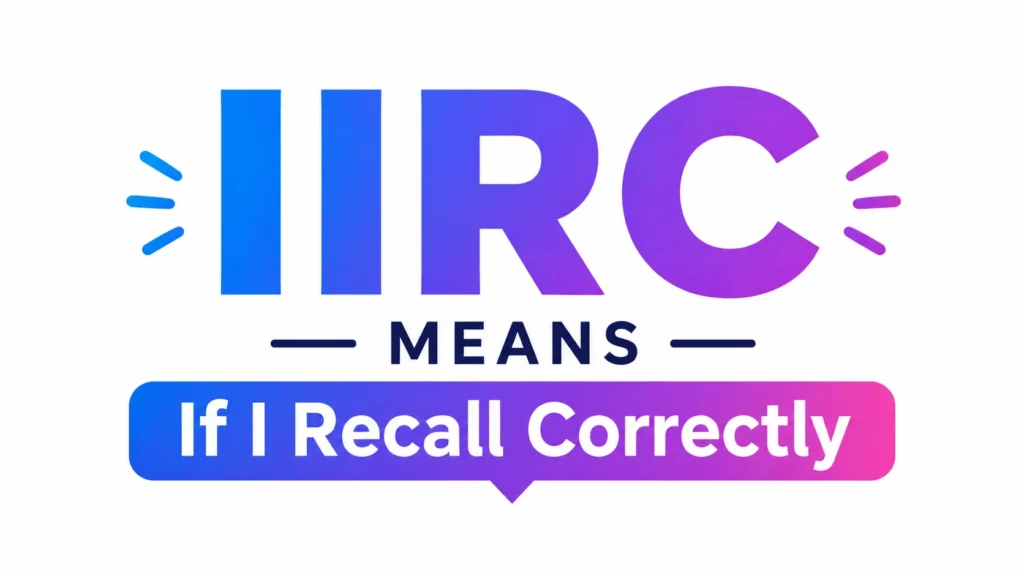
IIRC stands for:
“If I Recall Correctly” or “If I Remember Correctly.”
People use it when they want to share information but are not completely certain about the details.
It acts as a soft disclaimer before making a statement.
Simple Definition
IIRC means:
- I’m not 100% sure.
- This is what I remember.
- Please correct me if I’m mistaken.
- I’m sharing information from memory.
Quick Examples
“IIRC, the meeting starts at 10 a.m.”
“IIRC, that movie came out in 2019.”
“IIRC, you’ve visited Japan before.”
In each example, the speaker is relying on memory rather than checking facts.
Origin & Background
Where Did IIRC Come From?
IIRC originated in the early days of internet communication, particularly in online discussion boards, chat rooms, and forums during the 1990s.
When typing speed mattered and internet connections were slower, users developed abbreviations to communicate more efficiently. Acronyms such as LOL, BRB, IMO, and IIRC became common across online communities.
Early Internet Culture
Internet forums encouraged long discussions where users frequently shared information from memory. Instead of writing “if I remember correctly” every time, users shortened it to IIRC.
This made conversations quicker while still showing humility and uncertainty.
Social Media Influence
As communication shifted from forums to platforms like Twitter, Instagram, TikTok, and Reddit, IIRC remained relevant.
Unlike trend-based slang that comes and goes, IIRC survived because it serves a practical communication purpose.
How Its Meaning Evolved
Originally, IIRC was mostly used in technical discussions and online forums.
Today, it appears in:
- Text messages
- Social media comments
- Gaming chats
- Workplace messaging apps
- Online communities
Its meaning has remained remarkably consistent over time.
Real-Life Conversations
WhatsApp Conversation
Person A:
“Do you remember what time Sarah’s flight lands?”
Person B:
“IIRC, it’s around 8:30 tonight.”
Person A:
“Perfect, thanks!”
Instagram DM Conversation
Person A:
“Wasn’t that café in your travel photos located in Paris?”
Person B:
“IIRC, it was actually in Lyon.”
Person A:
“Oh right! My mistake.”
TikTok Comment Section
Person A:
“This song was huge in 2018.”
Person B:
“IIRC, it became popular in 2019.”
Person A:
“You’re probably right.”
Text Message Conversation
Person A:
“When’s the assignment due?”
Person B:
“IIRC, Friday afternoon.”
Person A:
“I’ll double-check with the teacher.”
These examples show how IIRC helps people contribute information without sounding overly confident.
Emotional & Psychological Meaning
What Emotion Does It Express?
At its core, IIRC expresses caution.
The speaker wants to help but also wants to avoid spreading incorrect information.
Why People Use It
Using IIRC communicates:
- Humility
- Honesty
- Openness to correction
- Respect for accuracy
Many people appreciate this approach because it creates a more collaborative conversation.
What It Reveals About Modern Communication
Digital communication often rewards speed.
People respond quickly before verifying every detail.
IIRC allows users to participate while acknowledging possible memory limitations.
This balance between confidence and uncertainty is increasingly important in online spaces.
Personal-Style Scenario
Imagine discussing travel plans with friends.
You remember reading that a museum closes on Mondays, but you’re not entirely sure.
Saying, “IIRC, it’s closed on Mondays,” helps the group while encouraging someone else to verify the information.
That small phrase prevents unnecessary confusion and shows responsible communication.
Usage in Different Contexts
Social Media
On social media, IIRC often appears in comment sections and discussions.
People use it when referencing events, dates, celebrities, trends, or news.
Example:
“IIRC, that actor won an award last year.”
Friends and Relationships
Among friends, IIRC creates a relaxed and conversational tone.
It helps avoid arguments because the speaker isn’t claiming absolute certainty.
Example:
“IIRC, your birthday party starts at 7.”
Work and Professional Settings
IIRC can appear in informal workplace chats.
However, it should be used carefully in professional environments.
Example:
“IIRC, the client approved the proposal last week.”
For critical information, verification is always better.
Casual vs Serious Tone
In casual conversations, IIRC sounds natural and friendly.
In serious situations involving legal, medical, or financial information, relying solely on memory can create problems.
The stakes determine whether IIRC is appropriate.
When NOT to Use It
High-Stakes Information
Avoid using IIRC when accuracy is essential.
Examples include:
- Medical advice
- Legal guidance
- Financial decisions
- Safety instructions
Formal Business Documents
Professional reports should contain verified information rather than memory-based assumptions.
Academic Writing
Research papers require sources and evidence.
IIRC is too informal for academic work.
Situations Prone to Misunderstanding
Some people may mistake memory-based information for factual certainty.
Whenever consequences are significant, confirm details first.
Common Misunderstandings
Assuming It Means Certainty
One common mistake is treating IIRC statements as verified facts.
The phrase actually signals uncertainty.
Thinking It Sounds Unprofessional
While informal, IIRC isn’t inherently careless.
Many professionals use it in quick internal conversations.
Confusing It With Other Acronyms
People sometimes mix it up with:
- IMO (In My Opinion)
- IMHO (In My Humble Opinion)
- FYI (For Your Information)
Each serves a different purpose.
Literal vs Figurative Meaning
Literally, IIRC refers to memory.
Figuratively, it often means:
“Don’t quote me on this, but I think…”
Comparison Table
| Expression | Meaning | Confidence Level | Typical Usage |
|---|---|---|---|
| IIRC | If I Recall Correctly | Medium | Memory-based information |
| IMO | In My Opinion | Personal view | Opinions |
| IMHO | In My Humble Opinion | Personal view | Soft opinions |
| FYI | For Your Information | High | Sharing information |
| AFAIK | As Far As I Know | Medium-High | Knowledge-based statements |
| IDK | I Don’t Know | Low | Lack of knowledge |
| Factually | Verified information | High | Confirmed details |
| Definitely | Absolute certainty | Very High | Strong confidence |
Key Insight
IIRC occupies a unique space between certainty and uncertainty. It allows people to contribute useful information while remaining open to correction, making conversations more collaborative and less confrontational.
Variations / Types
If I Remember Correctly
Alternative full version emphasizing memory.
If Memory Serves Me Right
A more traditional phrase with the same meaning.
As Far As I Recall
Used when referencing past events.
I Think
Less formal but similar uncertainty.
AFAIK
“As Far As I Know” focuses on knowledge rather than memory.
To the Best of My Knowledge
More professional and formal.
From What I Remember
Common in everyday speech.
If I’m Not Mistaken
A polite way to express uncertainty.
Correct Me If I’m Wrong
Invites feedback and verification.
I Believe So
Expresses moderate confidence without certainty.
How to Respond When Someone Uses It
Casual Replies
- “Sounds right.”
- “I think so too.”
- “That’s what I remember as well.”
Funny Replies
- “Your memory is better than mine.”
- “We’ll blame the internet if we’re wrong.”
- “That’s good enough for me.”
Mature Replies
- “Let’s verify it just to be safe.”
- “Thanks for sharing what you remember.”
Respectful Replies
- “I appreciate the clarification.”
- “I’ll double-check the details.”
- “That helps a lot.”
Regional & Cultural Usage
Western Culture
In North America and Europe, IIRC is widely recognized among internet users.
It often appears in online discussions and workplace chats.
Asian Culture
Many English-speaking internet users across Asia understand IIRC, especially younger generations involved in global online communities.
Middle Eastern Culture
Among English-speaking professionals and students, IIRC is commonly understood in digital communication.
Its usage tends to be more frequent in online spaces than face-to-face conversations.
Global Internet Usage
The acronym has become part of international internet culture.
People from different countries use it in similar ways.
Generational Differences
Gen Z
Gen Z understands IIRC but often prefers newer texting styles and emojis.
Millennials
Millennials use IIRC more frequently because they grew up during the era of forums and instant messaging.
Is It Safe for Kids?
Understanding the Context
Yes, IIRC is generally safe for children.
It contains no offensive, harmful, or inappropriate content.
The acronym simply indicates that someone is relying on memory rather than verified facts.
Parents and educators can treat it as a harmless communication abbreviation similar to FYI or BTW.
FAQs
What does IIRC stand for?
IIRC stands for “If I Recall Correctly” or “If I Remember Correctly.”
Is IIRC rude?
No. It is usually considered polite because it acknowledges uncertainty.
Is IIRC formal or informal?
IIRC is primarily informal and commonly used in online communication and text messaging.
Can I use IIRC at work?
Yes, in casual workplace chats. For important documents or reports, verify information instead.
Is IIRC the same as AFAIK?
Not exactly. IIRC refers to memory, while AFAIK refers to knowledge.
Why do people use IIRC?
People use it to share information while admitting they may not remember every detail perfectly.
Is IIRC still popular?
Yes. Although many internet trends fade, IIRC remains widely used because it serves a practical communication purpose.
Conclusion
Understanding the iirc meaning is surprisingly useful in today’s digital world. While it may look like just another internet abbreviation, it reflects something deeper about modern communication: the willingness to contribute information while remaining open to correction.
Whether you’re chatting with friends, commenting on social media, participating in online communities, or messaging coworkers, IIRC helps strike a healthy balance between confidence and humility.
Language constantly evolves, yet some expressions endure because they solve real communication problems. IIRC is one of those rare acronyms that remains relevant, practical, and easy to understand. Once you recognize its purpose, you’ll notice it everywhere—and you’ll probably start using it naturally yourself.