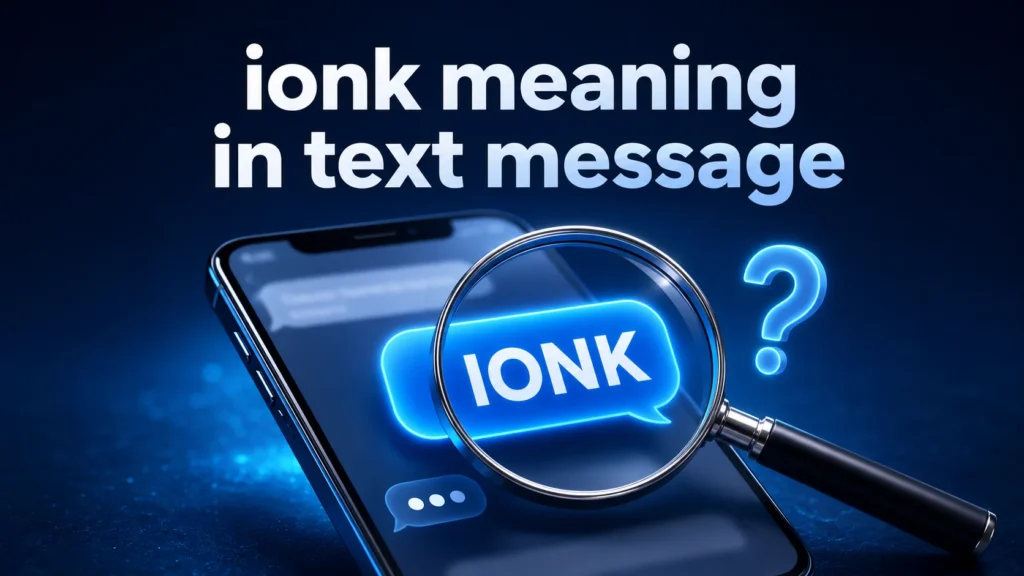
The ionk meaning in text message is usually “I don’t know.” It is an informal, phonetic spelling that reflects how “I don’t know” may sound when spoken quickly in casual conversation.
For example, if someone texts, “Ionk what happened,” they mean, “I don’t know what happened.”
At first, “ionk” can look like a typing mistake, secret code, or unfamiliar abbreviation. However, it is mainly internet slang used to make a message feel relaxed, humorous, expressive, or conversational.
Its exact emotional tone depends on context. Sometimes it expresses genuine uncertainty. In other situations, it can communicate indifference, disbelief, annoyance, or a playful refusal to explain something.
Understanding the surrounding message is important. The sender’s punctuation, emojis, and relationship with you can reveal whether “ionk” sounds confused, dismissive, funny, or serious.
Ionk Meaning in Text Message – Quick Meaning
The simplest ionk meaning in text message is:
Ionk = I don’t know
It is generally pronounced like “eye-onk” or as a compressed version of “I don’t know.” People use it when they lack information, cannot decide, or do not want to give a definite answer.
Common interpretations include:
- “I don’t know.”
- “I’m not sure.”
- “I have no idea.”
- “I can’t explain it.”
- “I don’t really care.”
- “Don’t ask me.”
- “I’m confused too.”
Consider these examples:
“Ionk where she went.”
This means, “I don’t know where she went.”
“Ionk, that story sounds suspicious.”
Here, the sender is uncertain or doubtful.
“Why did I buy it? Ionk 😂”
In this example, the slang adds a playful, self-aware tone.
“Ionk” is not a formal acronym in which every letter represents a separate word. Instead, it is a sound-based spelling shaped by fast speech and online communication.
Origin and Background of “Ionk”
Where Did “Ionk” Come From?
“Ionk” developed from the spoken pronunciation of “I don’t know.” When people say this phrase quickly, certain sounds may blend together or disappear.
Online writers often reproduce informal pronunciation through creative spelling. In the same way that “going to” becomes “gonna” and “want to” becomes “wanna,” “I don’t know” may appear as “ion know,” “ionk,” or simply “ion.”
There is no single confirmed person who invented the term. It grew naturally through casual speech, texting, memes, music, and social media.
Influence of African American English
The expression is strongly associated with online spellings influenced by African American English, particularly the pronunciation written as “ion” for “I don’t.”
However, African American English is a structured language variety with its own consistent patterns. It should not be treated as incorrect English or reduced to a collection of internet trends.
As expressions move between communities, their original cultural background can become less visible. Using the term naturally is usually acceptable, but mocking the pronunciation or presenting it as unintelligent can be disrespectful.
Music and Popular Culture
Hip-hop lyrics, viral videos, comedy clips, and celebrity interviews helped expose wider audiences to informal pronunciations such as “ion know.” Listeners then reproduced those sounds in captions, comments, and private messages.
Eventually, “ionk” emerged as an even shorter written version. Its unusual appearance made it especially suitable for humorous posts and quick reactions.
Social Media Impact
TikTok, Instagram, Snapchat, and X encourage short, expressive language. Consequently, users often write words the way they sound instead of following standard spelling.
A comment such as “ionk about this one” feels more conversational than “I do not know about this.” It may also communicate skepticism without requiring a long explanation.
Social media has therefore expanded the expression beyond its original speech communities. Today, many users understand it simply as casual slang for uncertainty.
Real-Life Conversations Using “Ionk”
WhatsApp Conversation: Genuine Uncertainty
Person A: Do you know why Sara left the group?
Person B: Ionk. She didn’t say anything to me.
Person A: I hope she’s okay.
Person B: Same. I’ll message her privately.
Here, “ionk” expresses genuine lack of knowledge. The sender is not being rude; they simply do not know what happened.
Instagram DM: Playful Confusion
Person A: Why did you like all my old pictures at 2 a.m.? 😂
Person B: Ionk, I couldn’t sleep and ended up scrolling.
and,
Person A: You went back three years!
Person B: Please pretend you never noticed 😭
In this conversation, the sender knows what happened but uses “ionk” humorously. It softens an embarrassing admission.
TikTok Comments: Doubt or Skepticism
User A: He says this phone can charge fully in five minutes.
and,
User B: Ionk about that claim.
User C: Same. It sounds too good to be true.
User D: Someone needs to test it properly.
“Ionk about that” means the commenter is doubtful. The person does not completely believe the claim.
Text Message: Avoiding an Answer
Person A: Are you still interested in going out with me?
Person B: Ionk right now. I have a lot on my mind.
Person A: That’s okay, but I’d appreciate an honest answer when you’re ready.
Person B: You’re right. Let’s talk tomorrow.
In this situation, “ionk” may reflect emotional uncertainty. It can also sound evasive because the question requires a sincere response.
Emotional and Psychological Meaning of “Ionk”
What Emotion Does It Express?
“Ionk” can express several emotions beyond simple confusion. Its meaning depends on how it appears within the conversation.
It may communicate:
- Genuine uncertainty
- Mild confusion
- Embarrassment
- Playful helplessness
- Disbelief
- Emotional hesitation
- Indifference
- Irritation
- Avoidance
For instance, “ionk what to wear 😭” sounds lighthearted. In contrast, “ionk.” sent after a serious question may feel cold or dismissive.
Why Do People Use It?
People use “ionk” because it sounds more natural and emotionally expressive than the formal phrase “I do not know.” It can make a conversation feel as though the sender is speaking aloud.
The unusual spelling also adds personality. A standard “I don’t know” may sound neutral, while “ionk 😂” feels humorous and informal.
Sometimes people use it to protect themselves emotionally. Saying “ionk” can help a sender avoid making a decision, admitting a feeling, or revealing information they would rather keep private.
What It Reveals About Modern Communication
Modern digital communication is not only about shortening words. People change spelling to recreate voice, attitude, rhythm, and cultural identity on a screen.
“Ionk” demonstrates how written language now carries features once limited to speech. Readers do not simply process the definition; they imagine how the sender would say it.
Imagine that a close friend asks why you have been distant. You reply, “Ionk, I’ve just been tired.” Although you may genuinely feel confused, your friend might interpret the response as avoidance. Adding, “I’m trying to understand it myself,” would make your emotional intention much clearer.
Usage in Different Contexts
On Social Media
“Ionk” commonly appears in captions, comments, memes, and short reactions. Users may employ it when reacting to surprising news, questionable behavior, confusing trends, or personal mistakes.
Examples include:
- “Ionk who needs to hear this, but get some sleep.”
- “Why did I order another pair? Ionk.”
- “Ionk about this trend.”
- “Everybody loves the song, but ionk.”
- “Ionk what’s happening in this video 😂”
The phrase “ionk who needs to hear this” is often used before advice, criticism, or a humorous observation.
Between Friends
Among friends, “ionk” usually sounds casual and harmless. It may replace “I have no idea” in everyday conversations.
“Ionk where we should eat.”
Friends may also use it jokingly when they know the answer but feel embarrassed:
“Why did you text your ex?”
“Ionk, my brain stopped working.”
The relationship matters. Close friends usually recognize the intended humor more easily than strangers do.
In Romantic Relationships
In romantic conversations, “ionk” can signal emotional indecision:
“Ionk how I feel yet.”
This may mean the person needs time to understand their emotions. Still, it may frustrate someone who wants clarity.
A short answer such as “ionk” can also appear dismissive during an argument. When the topic is sensitive, a fuller response is kinder:
“I’m honestly not sure how I feel, but I don’t want to ignore your question.”
At Work or in Professional Settings
“Ionk” is generally unsuitable for professional emails, reports, applications, or messages to clients. It may appear careless or overly casual.
Instead of writing:
“Ionk why the figures changed.”
Write:
“I’m not yet sure why the figures changed, but I’m reviewing the data.”
The second version communicates uncertainty while showing responsibility.
Among close coworkers, “ionk” may be acceptable in an informal group chat. Nevertheless, consider workplace culture and the seriousness of the subject.
Casual vs Serious Tone
A casual example might be:
“Ionk what movie to watch tonight.”
A serious example might involve a relationship or important decision:
“Ionk if I can trust him anymore.”
The same expression appears in both messages, yet the emotional weight is completely different. Read the full sentence before deciding how to respond.
When Not to Use “Ionk”
In Formal Communication
Avoid “ionk” in job applications, academic assignments, business emails, official complaints, and messages to people who expect standard English.
Some readers may not understand it. Others may view the spelling as careless, even when you intended a friendly tone.
Use “I don’t know,” “I’m uncertain,” or “I need to confirm” instead.
When Someone Needs a Clear Answer
If a person asks an important question, “ionk” may sound irresponsible. This is especially true when your answer affects safety, money, deadlines, or another person’s emotions.
For example, replying “ionk” when someone asks whether a payment was completed offers no useful direction. A better answer would be:
“I’m not sure yet. I’ll check the transaction and update you by 4 p.m.”
During Sensitive Conversations
A one-word “ionk” can appear emotionally distant when someone discusses trust, grief, mental health, or relationship problems.
Even if you truly do not know what to say, acknowledge the other person’s feelings:
“I don’t know exactly what to say, but I’m listening.”
Across Cultural or Language Barriers
English learners may not recognize the slang. They might assume “ionk” is an acronym, a name, or a typing error.
When communicating with a global audience, standard English is usually clearer. If you use the expression, provide enough context to reveal its meaning.
When It Copies or Mocks an Accent
Using “ionk” as part of a joke about how a racial or cultural group speaks may feel disrespectful. Language carries history and identity.
Use slang naturally for communication, not to stereotype or imitate people for entertainment.
Common Misunderstandings About “Ionk”
It Is Not Usually a Typing Error
“Ionk” may look like someone accidentally pressed the wrong keys. In most informal messages, however, the spelling is intentional.
The sender is recreating the sound of “I don’t know” in a compact form.
It Is Not a Standard Acronym
People sometimes assume each letter in “IONK” represents a word. Usually, it does not function that way.
It is better understood as phonetic slang rather than an initialism like “IDK.”
It Does Not Always Show Genuine Confusion
Someone may say “ionk” even when they know the answer. The term can signal embarrassment, humor, disbelief, or reluctance to explain.
For example:
“Why did you eat the entire cake?”
“Ionk 😭”
The person obviously knows they ate it. Their answer humorously suggests that they cannot justify the decision.
“Ionk” and “Ion” Are Related but Different
“Ion” commonly represents “I don’t,” while “ionk” usually represents “I don’t know.”
For example:
- “Ion like that” means “I don’t like that.”
- “Ionk why” means “I don’t know why.”
Some users write “ion know” instead of “ionk.” Both communicate the same general idea.
Tone Can Change the Meaning
Compare these messages:
“Ionk 😂”
This appears playful.
“Ionk…”
The ellipsis may suggest hesitation or emotional uncertainty.
“IONK!”
Capital letters can communicate frustration, strong confusion, or dramatic humor.
“ionk.”
The period may make the reply feel final, annoyed, or dismissive.
Punctuation does not have one guaranteed meaning, but it influences how readers interpret emotional tone.
Comparison of “Ionk” With Related Expressions
| Expression | Meaning | Typical tone | Example |
|---|---|---|---|
| Ionk | I don’t know | Very casual, expressive | “Ionk where he went.” |
| IDK | I don’t know | Casual and neutral | “IDK what happened.” |
| Ion know | I don’t know | Conversational, phonetic | “Ion know about that.” |
| Ion | I don’t | Informal | “Ion believe him.” |
| Dunno | Don’t know | Relaxed, widely understood | “Dunno what to choose.” |
| Not sure | Uncertain | Neutral and polite | “I’m not sure yet.” |
| No idea | Completely unaware | Casual or emphatic | “I have no idea.” |
| Who knows? | The answer is unknown | Casual or rhetorical | “Who knows what’ll happen?” |
| I know | The person understands | Opposite meaning | “I know the answer.” |
| Definitely | Strong certainty | Confident | “I’m definitely going.” |
Key Insight
“Ionk,” “IDK,” and “dunno” share a basic definition, but they do not always create the same feeling. “Ionk” often sounds more expressive and speech-like, while “IDK” is more neutral and widely recognized.
Variations and Types of “Ionk”
1. “Ionk”
Meaning: I don’t know.
It is the shortest and most direct form.
“Ionk what to tell her.”
2. “Ionk Bro”
Meaning: I don’t know, bro.
This version sounds casual and may express confusion or mild frustration.
“Ionk bro, the whole situation is strange.”
3. “Ionk Man”
Meaning: I really don’t know.
“Man” adds emotion, especially exhaustion, uncertainty, or disbelief.
“Ionk man, nothing is working today.”
4. “Ionk About That”
Meaning: I am doubtful or unconvinced.
This variation often expresses skepticism rather than a total lack of information.
“He says he’ll change, but ionk about that.”
5. “Ionk Why”
Meaning: I don’t know the reason.
It commonly introduces an explanation of confusing behavior.
“Ionk why she blocked me.”
6. “Ionk How”
Meaning: I don’t understand how something happened.
It may express surprise, confusion, or disbelief.
“Ionk how we passed that test.”
7. “Ionk Yet”
Meaning: I have not decided or discovered the answer.
The word “yet” suggests that clarity may come later.
“Are you going with us?”
“Ionk yet.”
8. “Ionk Fr”
Meaning: I genuinely do not know.
“Fr” means “for real” and strengthens the sincerity of the statement.
“Ionk fr. Nobody told me anything.”
9. “Ionk Tbh”
Meaning: Honestly, I don’t know.
“Tbh” means “to be honest.” It gives the response a more open or sincere tone.
“Ionk tbh. I need more time.”
10. “Ionk Anymore”
Meaning: I am no longer certain.
This version may express emotional exhaustion or changing beliefs.
“I thought I trusted him, but ionk anymore.”
11. “Ion Even Know”
Meaning: I am extremely confused or unable to explain.
Adding “even” creates emphasis.
“Ion even know where to begin.”
12. “Ionk What to Say”
Meaning: I cannot find an appropriate response.
This phrase may communicate shock, sadness, embarrassment, or discomfort.
“After reading that message, ionk what to say.”
How to Respond When Someone Uses “Ionk”
Casual Replies
When the topic is ordinary, keep your response relaxed:
- “Same, honestly.”
- “Let’s find out.”
- “No worries.”
- “Take your time.”
- “We’ll figure it out.”
- “Ask them and see.”
Funny Replies
If the conversation is playful, try:
- “Helpful as always 😂”
- “Neither do I, and that’s the problem.”
- “Great, we’re both lost.”
- “Your honesty is inspiring.”
- “Let me consult the group chat.”
- “The mystery continues!”
Make sure humor fits the sender’s mood. A joke may feel insensitive if they are genuinely upset.
Mature Replies
For decisions or emotional topics, respond with patience:
- “What part are you uncertain about?”
- “You don’t have to decide immediately.”
- “Would talking through it help?”
- “I understand. Let me know when you’re ready.”
- “It’s okay not to have every answer.”
- “Please be honest when you do know.”
Respectful Replies
If clarification matters, ask without sounding aggressive:
- “Do you mean you’re unsure, or would you rather not discuss it?”
- “Could you check and let me know?”
- “That’s okay. Who might have the answer?”
- “I understand. Please update me when you have more information.”
- “Would you like me to explain the question differently?”
A respectful response gives the person room to clarify without making them feel embarrassed.
Regional and Cultural Usage
Western Culture
In the United States, “ionk” appears mainly in highly informal online communication. It is especially visible in memes, social media comments, music-related communities, and conversations among younger users.
“I don’t know,” “IDK,” and “dunno” remain more universally understood. Therefore, “ionk” may sound culturally specific or highly internet-oriented to some readers.
In the United Kingdom, Canada, and Australia, people may recognize it through global media. Still, “dunno” or “IDK” may feel more locally familiar.
Asian Culture
Young English speakers across South Asia, Southeast Asia, and East Asia often learn American internet slang through TikTok, music, gaming, and Instagram.
As a result, “ionk” may appear in online conversations even when it is uncommon in local spoken English. Some users employ it for humor or to match the tone of global social media.
Nevertheless, older adults and beginner English learners may not understand it. “I don’t know” remains the safer choice when clarity matters.
Middle Eastern Culture
Young social media users in the Middle East may encounter “ionk” through music, memes, gaming, and international online communities.
Its usage is generally casual and English-based rather than connected to a specific regional meaning. In professional or family communication, standard wording will usually sound more respectful and understandable.
Global Internet Usage
Across the global internet, “ionk” normally retains one core definition: “I don’t know.” However, its emotional effect changes between communities.
In one group chat, it may sound natural and humorous. Somewhere else, it may look incorrect or confusing. Online slang depends heavily on shared knowledge.
Gen Z vs Millennials
Gen Z users are more likely to use or recognize “ionk” through short-form video platforms and meme culture. They may choose it because it feels expressive, ironic, or intentionally casual.
Millennials are generally more familiar with “IDK,” “dunno,” and “I have no idea.” Many will still understand “ionk,” particularly if they regularly follow newer internet language.
Older generations may interpret it as a spelling mistake. When messaging someone unfamiliar with current slang, use the complete phrase.
Is “Ionk” Safe for Kids?
Yes, “ionk” is generally safe for kids. It does not have an inherently sexual, violent, or offensive meaning. It usually means “I don’t know.”
However, children should understand that it is highly informal slang. It is fine in casual messages with friends, but it should not replace standard English in school assignments or formal communication.
Parents and teachers can also explain its cultural background. That lesson helps children enjoy evolving language without mocking the communities whose speech influences internet slang.
Frequently Asked Questions
What does “ionk” mean in a text message?
“Ionk” means “I don’t know.” It is an informal phonetic spelling commonly used in texts, memes, comments, and social media conversations.
Is “ionk” the same as “IDK”?
Both generally mean “I don’t know.” However, “IDK” is a standard texting abbreviation, while “ionk” imitates casual spoken pronunciation and often sounds more expressive.
What does “ionk about that” mean?
“Ionk about that” means “I’m not sure about that” or “I doubt it.” The sender may feel skeptical, suspicious, or unconvinced.
What is the difference between “ion” and “ionk”?
“Ion” commonly means “I don’t,” while “ionk” means “I don’t know.” For example, “ion care” means “I don’t care,” but “ionk why” means “I don’t know why.”
Is “ionk” rude?
“Ionk” is not automatically rude. Still, it can sound dismissive if used as a short response to an important, emotional, or serious question.
What does “ionk fr” mean?
“Ionk fr” means “I genuinely don’t know.” The abbreviation “fr” stands for “for real” and emphasizes that the sender is being sincere.
Can I use “ionk” in a professional message?
It is better to avoid “ionk” in professional communication. Use “I’m not sure,” “I need to confirm,” or “I don’t currently have that information” instead.
Conclusion
The ionk meaning in text message is usually simple: “I don’t know.” Yet its tone can communicate much more than uncertainty. Depending on the conversation, it may express humor, embarrassment, skepticism, irritation, emotional hesitation, or indifference.
Look beyond the word itself. Emojis, punctuation, recent messages, and your relationship with the sender all help reveal the intended emotion.
“Ionk” works best in relaxed conversations where everyone understands the slang. In serious, professional, or cross-cultural communication, “I don’t know” or “I’m not sure” will provide greater clarity.
When someone sends “ionk,” avoid assuming that they are being rude. They may simply feel confused or unable to explain themselves. A calm question such as “What are you unsure about?” can turn a vague reply into a meaningful conversation.