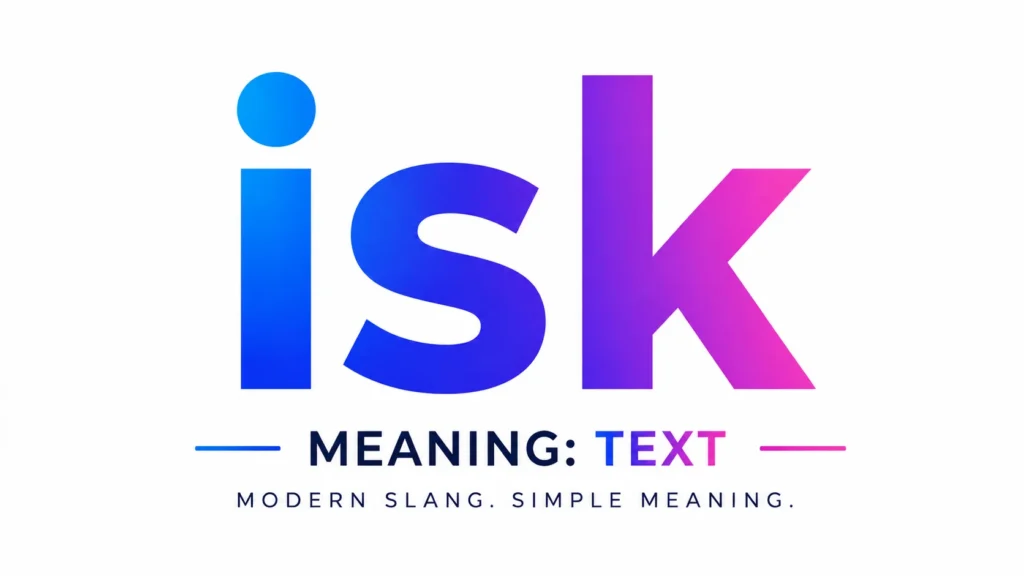
In today’s fast-moving digital conversations, even three-letter combinations can create confusion. One of those terms is “isk meaning text,” which often leaves people wondering whether it is a typo, slang, or a hidden expression used by Gen Z online.
Most people search this term when they see “isk” in a chat and can’t figure out what the sender really meant. It usually appears in informal messages, Instagram DMs, or casual replies where tone is short and fast.
The confusion comes from the fact that “isk” is not a globally standardized slang word. Instead, it has multiple interpretations depending on context, typing style, and even regional usage.
Understanding it properly helps avoid misreading emotions in conversations, especially in situations where tone matters more than words.
ISK Meaning Text – Quick Meaning
Core Definition
“ISK” in texting is an informal shorthand that can carry different meanings depending on context. The most common interpretations include:
- “I should know”
- “I suppose know” (rare and context-based)
- A typing variation or accidental abbreviation
- In some cases, a regional or personal slang expression with no fixed meaning
Unlike widely recognized slang like “idk” or “lol,” “isk” is not universally standardized.
Simple Examples
- “ISK what he meant tbh.”
- “ISK I should know but I forgot.”
- “ISK why she acted like that.”
In most cases, it appears in casual conversations where the speaker is expressing uncertainty or self-reflection.
Origin & Background
Where It Came From
Unlike established internet slang, “isk” does not have a clear documented origin. It likely emerged from fast typing habits where users shortened phrases like “I should know” or accidentally typed abbreviations that later got reused.
Cultural Influence
Digital slang often grows from small communities before spreading globally. “ISK” appears mostly in:
- Private chats
- Gaming conversations
- Short-form social media comments
Social Media Impact
Platforms like TikTok, Snapchat, and Instagram have encouraged ultra-short communication. This environment allows even unclear abbreviations like “isk” to circulate without formal meaning.
Evolution of Meaning
Over time, users began attaching personal meanings to it. This is why two people might use “isk” differently in separate conversations without realizing the mismatch.
Real-Life Conversations (MANDATORY)
WhatsApp Chat
Person A: Did you tell him the truth?
Person B: isk I should have, but I didn’t.
And,
Person A: Why not?
Person B: I panicked tbh.
Instagram DM
Person A: She ignored your message again?
Person B: isk what’s going on with her.
TikTok Comment Thread
User1: Why did he act like that?
User2: isk bro, people are weird sometimes 😭
Text Message
Friend A: You knew about the plan right?
Friend B: isk I forgot completely 💀
These examples show that “isk” is often used in moments of confusion, hesitation, or self-reflection.
Emotional & Psychological Meaning
What Emotion It Expresses
“ISK” usually reflects:
- Uncertainty
- Confusion
- Mild regret
- Self-questioning
It is not a strong emotional word, but it subtly shows that the speaker is unsure or mentally processing something.
Why People Use It
People prefer short expressions because:
- They want faster replies
- They are multitasking
- They avoid long emotional explanations
- They rely on shared digital understanding
What It Reveals About Modern Communication
Modern texting culture values speed over clarity. Words like “isk” show how people prioritize expression of feeling rather than grammatical correctness.
Personal-Style Scenario
Imagine someone realizing they forgot an important detail during a conversation. Instead of typing a full sentence like “I should have known this,” they simply write “isk…” This short form carries the same emotional weight but saves time.
Usage in Different Contexts
Social Media
On platforms like Instagram or TikTok, “isk” is used in comments to express confusion or reaction to content.
Friends & Relationships
Among friends, it often appears in casual chats when someone forgets something or is unsure about a situation.
Work / Professional Settings
It is not suitable for professional communication. In workplace chats, it may appear unprofessional or unclear.
Casual vs Serious Tone
- Casual: Common and acceptable among peers
- Serious: Not recommended because it lacks clarity
When NOT to Use It
In Professional Communication
Avoid using “isk” in emails, formal reports, or workplace messaging.
In Sensitive Conversations
If someone is sharing emotional or serious news, using unclear slang may seem dismissive.
Cultural Misunderstanding Risk
Since “isk” is not universally recognized, it can confuse people from different linguistic backgrounds.
When Clarity Is Needed
If accuracy matters, always use full phrases like “I should know” or “I’m not sure.”
Common Misunderstandings
What People Get Wrong
Many assume “isk” is a fixed abbreviation like “idk,” but it is not standardized.
Tone Confusion
Depending on context, it may sound:
- Confused
- Sarcastic
- Careless
Literal vs Intended Meaning
Some readers try to translate it literally, which leads to incorrect interpretation.
Comparison Table
| Expression | Meaning | Tone | Usage |
|---|---|---|---|
| ISK | I should know / unsure reaction | Casual, unclear | Informal chats |
| IDK | I don’t know | Direct uncertainty | Universal texting |
| IMO | In my opinion | Expressing view | Social + formal |
| TBH | To be honest | Emotional honesty | Casual chats |
| NVM | Never mind | Dismissal/reset | Everyday texting |
Key Insight
“ISK” is less stable compared to other slang terms. Its meaning depends heavily on context, while most slang has fixed definitions.
Variations / Types
1. ISK (I should know)
A way to express forgotten or obvious information.
2. isk…
Used to show hesitation or emotional pause.
3. ISK what
Shows confusion in response to something.
4. ISK I guess
Mild uncertainty with acceptance.
5. isk bro
Casual confusion among friends.
6. isk tbh
Uncertain honesty in conversation.
7. isk fr
Emphasized confusion or disbelief.
8. ISK??
Stronger questioning tone.
9. isk man
Emotional frustration or regret.
10. isk lol
Lighthearted confusion or joking tone.
How to Respond When Someone Uses It
Casual Replies
- “What do you mean?”
- “Same here lol”
- “Yeah I get it”
Funny Replies
- “Bro thinking mode activated 😂”
- “Google it for both of us”
- “We all confused here”
Mature Replies
- “Can you explain a bit more?”
- “I’m not sure I understand”
- “Let’s clarify this”
Respectful Replies
- “No worries, take your time”
- “It’s okay, I understand”
- “Let me know if you remember”
Regional & Cultural Usage
Western Culture
Mostly seen in casual online chats, but not widely recognized.
Asian Culture
Appears in youth messaging apps, especially among students using mixed English slang.
Middle Eastern Culture
Used in informal texting, often influenced by English-speaking online communities.
Global Internet Usage
Still emerging, not a dominant slang term worldwide.
Generational Differences
- Gen Z: More likely to experiment with it
- Millennials: Prefer standard slang like “idk” or “tbh”
Is It Safe for Kids?
Yes, “isk” is generally safe because it contains no offensive or harmful meaning. However, children may get confused by its unclear usage.
Parents and educators usually recommend learning standard expressions first before using ambiguous slang like this.
FAQs
What does ISK mean in texting?
It usually means “I should know” or shows confusion depending on context.
Is ISK a real slang word?
Not officially. It is an informal, emerging expression used online.
Is ISK the same as IDK?
No, “idk” means “I don’t know,” while “isk” is less fixed and more contextual.
Why do people use ISK?
Because it is short, quick, and fits casual fast texting habits.
Can ISK be offensive?
No, it is not offensive or harmful.
Is ISK used in formal writing?
No, it is strictly informal.
Does ISK always mean the same thing?
No, its meaning changes depending on conversation context.
Conclusion
“ISK meaning text” is a great example of how modern communication keeps evolving in unpredictable ways. It does not have a single fixed definition, but it usually reflects uncertainty, hesitation, or a short emotional reaction in conversations.
While it may seem confusing at first, understanding its context makes it easier to interpret messages correctly without misreading tone or intent.
In a world where digital language keeps changing, knowing these small expressions helps you stay connected and confident in online conversations.