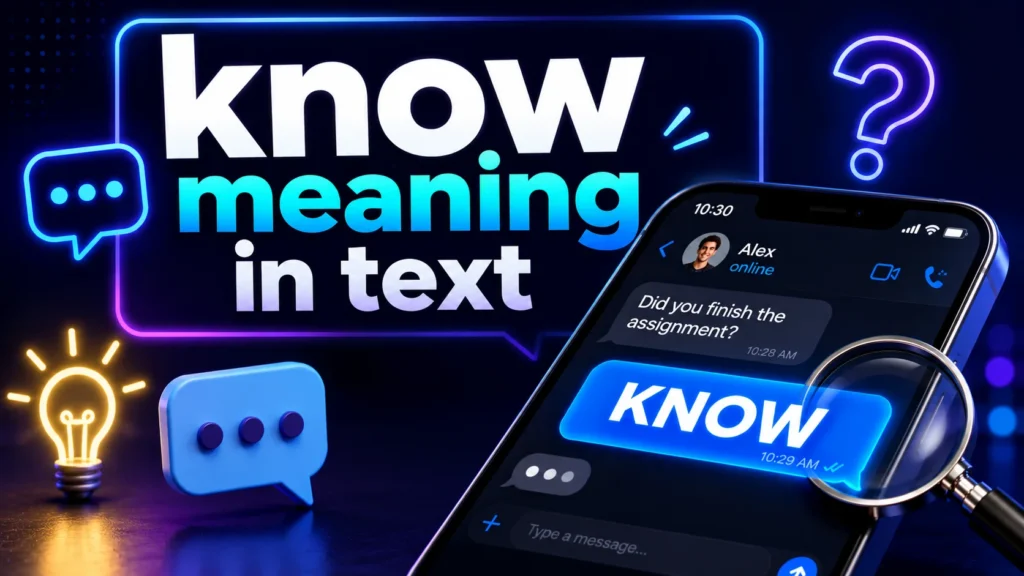
The word “know” looks simple, but its meaning can change depending on where and how it appears in a text message, social media post, or online conversation.
When someone writes “I know,” “you know,” or “know what I mean?” in a chat, they are not always just talking about having information. The word can express agreement, understanding, confidence, emotion, sarcasm, or even frustration.
Many people search for know meaning in text because digital conversations often remove facial expressions and voice tone. A short message like “I know” can feel supportive in one situation but rude or dismissive in another.
Understanding the real meaning behind “know” helps you communicate better with friends, coworkers, and online communities.
In modern texting culture, context is everything. The same word can carry different emotional messages depending on the relationship between the people, the topic being discussed, and the tone of the conversation.
Know Meaning in Text – Quick Meaning
What Does “Know” Mean in Text Messages?
In texting, “know” usually means having information, understanding something, or being aware of a situation.
The basic meanings include:
- To have knowledge: “I know the answer.”
- To understand: “I know what you mean.”
- To agree or relate: “I know, right?”
- To show awareness: “I know about that movie.”
- To express certainty: “I know this will work.”
The meaning depends heavily on the surrounding words.
Common Examples of “Know” in Text
Example 1:
Person A: “Are you coming to the party tonight?”
Person B: “I know the place.”
Meaning: The person is familiar with the location.
Example 2:
Person A: “This exam was so difficult.”
Person B: “I know!”
Meaning: The person agrees and understands the feeling.
Example 3:
Person A: “You need to submit the form today.”
Person B: “I know.”
Meaning: The person is already aware and may sound slightly annoyed depending on tone.
Short Forms Related to “Know”
In casual texting, people may also use:
- IK = I know
- IKR = I know, right?
- YKW = You know what
- YK = You know
- IDK = I don’t know
These abbreviations are common in social media and casual conversations.
Origin & Background of “Know”
Where Did the Word “Know” Come From?
The word “know” is one of the oldest words in the English language. It comes from Old English “cnāwan,” which meant to recognize, understand, or have knowledge of something.
Over centuries, the word developed broader meanings. It moved beyond simple facts and became connected with human experience, emotions, and relationships.
Today, “know” is used not only to describe knowledge but also emotional connection.
For example:
“I know how you feel.”
This does not mean someone has exact information. It means they understand or relate to another person’s emotions.
Cultural Influence of “Know” in Modern Communication
With the growth of texting, social media, and instant messaging, “know” gained many conversational meanings.
Platforms like:
- TikTok
- Snapchat
- Discord
changed how people use simple words. Short replies became emotional signals.
A message like:
“I know 😭”
can communicate sympathy, agreement, and shared experience without a long explanation.
How Social Media Changed the Meaning
Online communication often depends on quick emotional responses.
For example:
“Know that feeling?”
is not asking for information. It is inviting someone to connect emotionally.
Similarly:
“You know what?”
often introduces an opinion, surprise, or personal story.
The digital age transformed “know” from a simple knowledge word into a powerful conversation tool.
Real-Life Conversations Using “Know” in Text
WhatsApp Conversation Example
Person A:
I failed my driving test today.
Person B:
I know how hard you worked for it. Don’t give up.
Meaning: “Know” shows emotional understanding and support.
Instagram DM Example
Person A:
This new song is everywhere.
Person B:
I know! Everyone is posting it.
Meaning: “I know” expresses agreement.
TikTok Comment Example
User 1:
Nobody talks about how stressful adulthood is.
User 2:
I know 😭
Meaning: The person relates to the feeling.
Text Message Example
Person A:
You forgot to call me yesterday.
Person B:
I know, sorry. I was really busy.
Meaning: The person admits awareness of the mistake.
Emotional & Psychological Meaning of “Know” in Text
What Emotion Does “Know” Express?
The word “know” in text messages can express many emotions depending on the situation.
It can show:
- Agreement: “I know!” shows that someone shares the same opinion.
- Understanding: “I know how you feel” shows empathy.
- Confidence: “I know the answer” shows certainty.
- Frustration: “I know” can sometimes sound like “I already understand.”
- Connection: “You know?” invites someone to relate emotionally.
In face-to-face conversations, people use voice and facial expressions to show their feelings. Text messages remove those signals, so the surrounding words, emojis, and conversation history become important.
Why Do People Use “Know” in Modern Communication?
People often use “know” because it creates a feeling of connection.
When someone says:
“I know what you mean.”
They are not only sharing information. They are saying:
“I understand your experience.”
This makes conversations feel more personal and supportive.
The word helps people create emotional bonds quickly, especially in online conversations where messages are usually short.
A Personal-Style Scenario
Imagine a friend texting:
Friend:
“I feel like nobody understands how stressful my job is.”
Reply:
“I know what you mean. I felt the same way last year.”
Here, “know” creates comfort. The person is not claiming to know everything; they are showing empathy and shared experience.
Usage of “Know” in Different Contexts
“Know” in Social Media
On social media platforms, “know” is commonly used as a reaction.
Examples:
- “I know 😭”
- “You know it!”
- “You know the vibes.”
- “You know what I mean?”
These expressions create a casual and friendly tone.
People often use them in comments, captions, and direct messages to show agreement or familiarity.
“Know” Between Friends and Relationships
Among friends, “know” often shows closeness.
Examples:
“Only you know me.”
Meaning: You understand my personality deeply.
“You know I always support you.”
Meaning: The speaker trusts that the other person understands their intentions.
In relationships, “know” can express emotional connection and trust.
“Know” in Professional Settings
In professional conversations, “know” is still common but requires careful tone.
Examples:
Professional:
“I know the deadline is tomorrow, and I will complete the report today.”
This shows awareness and responsibility.
Less professional:
“I know, okay?”
This may sound defensive or disrespectful.
In workplace messages, adding polite words makes the meaning softer.
For example:
“I understand. I know the importance of this task.”
sounds more respectful.
Casual vs Serious Tone
The word “know” can be casual or serious.
Casual:
“Yeah, I know 😂”
Meaning: Friendly agreement.
Serious:
“I know this decision is important.”
Meaning: The person understands the importance.
The tone comes from the entire message, not just the word itself.
When NOT to Use “Know” in Text
Situations Where “Know” May Sound Rude
A simple “I know” can sometimes create the wrong impression.
Example:
Person A:
“Please remember to send the documents.”
Person B:
“I know.”
Although grammatically correct, it may sound impatient.
A better response:
“I know, thanks for reminding me.”
This keeps the conversation respectful.
Avoid Using It When Someone Needs Support
If someone shares a problem, replying only:
“I know.”
may feel dismissive.
Example:
Person A:
“I’m really struggling this week.”
Person B:
“I know.”
This response may sound unclear.
A warmer reply:
“I know it has been difficult for you. I’m here if you need anything.”
Cultural Sensitivity
Different cultures interpret short replies differently.
In some cultures, direct answers are normal. In others, extra politeness is expected.
A short “I know” may be acceptable among close friends but may appear cold in formal conversations.
Common Misunderstandings About “Know” in Text
Confusing Knowledge With Agreement
Many people think “I know” always means “I have information.”
However, in texting, it often means:
“I agree.”
Example:
Person A:
“This weather is terrible.”
Person B:
“I know!”
Meaning:
“I completely agree.”
Thinking “I Know” Is Always Rude
The phrase is not automatically rude.
The tone depends on:
- The relationship
- Previous messages
- Emojis
- Situation
Example:
“I know 😂”
feels friendly.
“I know.”
may feel serious or annoyed.
Literal Meaning vs Emotional Meaning
Literal meaning:
“I know the answer.”
= I have information.
Emotional meaning:
“I know how you feel.”
= I understand your emotions.
Modern texting often uses words emotionally rather than literally.
Comparison Table: “Know” and Related Expressions
| Expression | Meaning in Text | Tone |
|---|---|---|
| I know | I understand / I am aware | Neutral |
| IKR | I know, right? / I agree | Casual |
| I get it | I understand | Friendly |
| Got it | Message received | Direct |
| IDK | I don’t know | Uncertain |
| You know | Seeking agreement or connection | Conversational |
| I understand | Showing awareness | Polite |
| No idea | Lack of knowledge | Casual |
| Obviously | Strong certainty | Sometimes rude |
| I agree | Sharing the same opinion | Clear |
Key Insight
The meaning of “know” in text depends less on the word itself and more on the emotion behind it. A single word can show agreement, empathy, confidence, or frustration depending on the conversation.
Variations and Types of “Know” in Text
1. “I Know”
Meaning: I am aware or I understand.
Example:
“I know what happened.”
Used when someone already has information.
2. “I Know!”
Meaning: Strong agreement or excitement.
Example:
“That movie was amazing.”
“I know!”
Shows enthusiasm.
3. “I Know Right?”
Meaning: Asking someone to agree.
Example:
“That restaurant was incredible, I know right?”
Common in casual conversations.
4. “You Know”
Meaning: Inviting understanding or attention.
Example:
“You know, I never thought about it that way.”
Often introduces an idea.
5. “You Know What”
Meaning: Introducing a decision, thought, or surprise.
Example:
“You know what? Let’s go tomorrow.”
6. “Know That”
Meaning: Giving reassurance.
Example:
“Know that I’m always here for you.”
7. “Don’t Know”
Meaning: Lack of information.
Example:
“I don’t know what happened.”
8. “I Don’t Know”
Meaning: Uncertainty or sometimes hesitation.
Example:
“I don’t know if I should go.”
9. “You Should Know”
Meaning: Giving important information.
Example:
“You should know that I appreciate you.”
10. “Good to Know”
Meaning: Showing that information is useful.
Example:
“Good to know. Thanks for telling me.”
How to Respond When Someone Uses “Know” in Text
The best response to “know” in text depends on the situation, relationship, and emotional tone. A casual conversation with a friend may need a playful reply, while a serious discussion may require a thoughtful response.
Casual Replies
When someone says “I know” during a normal conversation, you can reply naturally.
Examples:
- “Haha, exactly!”
- “Right? That’s what I was thinking.”
- “Same here.”
- “You get it!”
- “Exactly!”
These responses keep the conversation friendly and relaxed.
Funny Replies
Among close friends, “know” can be part of a playful conversation.
Examples:
Person A:
“I know everything.”
Possible replies:
- “Oh really, professor? 😂”
- “Google has competition now.”
- “Mr. Know-it-all has arrived.”
- “Okay, genius 😂”
These replies work best when you already have a comfortable relationship.
Mature Replies
In serious conversations, respond with understanding.
Examples:
Person A:
“I know this situation is difficult.”
Possible replies:
- “I appreciate that you understand.”
- “Thanks for recognizing that.”
- “I’m glad we are on the same page.”
- “That means a lot.”
These responses show emotional maturity.
Respectful Replies
In professional or formal situations:
Examples:
- “Thank you for confirming.”
- “I appreciate your understanding.”
- “Thanks for acknowledging that.”
- “Understood.”
These avoid misunderstandings and maintain professionalism.
Regional & Cultural Usage of “Know” in Text
“Know” in Western Culture
In Western English-speaking countries, “know” is commonly used in casual digital communication.
Expressions like:
- “I know!”
- “I know, right?”
- “You know what I mean?”
are extremely common among friends.
The phrase often creates a feeling of connection and shared understanding.
For example:
“This weather is crazy.”
“I know!”
The reply means:
“I completely agree.”
It is not simply about having information.
“Know” in Asian Culture
In many Asian countries, English texting often mixes local communication styles with internet slang.
People may use:
- “I know”
- “I understand”
- “Got it”
depending on their comfort level with English.
In some cultures, a short reply may appear more direct, so people may add polite words.
Instead of:
“I know.”
They may write:
“Yes, I know. Thank you for telling me.”
This sounds more respectful.
“Know” in Middle Eastern Culture
In Middle Eastern online communication, English words are often mixed with local languages.
The expression “I know” may be used among younger people on platforms like WhatsApp and Instagram.
However, tone is important.
A direct:
“I know.”
can sometimes feel too strong in a respectful conversation.
A softer version:
“Yes, I understand.”
may sound more polite.
Global Internet Usage
Because of social media, “know” has become a worldwide expression.
People use it in:
- TikTok comments
- Instagram captions
- Gaming chats
- Online communities
- Messaging apps
The emotional meaning is often universal:
“I understand you.”
and,
“I agree with you.”
“I relate to this.”
Generational Differences: Gen Z vs Millennials
Gen Z Usage
Gen Z often uses “know” with emojis and internet expressions.
Examples:
- “I know 😭”
- “You know the vibe.”
- “You know what I mean fr.”
The word is often emotional and informal.
Millennials Usage
Millennials may use more traditional forms:
- “I know what you mean.”
- “I know, right?”
- “Good to know.”
Both generations use the word, but Gen Z communication is usually shorter and more expressive.
Is “Know” Safe for Kids?
Yes, the word “know” is completely safe for kids because it is a normal English word used in everyday communication.
Children commonly use it when talking about:
- School
- Friends
- Family
- Learning
- Feelings
Examples:
“I know the answer.”
and,
“I know my friend.”
“I know what happened.”
Parents should teach children that online communication requires understanding tone.
A child may write:
“I know.”
without realizing it can sound rude in some situations.
Teaching polite alternatives helps children communicate better:
- “I understand.”
- “Okay, thanks.”
- “I already knew that.”
Context matters more than the word itself.
Frequently Asked Questions
What does “know” mean in text messages?
“Know” in text usually means being aware of something, understanding something, or agreeing with someone. The exact meaning depends on the conversation and tone.
What does “I know” mean in texting?
“I know” can mean “I understand,” “I am aware,” or “I agree.” It may show support, confidence, or sometimes frustration.
Is “I know” rude in a text?
Not always. “I know” can sound friendly or rude depending on the situation. Adding words like “thanks” or emojis can make it softer.
What does “I know right?” mean in chat?
“I know right?” or “IKR” means “I completely agree with you.” It is commonly used in casual online conversations.
What does “you know” mean in texting?
“You know” can ask someone to relate, introduce an idea, or check if someone understands.
Example:
“You know what I mean?”
means:
“Do you understand my feelings or point?”
What does “I don’t know” mean in text?
“I don’t know” means someone is unsure, lacks information, or does not want to make a decision.
Why do people say “I know” instead of explaining more?
People often use “I know” because texting is usually quick. The phrase can communicate agreement or understanding without needing a long explanation.
Conclusion
The word “know” may be simple, but its meaning in digital communication is surprisingly deep. It can represent knowledge, agreement, empathy, confidence, or emotional connection.
When someone writes “I know,” they may not simply be saying they have information. They might be saying:
“I understand you.”
and,
“I feel the same.”
“I already realize that.”
“I’m connected to what you’re saying.”
The key to understanding know meaning in text is paying attention to context, relationship, and tone. A short message can carry a lot of emotion when you understand the intention behind it.
Using “know” correctly helps conversations feel more natural, respectful, and meaningful in today’s fast-moving online world.