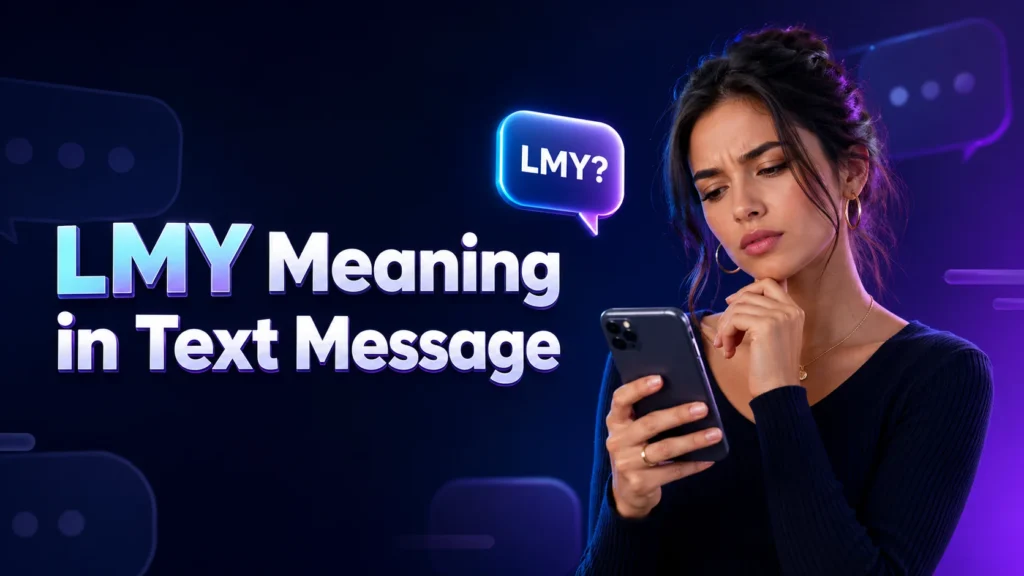
LMY meaning in text message is most commonly “Love and Miss You” or “Love, Miss You.” When someone texts LMY, they are usually expressing affection while saying they miss your presence.
It is an acronym because each letter represents part of the longer emotional phrase:
- L = Love
- M = Miss
- Y = You
LMY often appears in messages between romantic partners, family members, and close friends who have not seen each other recently. A person might write, “Goodnight, LMY ❤️,” to express warmth and longing in a few characters.
The acronym can occasionally mean “Love You More,” particularly when it appears as a reply to “I love you.” However, that meaning is less standard and depends heavily on context.
Because LMY is not as universally recognised as ILY or IMY, some people confuse it with “let me know.” The standard abbreviation for “let me know” is LMK, not LMY.
LMY Meaning in Text Message – Quick Explanation
LMY is an affectionate texting acronym primarily meaning “Love and Miss You.” Dictionary.com also identifies “love and miss you” as its established textspeak meaning.
People use it when they want to communicate two feelings at once:
- Love or deep affection
- Longing for someone who is absent
- Emotional closeness despite physical distance
- Warmth at the end of a conversation
- A desire to reconnect soon
Common examples include:
“I wish you were here. LMY ❤️”
“Goodnight! Call me tomorrow, LMY.”
“It’s been forever since we met. LMY so much!”
In each example, the sender is saying that they care about the recipient and miss spending time with them.
Is LMY Always Romantic?
No. LMY can be romantic, but it can also express family love or close friendship.
A partner might send:
“Only three more days until you’re home. LMY 😘”
A parent could write:
“Study hard and take care of yourself. LMY.”
A close friend might say:
“Our group isn’t the same without you. LMY!”
The surrounding words, relationship, and emojis usually reveal whether the message is romantic or platonic.
What Does LMY Mean From a Girl?
When a girl texts LMY, she is usually saying that she loves or cares about you and misses you. Her meaning may be romantic if she sends it with affectionate messages, heart emojis, compliments, or comments about wanting to see you.
It may simply show close friendship if you already have a strong platonic relationship.
What Does LMY Mean From a Guy?
When a guy sends LMY, he is usually expressing affection and saying that he misses you. Some people find it easier to communicate emotional feelings through short acronyms than complete sentences.
Do not assume that it is automatically a romantic confession. Consider your existing relationship and the rest of his message.
Origin and Background of LMY
LMY developed from the broader culture of shortening common phrases in digital communication. Early SMS messages had character limits, and typing on traditional mobile keypads required more effort than using modern touchscreens.
People therefore shortened emotional expressions:
- ILY for “I love you”
- IMY for “I miss you”
- LY for “love you”
- XOXO for “hugs and kisses”
- LMY for “love and miss you”
LMY combines affection and longing in one compact message. Instead of sending “I love you, and I miss you,” the sender can communicate both feelings with three letters.
Social-Media Influence
Messaging apps helped the acronym move beyond traditional SMS. It may now appear in:
- WhatsApp messages
- Instagram DMs and captions
- Snapchat conversations
- Facebook comments
- TikTok captions
- Discord chats
- Birthday and farewell posts
The expression is especially useful in private communication because the sender and receiver usually understand their relationship without needing a lengthy explanation.
LMY remains less common than ILY and IMY. That relative rarity gives it an intimate quality, but it can also create confusion when the recipient has never encountered it before.
Real-Life Conversations Using LMY
These conversations demonstrate how the meaning changes according to the relationship and emotional situation.
WhatsApp: A Long-Distance Relationship
Person A: I finally booked my flight for next month.
Person B: Seriously? I’ve been counting the days!
Person A: Me too. LMY more than you know ❤️
Person B: LMY too. I can’t wait to see you.
Here, LMY clearly means “love and miss you.” The physical distance and heart emoji support the romantic interpretation.
Instagram DM: Close Friends
Person A: Your graduation pictures made me emotional.
and,
Person B: I wish you could have been there!
Person A: Same. LMY, bestie. We need to meet soon.
Person B: Definitely! I miss our random adventures.
This use is affectionate but platonic. Calling the recipient “bestie” makes the friendship context clear.
Text Message: Parent and Child
Parent: Did you reach your accommodation safely?
Child: Yes, I’ve just unpacked everything.
Parent: Good. Eat properly and call tomorrow. LMY.
Child: LMY too. I’ll call after class.
The acronym communicates family affection and concern. There is no romantic implication.
Snapchat: Possible Flirting
Person A: Tonight was actually fun.
Person B: “Actually”? You sound surprised 😂
Person A: Maybe you made it better. LMY already 😏
Person B: You miss me that quickly?
In this conversation, “already” and the smirking emoji give LMY a flirtatious tone. The sender may be testing whether the recipient shares the attraction.
Emotional and Psychological Meaning of LMY
LMY communicates connection during absence. It tells the recipient, “You matter to me even when you are not here.”
Love and longing are emotionally vulnerable feelings. Some people struggle to express them in a complete sentence because it seems intense or exposes them to possible rejection. An acronym creates a small emotional cushion.
Writing “LMY” may feel safer than writing:
“I love you, and your absence is affecting me.”
The shortened form still communicates affection, but its casual appearance reduces the emotional pressure.
What LMY Can Reveal About the Sender
Depending on the conversation, LMY may show that the sender:
- Feels emotionally attached to you
- Misses your presence or conversations
- Wants reassurance that you feel the same
- Is thinking about shared experiences
- Wants to reconnect after time apart
- Feels shy about expressing affection directly
- Is trying to end a conversation warmly
Imagine that an old friend moved to another city. You continue exchanging memes, but neither of you openly discusses how the friendship has changed. One evening, your friend writes, “Our coffee place isn’t the same without you. LMY.”
The acronym carries more than a casual goodbye. It acknowledges the emotional distance while inviting reconnection.
Still, words should be considered alongside behaviour. Someone who repeatedly writes LMY but never makes time for you may be expressing momentary emotion rather than sustained commitment.
How LMY Is Used in Different Contexts
SMS, iMessage, and WhatsApp
LMY is most natural in personal text messages. It frequently appears when people say goodnight, say goodbye, discuss distance, or arrange their next meeting.
Examples include:
- “Sleep well. LMY ❤️”
- “Have a safe flight! LMY.”
- “Call me when you’re free. LMY.”
- “Can’t wait until Friday. LMY!”
Uppercase and lowercase versions usually have the same meaning. Writing “lmy” may feel more relaxed, while “LMY” is easier to notice.
Instagram and Snapchat
On Instagram, someone may place LMY under an old photo, respond to a travel story, or include it in a birthday post.
For example:
“Throwback to our best summer. LMY!”
On Snapchat, it may appear at the end of a private conversation or alongside a selfie sent to a partner.
TikTok and Public Comments
LMY is less common in unrelated public comments than it is in private messages. It can still appear beneath emotional videos about friendship, relationships, family, travel, or grief.
The phrase may also appear in captions honouring a person who is no longer nearby. In that situation, it can carry sadness rather than casual affection.
Friends and Relationships
Between friends, LMY usually represents warm platonic love. Close friends often speak affectionately without romantic intention.
Between partners, it is more likely to carry romantic intimacy. It can reassure someone in a long-distance relationship or strengthen connection after a goodbye.
Professional Communication
LMY is unsuitable for most workplace, academic, or customer-facing communication. It is highly personal and may create awkwardness or suggest inappropriate emotional closeness.
Use clear professional alternatives such as:
- “I look forward to seeing you again.”
- “It was a pleasure working with you.”
- “I hope we can reconnect soon.”
- “Thank you for staying in touch.”
When Not to Use LMY
LMY should be reserved for people with whom you already share affection or emotional familiarity.
Avoid using it:
- With strangers
- In formal emails
- With clients or customers
- In job applications
- With teachers or managers
- During a serious disagreement
- When romantic boundaries are unclear
- When the recipient has rejected affectionate attention
- When a complete explanation is needed
- If the person may not understand texting acronyms
Sending LMY too early in a developing relationship can feel emotionally intense. The recipient may wonder whether you are declaring love, flirting, or simply being friendly.
When Clarity Matters More Than Brevity
Do not rely on LMY during a sensitive emotional conversation. If someone feels neglected, writing “LMY” does not explain your intentions or resolve the issue.
A clearer message might be:
“I care about you and genuinely miss spending time together. I would like us to talk and reconnect.”
A full sentence reduces ambiguity and demonstrates emotional effort.
Common Misunderstandings About LMY
LMY Does Not Normally Mean “Let Me Know”
People sometimes interpret LMY as “let me know,” but the familiar abbreviation for that phrase is LMK.
Compare:
- “LMK when you arrive” = Let me know when you arrive.
- “LMY, come home soon” = Love and miss you; come home soon.
If LMY appears in a sentence where “let me know” seems logical, it might be a typing mistake for LMK.
LMY May Mean “Love You More”
Some couples use LMY to mean “Love You More.” This interpretation is most likely when it directly answers “I love you.”
For example:
Person A: I love you.
Person B: LMY ❤️
The response could mean “love you more.” Because “Love You More” would naturally be shortened as LYM, however, you should not assume this meaning without contextual evidence.
It Is Not Exclusively Romantic
Parents, siblings, and best friends can use LMY without suggesting romantic attraction. Affection exists in many forms.
It Is Not Always a Serious Declaration
Someone may use LMY casually because affectionate language is normal in their friendships. One message does not necessarily indicate deep romantic commitment.
Capitalisation Does Not Change the Definition
LMY, lmy, and Lmy generally mean the same thing. Lowercase letters create a softer, more relaxed appearance but do not establish a separate definition.
LMY Compared With Similar Texting Acronyms
| Acronym | Full meaning | Emotional focus | Example |
|---|---|---|---|
| LMY | Love and miss you | Affection plus longing | “Come home soon, LMY.” |
| ILY | I love you | Direct love | “Goodnight, ILY.” |
| IMY | I miss you | Missing someone | “It’s been too long, IMY.” |
| LY | Love you | Casual affection | “Thanks for everything, LY.” |
| LYM | Love you more | Playful affectionate reply | “You love me? LYM!” |
| ILYSM | I love you so much | Strong affection | “You’re amazing, ILYSM.” |
| IMYSM | I miss you so much | Strong longing | “Please visit soon, IMYSM.” |
| ML | Much love or my love | Affectionate sign-off | “Take care, ML.” |
| XOXO | Hugs and kisses | Warmth and affection | “Goodnight, XOXO.” |
| BFF | Best friends forever | Close friendship | “LMY, BFF!” |
| LMK | Let me know | Request for information | “LMK when you’re free.” |
| TTYL | Talk to you later | Casual goodbye | “I have class now, TTYL.” |
Key Insight
LMY is emotionally broader than ILY or IMY alone because it combines love and absence. Context remains essential because its letters can occasionally be interpreted differently.
Variations and Related Forms of LMY
1. LMY
The standard form means “Love and Miss You.” It is warm, brief, and suitable for personal messages.
2. lmy
The lowercase version has the same definition. It often feels softer and more casual in a relaxed conversation.
3. LMY ❤️
The red heart strengthens the affectionate meaning. From a partner, it will usually feel romantic.
4. LMY 🥺
The pleading-face emoji adds vulnerability or sadness. It suggests that the sender deeply feels your absence.
5. LMY 😘
The kissing emoji makes the message more intimate. It is common between partners and people who are openly flirting.
6. LMY Bestie
This variation makes the platonic meaning clear. It expresses love and longing between close friends.
7. LMY Already
“LMY already” means the sender began missing you soon after you left. It can sound romantic, sweet, or playfully dramatic.
8. LMY So Much
This variation intensifies the emotion. It means “I love and miss you very much.”
9. LMY More
Depending on the conversation, this may mean “I love and miss you more” or “love you more.” The previous message provides the necessary clue.
10. LMY Forever
This is a stronger, more sentimental expression. It may appear in relationships, farewell messages, memorial captions, or posts about lasting friendship.
11. LYM
LYM is more logically interpreted as “Love You More.” People sometimes confuse it with LMY because the letters are similar.
12. ILY + IMY
Some people avoid ambiguity by writing both acronyms:
“ILY and IMY ❤️”
This communicates the same basic emotion as LMY but is easier for many recipients to understand.
How to Respond When Someone Sends LMY
Your reply should reflect your relationship and genuine feelings. You do not need to return the same emotional intensity if you are uncomfortable.
Affectionate Replies
- “LMY too ❤️”
- “Love and miss you more.”
- “I’ve been thinking about you all day.”
- “I can’t wait to see you again.”
- “Come back soon—I miss you!”
Romantic Replies
- “Distance only makes me love you more.”
- “I wish you were here with me.”
- “Counting the days until I see you 😘”
- “You have no idea how much I miss you.”
- “LMY more, and that’s final.”
Friendly Replies
- “Miss you too, bestie!”
- “We seriously need to meet soon.”
- “Love you! Let’s plan something.”
- “Our group isn’t complete without you.”
- “Same here—call me when you’re free.”
Funny Replies
- “Then book your ticket already!”
- “You miss my snacks, not me.”
- “Prove it—bring coffee.”
- “I miss me too, honestly.”
- “Emotional damage detected 😂”
Mature or Neutral Replies
- “That’s sweet of you to say.”
- “I appreciate you thinking of me.”
- “I miss our conversations too.”
- “Thank you. I hope you’re doing well.”
- “I’m glad we’ve stayed in touch.”
If You Do Not Share the Same Feelings
You can respond kindly without encouraging unwanted intimacy:
- “Thank you for being honest.”
- “I care about you as a friend.”
- “That’s thoughtful, but I want to keep things friendly.”
- “I appreciate the message, although I don’t feel the same way.”
- “I think we should be clear about our boundaries.”
Regional, Cultural, and Age-Based Usage
Western Texting Culture
In English-speaking online communities, LMY is understood as an affectionate acronym, although it is less widespread than ILY and IMY.
The expression may feel natural among people who already use emotional shorthand. Others may need to ask what it means.
Asian Texting Culture
English acronyms are common in multilingual messaging, particularly among younger users. LMY may be mixed with local languages in messages between partners, friends, and family members.
Its emotional meaning usually remains the same, but cultural attitudes toward openly expressing love can affect how frequently people use it.
Middle Eastern Culture
LMY may provide a discreet way to express affection without writing a visibly romantic sentence. Young users familiar with English-language social media are more likely to recognise it.
Romantic interpretation should still account for family expectations, personal boundaries, and cultural context.
Gen Z and Millennials
Both Gen Z and Millennials use emotional abbreviations, although LMY is not among the most universal terms. Millennials may associate this style with early SMS and online chat culture.
Gen Z users may combine it with emojis, lowercase writing, voice notes, or ironic humour. Personal texting habits matter more than age alone.
Is LMY Safe for Kids?
LMY is generally safe for children and teenagers. It expresses love and missing someone and has no inherently offensive meaning.
Parents should still consider who sent it and why. A message from a relative or close friend is usually harmless. Affectionate messages from an unknown adult require closer attention, especially if the person is requesting secrecy or trying to establish inappropriate intimacy.
Frequently Asked Questions About LMY
What does LMY stand for in texting?
LMY most commonly stands for “Love and Miss You.” It expresses affection for someone while communicating that their absence is felt.
Does LMY mean “Love You More”?
It can mean “Love You More” in some personal conversations, particularly as a response to “I love you.” However, LYM is the more logical acronym for that phrase.
Is LMY the same as LMK?
No. LMY usually means “Love and Miss You,” while LMK means “Let Me Know.” Confusion may arise because the acronyms look similar.
Is LMY romantic?
LMY can be romantic when sent by a partner or crush. It can also express platonic or family love, so the relationship and surrounding message determine the tone.
What does LMY mean on Snapchat?
On Snapchat, LMY generally means “Love and Miss You.” It may accompany a selfie, goodbye snap, emotional message, or conversation between people who are apart.
What does LMY mean on Instagram?
In Instagram DMs or captions, LMY usually communicates affection and longing. Friends may add it to an old photo, while couples may use it beneath romantic posts.
How do I know which LMY meaning is intended?
Read the entire sentence and consider your relationship with the sender. Hearts, kisses, goodnight messages, farewells, and references to distance strongly support “Love and Miss You.”
Conclusion
The primary LMY meaning in text message is “Love and Miss You.” It combines affection and longing in a short acronym that can be shared between partners, family members, or close friends.
LMY often appears in goodnight texts, farewell messages, long-distance relationships, throwback captions, and conversations about meeting again. Although it may occasionally mean “Love You More,” that interpretation depends on the preceding message.
The most reliable approach is to read the emotional context. If someone writes “Wish you were here, LMY ❤️,” the meaning is clearly affectionate. If the message seems confusing, asking “Do you mean love and miss you?” is completely reasonable.
Three letters can carry a surprising amount of emotion. Used thoughtfully, LMY reminds someone that distance has not weakened the connection you share.