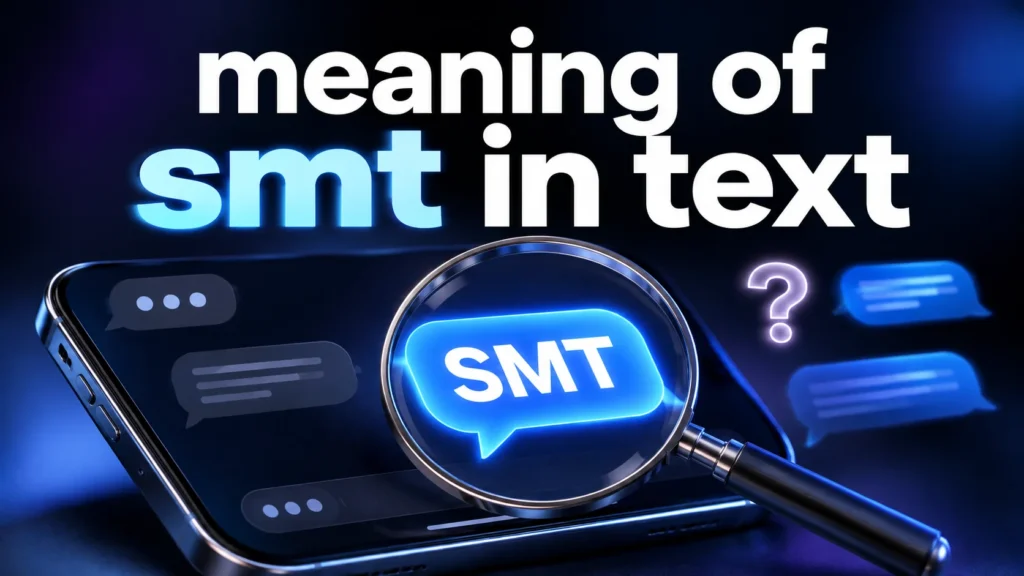
If someone sends you a message like “I need to tell you smt,” you might stop for a second and wonder what those three letters mean. The meaning of SMT in text is usually “something.”
It is a casual abbreviation people use when they want to type quickly in messages, comments, captions, or direct messages.
For example, “I have smt to show you” simply means “I have something to show you.”
However, SMT can be confusing because it does not always mean the same thing. In certain conversations, it may represent “sucking my teeth,” an expression of irritation, while on social media it can occasionally mean “send me that.”
Current slang references reflect this context-dependent usage. Slang.net identifies “something” as a common messaging meaning, while other texting references document “sucking my teeth” and “send me that” as alternative interpretations. (Slang Dictionary)
The easiest way to understand SMT is therefore not to memorize one definition but to look at how it fits into the sentence.
This guide explains exactly how to do that.
Meaning of SMT in Text – Quick Meaning
What Does SMT Mean in Text?
In most everyday chats, SMT means “something.”
It is simply a shortened spelling used to make texting quicker.
For example:
“I wanna ask you smt.”
This means:
“I want to ask you something.”
Another example:
“There’s smt different about you today.”
Here, SMT clearly replaces the word “something.”
People commonly use it in casual digital conversations where perfect spelling and formal grammar are not important. Slang references also document this use in chats, forums, text messages, and social media.
Other Possible SMT Meanings
Depending on context, SMT can also mean:
- Something — the most straightforward texting abbreviation.
- Sucking my teeth — a reaction showing annoyance or disbelief.
- Send me that — a request for a photo, video, link, post, or other content.
- Shin Megami Tensei — a video game franchise, usually in gaming discussions.
- Statistical Machine Translation — a technical meaning unrelated to everyday slang.
The surrounding words normally make the correct meaning obvious.
Origin & Background of SMT
Where Did SMT Come From?
There is no single documented moment when people officially decided that SMT should mean “something.”
Instead, it developed naturally from the culture of shortened digital communication.
Early text messaging encouraged people to shorten words because typing on older mobile phones was slower and messages often had character limits. Expressions such as “u” for “you,” “r” for “are,” and “msg” for “message” became normal.
“Something” was eventually shortened in several ways, including smt, smth, and sth.
How Social Media Changed SMT
Social platforms made abbreviations even more flexible.
A teenager typing:
“Need smt new to wear.”
is probably using SMT for “something.”
Yet someone commenting “SMT 😒” after an irritating statement might be using it as a representation of sucking their teeth.
Meanwhile, “smt” beneath a product photo may occasionally be interpreted as “send me that.”
This explains why searching for one universal SMT definition can lead to conflicting answers. The expression has developed multiple internet meanings rather than one rigid definition.
Real-Life Conversations Using SMT
Seeing SMT inside natural conversations makes its meaning much easier to understand.
WhatsApp Conversation
Person A: Are you busy?
Person B: Not really, why?
and,
Person A: I need to tell you smt.
Person B: Now you’ve made me nervous 😭 tell me.
Here, smt means “something.” The message creates a little suspense because the sender has something important to share.
Instagram DM
Person A: Did you see the shoes I posted?
and,
Person B: Yeahhh 😭 I need smt like that for my birthday.
Person A: I’ll send you the store.
Here, SMT again means “something.” The person wants something similar to the shoes.
TikTok Comments
Person A: He really said he forgot her birthday again 💀
and,
Person B: SMT 😒
Person A: Exactly. I’d be so annoyed.
In this conversation, SMT may represent “sucking my teeth,” communicating irritation or disapproval rather than the word “something.”
The reaction-style placement is the clue.
Text Message
Person A: Look at this jacket 😂
Person B: SMT!!
and,
Person A: Okay, I’ll send you the link.
In this particular context, SMT can be understood as “send me that.”
Notice how the meaning changes because the conversation is about sharing an item.
Emotional & Psychological Meaning of SMT
SMT may be tiny, but its emotional meaning depends heavily on placement.
When SMT means “something,” it normally carries very little emotion by itself. Instead, the rest of the sentence creates the emotional tone.
Consider:
“I have smt to tell you 👀”
That feels mysterious.
Now compare:
“Is smt wrong?”
That feels concerned.
And:
“We need to do smt tonight 😂”
That feels casual and spontaneous.
The abbreviation itself has not changed, but the emotional atmosphere has.
When SMT Expresses Annoyance
Things become different when SMT represents “sucking my teeth.”
Sucking the teeth is a nonverbal reaction associated in some communities with annoyance, disbelief, impatience, or disapproval.
Writing SMT can turn that physical reaction into a digital one.
Imagine telling a friend that someone cancelled your plans five minutes before meeting you.
You write:
“They just cancelled again.”
Your friend replies:
“SMT 😒”
They are not talking about “something.” They are reacting to the situation.
This is why emotional context matters as much as dictionary definitions when interpreting internet slang.
Usage of SMT in Different Contexts
SMT on Social Media
On TikTok, Instagram, Snapchat, X, and similar platforms, SMT may appear in captions, comments, or private messages.
A sentence such as:
“I need smt like this.”
almost certainly means:
“I need something like this.”
A standalone reaction such as:
“smt 🙄”
may instead suggest irritation.
SMT Between Friends
Friends often use abbreviated language because they share enough context to understand one another quickly.
For example:
“Let’s do smt after class.”
There is little risk of misunderstanding because “something” fits grammatically into the sentence.
SMT in Relationships
Romantic conversations can give SMT a more emotional feeling.
“Can I tell you smt?”
might signal a confession, concern, compliment, or serious conversation.
The abbreviation itself is casual, even when the subject that follows is important.
SMT in Professional Settings
It is generally better to write “something” in professional communication.
Instead of:
“I noticed smt in the report.”
write:
“I noticed something in the report.”
SMT may look overly casual or unclear in an email to a manager, professor, client, recruiter, or customer.
Casual vs. Serious Tone
SMT fits naturally into casual conversations.
For serious communication, spelling out the intended phrase reduces ambiguity.
That distinction becomes especially important because SMT has several possible meanings.
When NOT to Use SMT
Formal Emails
Avoid SMT in job applications, academic correspondence, customer communications, and official documents.
Writing complete words looks clearer and more professional.
Important Emotional Conversations
If you are discussing a sensitive issue, abbreviations can sometimes make your message appear dismissive.
“I need to tell you something important” sounds more deliberate than:
“I gotta tell u smt.”
The second version is not necessarily rude, but the first carries more emotional weight.
When Your Audience May Not Know Slang
Not everyone recognizes SMT.
Age, language background, social platform, and personal texting habits can all affect interpretation.
If clarity matters, simply write “something.”
Cross-Cultural Conversations
Avoid assuming every English speaker interprets internet abbreviations identically.
Even online discussions among English speakers show disagreement about how familiar “smt” is as shorthand for “something.” (Reddit)
Common Misunderstandings About SMT
SMT Always Means “Sucking My Teeth”
Not necessarily.
This is one recognized interpretation, particularly when SMT appears as a reaction.
However, in a sentence such as:
“I want smt sweet.”
“Something” is the logical meaning.
SMT Always Means “Something”
This is also incorrect.
If someone replies simply:
“SMT 🙄”
they may be communicating annoyance rather than saying “something.”
SMT Means the Same Thing Everywhere
Internet slang rarely works that neatly.
Meaning can change between communities, platforms, countries, age groups, and even individual friend groups.
Capitalization Changes the Meaning
Not automatically.
“SMT” and “smt” can represent the same slang expression.
Capital letters may simply add emphasis.
SMT Is a Formal English Abbreviation
It is not appropriate as a universal abbreviation for “something” in formal prose.
For professional or academic English, writing the complete word is safer.
SMT Meaning Comparison Table
| Expression | Common Meaning | Typical Tone | Example |
|---|---|---|---|
| SMT | Something | Casual | “Tell me smt funny.” |
| SMTH | Something | Casual | “I need smth new.” |
| STH | Something | Informal/abbreviated | “We should do sth.” |
| SMT | Sucking my teeth | Annoyed | “SMT 😒” |
| SMT | Send me that | Requesting | “That jacket 😍 smt.” |
| SMH | Shaking my head | Disappointed | “SMH, not again.” |
| IDK | I don’t know | Neutral/casual | “IDK what happened.” |
| NVM | Never mind | Casual/dismissive | “NVM, I found it.” |
Key Insight
The easiest clue is grammar. If replacing SMT with “something” produces a natural sentence, that is usually the intended meaning. If SMT appears alone as a reaction or beneath shareable content, consider the alternative meanings.
Variations and Types of SMT
1. SMT — Something
The standard casual interpretation.
Example: “I need smt to eat.”
2. SMTH — Something
Another common shortened form that may be clearer because it keeps more letters from the original word.
Example: “There’s smth weird here.”
3. STH — Something
A compact abbreviation commonly encountered in dictionaries, notes, language learning, and informal writing.
Example: “Do you want sth different?”
4. Smt? — Something?
Used as a short question when the meaning is already clear from the conversation.
Example: “You wanted to ask me smt?”
5. “Tell You SMT”
Means the speaker has something to reveal.
Example: “Wait, I gotta tell you smt.”
6. “Do SMT”
Means to do an unspecified activity.
Example: “I’m bored. Let’s do smt.”
7. “Get SMT”
Means to obtain an unspecified thing.
Example: “I’m going out to get smt for dinner.”
8. “SMT Wrong”
A shortened way of saying “something wrong.”
Example: “Is smt wrong with your phone?”
9. SMT as a Reaction
May represent “sucking my teeth,” especially when used independently.
Example: “SMT 🙄 you cannot be serious.”
10. SMT as a Sharing Request
Sometimes interpreted as “send me that” when someone is responding to a photo, video, product, meme, or link.
Example: “Where did you get that? SMT 😭”
The context is more important than capitalization.
How to Respond When Someone Uses SMT
Your reply should match what SMT means in the conversation.
Casual Replies
If someone says:
“Can I tell you smt?”
Try:
- “Yeah, tell me.”
- “Of course.”
- “What happened?”
- “Go ahead 👀”
- “I’m listening.”
Funny Replies
For a playful conversation:
- “Why does that sound dangerous? 😂”
- “Okayyy, spill 👀”
- “Should I be scared? 😭”
- “You have my attention now.”
- “This better be good 😂”
Mature Replies
If the message sounds serious:
- “Sure. What’s going on?”
- “You can tell me.”
- “I’m listening. Take your time.”
- “Of course. Is everything okay?”
Respectful Replies
If you are uncertain about the abbreviation:
- “Sure—what did you want to tell me?”
- “Do you mean something?”
- “What do you mean by SMT here?”
Asking for clarification is better than reacting to the wrong meaning.
Regional & Cultural Usage of SMT
Western Culture
In English-language digital spaces, “smt” can appear as shorthand for “something,” although familiarity varies considerably between speakers.
Some users may prefer “smth,” while others simply write the complete word.
Asian Digital Communication
English abbreviations are widely mixed into multilingual online conversations throughout Asia.
SMT may therefore appear alongside local-language words, Romanized spellings, emojis, or other English internet abbreviations.
Its exact popularity varies by country and online community, so it should not be treated as a universal Asian texting convention.
Middle Eastern Digital Communication
Multilingual messaging is also common across Middle Eastern online communities.
Users may combine Arabic, English, emojis, and Romanized expressions within the same conversation.
When SMT appears, sentence structure is usually the safest clue to its intended meaning.
Global Internet Usage
Social media increasingly mixes slang from different communities.
A phrase that begins in one region can quickly appear in another through TikTok videos, memes, gaming communities, Instagram Reels, and group chats.
As a result, internet slang rarely belongs permanently to one place.
Gen Z vs. Millennials
Gen Z communication tends to make heavy use of contextual shorthand, reaction language, intentional lowercase writing, emojis, and rapidly changing expressions.
Millennials also use abbreviations extensively, although familiar terms such as LOL, BTW, IDK, TBH, and OMG may be more immediately recognizable to some users.
Neither generation uses slang in exactly the same way, so individual habits matter more than stereotypes.
Is SMT Safe for Kids?
Yes, SMT itself is generally harmless.
When it means “something,” there is nothing inappropriate about the abbreviation.
Even the “sucking my teeth” interpretation mainly communicates annoyance or disapproval rather than explicit language.
Parents should still consider context because, like many internet abbreviations, SMT can appear inside conversations containing unrelated mature content.
The abbreviation alone is not normally a cause for concern.
FAQs About the Meaning of SMT in Text
What does SMT mean in a text message?
SMT most commonly means “something” when it replaces that word inside a sentence. It can also mean “sucking my teeth” or “send me that” depending on context.
What does SMT mean from a girl?
There is no special female-specific meaning. If a girl writes “I want to tell you smt,” she means “I want to tell you something.” Her tone and surrounding message determine whether it feels serious, romantic, funny, or casual.
What does SMT mean from a guy?
The meaning does not change based on gender. A guy writing “Can I ask you smt?” normally means “Can I ask you something?”
What does SMT mean on Instagram?
On Instagram, SMT can mean “something,” “send me that,” or “sucking my teeth.” Look at whether it appears inside a sentence, under shareable content, or as an emotional reaction.
What does SMT mean on TikTok?
On TikTok, SMT may simply shorten “something,” especially inside comments and captions. A standalone “SMT” accompanied by an annoyed emoji may instead represent “sucking my teeth.”
Does SMT mean “send me that”?
It can. “Send me that” is a context-dependent interpretation, particularly when someone is reacting to a picture, meme, video, product, or link. It is not the only meaning.
How can I tell what SMT means?
Replace SMT with “something.” If the sentence still sounds natural, that is probably the intended meaning. If SMT appears alone as a reaction or request, check the surrounding conversation for clues.
Conclusion
The meaning of SMT in text is usually much simpler than it first appears.
In sentences such as “I need smt to eat,” “Can I tell you smt?” or “There’s smt wrong,” SMT means “something.”
The confusion comes from the fact that the same three letters can carry other meanings. In reaction-based conversations, SMT can represent “sucking my teeth,” while discussions about sharing content may use it for “send me that.”
Rather than interpreting the abbreviation in isolation, read the entire message.
Grammar tells you whether “something” fits. Emojis can reveal emotion. A photo or video may suggest a sharing request. A standalone reaction may signal annoyance.
Once you learn those clues, SMT becomes much easier to understand.
That is the real skill behind modern texting slang: not memorizing hundreds of abbreviations, but understanding tone, context, and the person behind the screen.