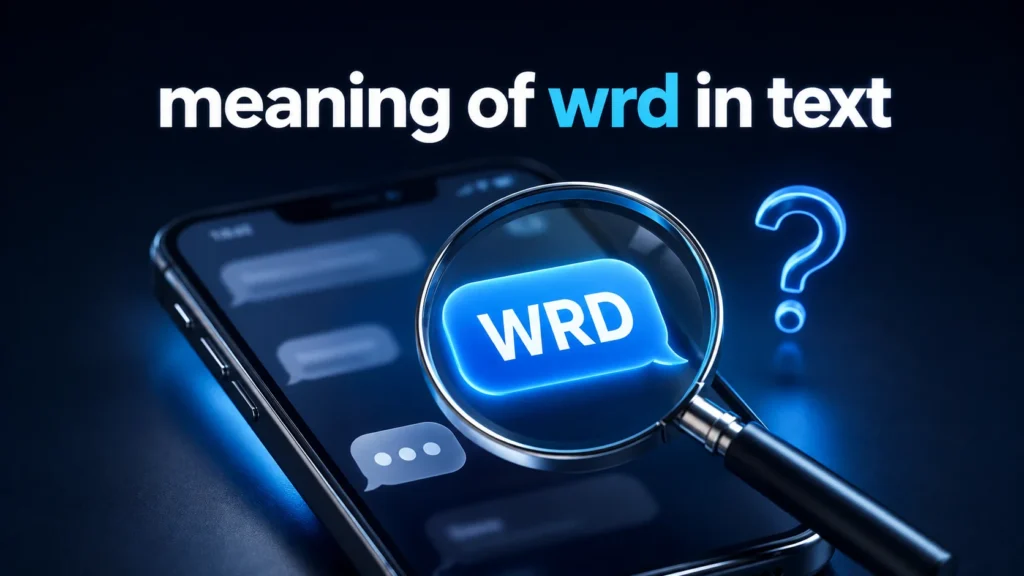
The meaning of WRD in text is usually “word.” Although it may look like an unfinished spelling, WRD is an intentional slang expression used to show agreement, understanding, confirmation, or surprise.
For example, if someone says, “That new restaurant is overpriced,” and their friend replies, “wrd,” the response means, “I agree” or “That’s true.”
However, WRD does not carry one fixed emotional tone. It may sound supportive, relaxed, curious, impressed, or slightly dismissive. Capital letters, punctuation, emojis, and the relationship between the speakers all influence its meaning.
People often search for this expression because a three-letter response can feel confusingly brief. Was the sender agreeing, questioning you, or ending the conversation? Understanding the context helps you interpret it correctly.
Meaning of WRD in Text – Quick Meaning
WRD is a shortened spelling of “word.” In casual digital communication, it commonly means:
- “I agree.”
- “That’s true.”
- “I understand.”
- “Okay, got it.”
- “Really?”
- “Are you serious?”
- “I respect what you said.”
WRD is not usually an acronym in everyday conversations. Each letter does not represent a separate word. Instead, the vowels have been removed from “word” to make it shorter and faster to type.
Consider these examples:
“That exam was much harder than expected.”
“Wrd, the final section was terrible.”
“We’re meeting outside the café at seven.”
“Wrd, I’ll be there.”
“She got the job yesterday.”
“Wrd? That’s amazing!”
In the first example, WRD expresses agreement. In the second, it confirms that the message was understood. Meanwhile, the question mark in the third example changes it into a surprised “Really?”
Origin and Background of WRD
Where Did WRD Come From?
WRD developed from the slang use of “word,” an expression strongly associated with African American Vernacular English, urban American communities, and hip-hop culture.
In spoken conversation, saying “word” could communicate truth, agreement, understanding, or respect. Expressions such as “word up,” “say word,” and “word is bond” also carried ideas of honesty and authenticity.
During the growth of hip-hop in the 1980s and 1990s, music, films, and youth culture introduced this language to wider audiences. Eventually, “word” became a familiar casual response far beyond the communities where its slang meaning developed.
How “Word” Became “WRD”
As texting and instant messaging grew, people began removing letters from familiar words. “Please” became “pls,” “message” became “msg,” and “though” became “tho.”
The same pattern turned “word” into “wrd.”
Removing the vowel did not change the basic meaning. Instead, it created a quicker and more visually modern spelling suitable for fast conversations.
Current texting references consistently describe WRD as a form of “word” used for agreement, acknowledgment, confirmation, or surprise. NoSlang’s WRD definition provides examples of its use as “yes,” “cool,” or acknowledgment.
Social Media’s Influence
TikTok, Snapchat, Instagram, WhatsApp, Discord, and gaming chats helped WRD spread globally. On these platforms, users often prefer short reactions that keep conversations moving.
A TikTok user might comment “wrd 💯” under a relatable opinion. Someone on Snapchat may reply “wrd?” after receiving unexpected news. In a gaming chat, WRD can quickly confirm a strategy without distracting players from the game.
Therefore, WRD has evolved into a flexible digital reaction rather than a simple misspelling.
Real-Life Conversations Using WRD
WhatsApp Conversation: Confirming a Plan
Person A: We’re leaving at 6:30 tomorrow morning.
Person B: Wrd, I’ll be ready.
and,
Person A: Please don’t make us wait again.
Person B: I promise I’ll set three alarms this time 😂
Here, WRD means “Okay, I understand.” It acknowledges the plan and confirms that Person B accepts it.
Instagram DM: Agreeing With an Opinion
Person A: That café looked beautiful online, but the food wasn’t worth the price.
Person B: Wrd! I went last week and thought the same thing.
Person A: Finally, someone agrees with me.
Person B: The lighting deserves five stars, but the food gets two.
In this exchange, WRD communicates strong agreement. The exclamation mark also gives the response more energy.
TikTok Comments: Relatable Agreement
Creator: Growing up is realizing that staying home can be more exciting than going out.
Commenter A: Wrd 💯
Commenter B: Especially after a long week.
Creator: Exactly! My bed and a good movie are enough.
The commenter uses WRD to mean “That is completely true.” The 💯 emoji strengthens the agreement.
Text Message: Surprise
Person A: My brother bought us tickets for the final.
and,
Person B: Wrd??
Person A: Yes! He surprised me this morning.
Person B: That’s incredible. You’re so lucky!
In this conversation, WRD does not mean “I agree.” The question marks turn it into “Really?” or “Are you serious?”
Emotional and Psychological Meaning of WRD
What Emotion Does WRD Express?
WRD often communicates social validation. It tells the other person, “I hear you,” “Your point makes sense,” or “I share that feeling.”
That validation may seem small, but it helps people feel understood. A friend who has just described a frustrating experience may appreciate a simple “wrd” because it confirms that someone relates to them.
Nevertheless, emotional meaning depends on presentation:
- “wrd” feels calm and casual.
- “WRD!” sounds enthusiastic.
- “wrd?” expresses surprise or doubt.
- “wrd…” may sound thoughtful or uncertain.
- “wrd bro” feels friendly and supportive.
- “wrd.” can appear dry or dismissive.
Why Do People Use It?
Modern conversations often happen quickly. People may be walking, working, gaming, or responding to several messages at once. WRD allows them to acknowledge a statement without writing a full response.
It can also create a sense of belonging. Slang shows familiarity with a particular social style, age group, or online community.
At the same time, some people use WRD to avoid emotional effort. Instead of offering a thoughtful response, they send three letters. That may be acceptable during a casual discussion but disappointing during a sensitive conversation.
A Relatable Scenario
Imagine telling a friend that you finally stopped speaking to someone who repeatedly disrespected you. Your friend replies:
“Wrd, you deserve better.”
In this situation, WRD does more than express agreement. It shows support for your decision and validates your feelings.
However, if you share a serious personal problem and receive only “wrd,” the message may feel emotionally distant. The expression itself is not rude, but the situation can make it seem inadequate.
Usage of WRD in Different Contexts
On Social Media
WRD frequently appears beneath opinions, relatable videos, jokes, and personal stories.
Common examples include:
- “Wrd, people need to hear this.”
- “Wrd 💯”
- “Wrd because why does nobody talk about this?”
- “WRD? When did that happen?”
- “Wrd, this is exactly how I feel.”
In comment sections, WRD often functions like “facts,” “true,” or “exactly.”
Between Friends
Friends use WRD to confirm plans, support opinions, or react to surprising news.
For instance:
“We should order pizza instead.”
“Wrd, I don’t feel like cooking.”
Because both people understand the casual tone, the response feels natural rather than careless.
In Friendships and Relationships
Within close relationships, WRD may communicate understanding. A partner might say, “We need to communicate more clearly,” and the other person may reply, “Wrd, I’ve been thinking that too.”
Still, WRD should not replace genuine discussion. If someone shares emotional pain, a fuller reply such as “I understand, and I’m sorry you experienced that” shows more care.
At Work
WRD is generally unsuitable for professional emails, reports, applications, or formal workplace messages.
Instead of writing “wrd,” use:
- “Understood.”
- “I agree.”
- “That’s correct.”
- “I’ll take care of it.”
- “Thank you for confirming.”
- “We’re on the same page.”
It may be acceptable in a private chat with a close coworker, but only when the workplace culture is extremely relaxed.
Casual Versus Serious Tone
WRD works best in informal conversations. It feels effortless when discussing entertainment, plans, jokes, everyday frustrations, or shared opinions.
Conversely, it can sound insensitive during serious discussions about grief, illness, conflict, or mental health. In those situations, a thoughtful sentence is more appropriate.
When Not to Use WRD
Avoid WRD whenever clarity, respect, or emotional sensitivity matters more than speed.
It may be inappropriate:
- In academic assignments
- During job interviews
- In professional emails
- When speaking to a customer or unfamiliar manager
- After someone shares painful personal news
- During a serious apology
- When communicating with people unfamiliar with slang
- In formal international conversations
- When your response could look sarcastic
- When a detailed answer is expected
For example, if someone says, “My grandmother is seriously ill,” replying “wrd” would appear confusing and uncaring. A better response would be, “I’m very sorry. I hope she recovers soon.”
Cultural awareness matters as well. People who learned English formally may interpret WRD as a typing error. When communicating across cultures or generations, “I understand” is safer and clearer.
Common Misunderstandings About WRD
WRD Does Not Usually Mean “Weird”
One common mistake is assuming WRD is an abbreviation of “weird.” In most social media and texting conversations, it means “word,” not “weird.”
Context still matters. Someone may remove letters from “weird” creatively, but that use is far less common.
It Is Not Always Agreement
Although agreement is its most recognizable function, WRD may also express confirmation or surprise.
Compare:
- “That teacher gives too much homework.” — “Wrd.”
Meaning: “I agree.” - “Meet me at eight.” — “Wrd.”
Meaning: “Okay, understood.” - “I won two free tickets.” — “Wrd?”
Meaning: “Really?”
It Is Not Automatically Rude
A brief message can feel cold, yet WRD is not inherently disrespectful. Among friends, it often sounds friendly and natural.
However, replying only with “wrd” after someone sends a long emotional message may appear dismissive. The mismatch between their effort and your response creates the problem.
Capital Letters Do Not Change the Definition
WRD, Wrd, and wrd generally have the same definition. Capitalization primarily changes the visual intensity.
“WRD!” may look excited, while “wrd” feels calmer.
Punctuation Can Change the Tone
A question mark is especially important:
- wrd — I agree or understand.
- wrd? — Really?
- wrd! — Absolutely!
- wrd… — I understand, but I am thinking.
- wrd. — Okay; possibly dry or final.
WRD Compared With Similar Expressions
| Expression | Meaning | Typical tone | Example |
|---|---|---|---|
| WRD | I agree, understand, or really? | Calm and casual | “Wrd, that’s true.” |
| Word | Agreement or acknowledgment | Casual but clearer | “Word, I understand.” |
| Bet | Okay or agreed | Confident and energetic | “Meet at seven?” “Bet.” |
| Facts | That is completely true | Strong agreement | “Facts, nobody talks about this.” |
| True | I agree | Neutral | “True, it was expensive.” |
| Exactly | You expressed my thought | Clear and emphatic | “Exactly! That’s my point.” |
| Got it | I understand | Neutral or professional | “Got it, I’ll arrive early.” |
| For real | Seriously or genuinely | Emphatic | “For real, that was difficult.” |
| Say word | Are you serious? | Surprised | “You won?” “Say word!” |
| Nah | I disagree or refuse | Casual opposition | “Nah, I don’t think so.” |
Key Insight
WRD sits between “true” and “bet.” It can acknowledge information calmly, support an opinion, or become a question when the sender is surprised.
Variations and Types of WRD
1. WRD
Meaning: Strong agreement or acknowledgment.
Capital letters make the response more noticeable and sometimes more enthusiastic.
2. wrd
Meaning: “I agree” or “I understand.”
This lowercase version feels relaxed and is common in everyday messages.
3. Wrd.
Meaning: “Okay” or “I hear you.”
The period may make the reply appear serious, final, or slightly cold.
4. Wrd?
Meaning: “Really?” or “Are you serious?”
The question mark changes WRD from agreement into a request for confirmation.
5. WRD!
Meaning: “Absolutely!” or “Exactly!”
An exclamation mark adds excitement and confidence.
6. Wrd Fr
Meaning: “Word, for real.”
This variation shows serious or emphatic agreement.
7. Wrd Tho
Meaning: “That is true, though.”
It often supports a point that others may overlook.
8. Wrd Bro
Meaning: “I agree with you, friend.”
“Bro” adds familiarity, support, or friendly respect.
9. Wrd 💯
Meaning: “That is completely true.”
The 💯 emoji strengthens the sense of validation.
10. Wrd 😂
Meaning: “I agree, and that is funny.”
The laughing emoji keeps the reaction humorous and light.
11. Say Wrd
Meaning: “Tell me that is true.”
This expression is commonly used after surprising or exciting information.
12. Word Up
Meaning: Agreement, approval, respect, or greeting.
This is an older variation strongly associated with hip-hop and popular culture.
How to Respond When Someone Uses WRD
The best response depends on whether WRD expresses agreement, acknowledgment, or surprise.
Casual Replies
- “Exactly.”
- “You get it.”
- “Right?”
- “That’s what I’m saying.”
- “Glad we agree.”
- “For real.”
Funny Replies
- “A rare moment of agreement 😂”
- “Finally, someone understands me.”
- “Certified facts only.”
- “I knew you had good taste.”
- “Put it on the record.”
- “No lies detected.”
Mature Replies
- “I appreciate you understanding.”
- “I’m glad we’re on the same page.”
- “That’s exactly how I see it.”
- “Thanks for hearing me out.”
- “I value your support.”
- “It means a lot that you agree.”
Respectful Replies
- “Yes, that’s correct.”
- “Thank you for confirming.”
- “I appreciate your response.”
- “I’m happy that makes sense.”
- “Let me know if you want more details.”
- “Yes, I was surprised too.”
If someone writes “wrd?” after unexpected news, provide confirmation: “Yes, seriously!” or “I know—it surprised me too.”
Regional and Cultural Usage of WRD
Western Culture
WRD is especially recognizable in the United States, where its longer form, “word,” has deep connections to AAVE and hip-hop culture.
It is also understood by many young users in Canada and the United Kingdom through music, entertainment, and social media.
Asian Culture
Among English-speaking users in South Asia and Southeast Asia, WRD often appears in global online communities. TikTok, gaming, rap music, and international friendships influence its use.
Nevertheless, it may confuse people who primarily learned formal English because WRD is not a standard abbreviation taught in classrooms.
Middle Eastern Culture
Young social media users in the Middle East may use WRD when communicating in English, particularly in gaming chats and international online spaces.
Older adults or people less familiar with American slang may read it as a spelling error. Therefore, context and audience remain important.
Global Internet Usage
WRD now travels beyond any single country. Memes, music, games, videos, and online friendships allow slang to cross borders quickly.
Still, its cultural origins should not be erased. The slang use of “word” is closely connected to Black American language and hip-hop’s influence on global communication.
Gen Z Versus Millennials
Gen Z users are more likely to type “wrd,” combine it with emojis, or use it in TikTok comments and Snapchat messages.
Millennials may recognize both “wrd” and the fully written “word.” Meanwhile, Gen X and older users may prefer clearer responses such as “I agree” or “understood.”
Is WRD Safe for Kids?
Yes, WRD is generally safe for children and teenagers. It does not have an inherently sexual, violent, or offensive definition.
However, children should learn when slang is appropriate. WRD works in casual chats with friends but does not belong in school assignments or respectful messages to teachers.
Parents can also explain that short replies sometimes look dismissive. When a friend shares something emotional, writing a caring sentence is better than sending only “wrd.”
Frequently Asked Questions
What does WRD mean in a text message?
WRD usually means “word.” It is used to express agreement, acknowledgment, confirmation, or surprise depending on the punctuation and context.
Does WRD mean “I agree”?
Yes, “I agree” is one of its most common meanings. If someone responds “wrd” to your opinion, they are usually saying “true” or “exactly.”
What does WRD with a question mark mean?
“WRD?” generally means “Really?” or “Are you serious?” The sender is asking you to confirm surprising information.
Is WRD short for “weird”?
Usually, no. In modern texting slang, WRD is typically a shortened spelling of “word,” although the wider conversation should always be considered.
What does WRD mean from a guy?
From a guy, WRD may mean “I agree,” “I understand,” or “really?” It does not have a special gender-specific meaning.
What does WRD mean from a girl?
From a girl, WRD carries the same general meanings: agreement, acknowledgment, confirmation, or surprise. Her punctuation and follow-up message reveal the intended tone.
Is WRD rude or disrespectful?
WRD is not automatically rude. Nevertheless, it may feel dismissive if someone uses it as the only response to a serious or emotional message.
Conclusion
The meaning of WRD in text is usually “word,” a flexible slang response that can mean “I agree,” “I understand,” “that’s true,” or “really?”
To identify the right interpretation, examine the punctuation and conversation. “Wrd” usually shows calm agreement, while “wrd?” expresses surprise. Emojis and follow-up words can make the intended emotion even clearer.
WRD works naturally in casual messages, comments, and friendly conversations. However, thoughtful language remains better in professional or emotionally sensitive situations.
Once you understand its tone, WRD becomes simple to use. It is a quick way of telling another person, “I hear you, and what you said makes sense.”