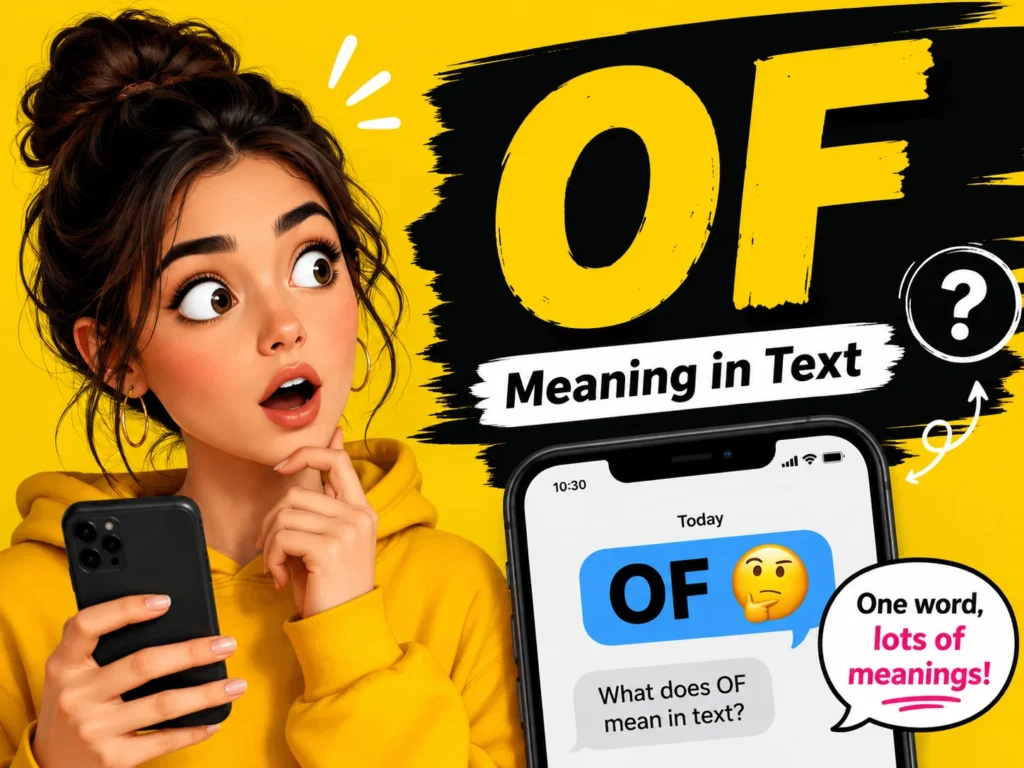
OF meaning in text depends on how someone uses it. Most of the time, lowercase “of” is simply the ordinary English preposition, as in “one of my friends.” When someone sends “of” by itself, however, it can sometimes be a shortened form of “of course.” In social-media conversations, uppercase “OF” can also refer to OnlyFans. Context tells you which meaning someone intended.
That distinction matters because “of” is an extremely common English word, so capitalization alone doesn’t prove that someone is using slang. A message such as “thinking of you” has nothing to do with internet slang. A message such as “OF?” may require more context before you can interpret it correctly.
What Does “OF” Mean in Text?
There are three meanings worth knowing when you see of or OF in a message:
| Form | Meaning | How common? |
|---|---|---|
| of | The normal English preposition | Very common |
| of / OF | Shortened “of course” in some casual chats | Less standardized |
| OF | OnlyFans in online/social-media contexts | Common in relevant discussions |
The first meaning is by far the safest assumption when of appears naturally inside a sentence. Cambridge Dictionary classifies “of” as a preposition used for relationships such as possession, amount, contents, position, cause, and comparison.
For example:
“She is a friend of mine.”
“I want a cup of coffee.”
“He is one of my classmates.”
Here, of is not slang or an abbreviation. It is standard English.
The situation changes when somebody types “of” as a standalone reply. In some informal online conversations, users shorten “of course” to “of.” This usage is not as standardized as abbreviations such as IDK, TBH, or BTW, so you should consider the surrounding conversation before assuming that meaning.
A third interpretation appears when people discuss creators, subscriptions, or online content. In that setting, OF may mean OnlyFans. If someone writes, “She has an OF,” they aren’t using the ordinary preposition.
The Most Common Meaning: The Word “Of”
Before treating of as slang, check whether it simply works as a normal English word.
It often connects one thing with another and can express possession, belonging, origin, quantity, contents, position, or a relationship.
You might see:
- “one of my best friends”
- “a picture of us”
- “a lot of people”
- “the end of the movie”
- “a bottle of water”
- “the color of her dress”
- “part of the problem”
- “thinking of you”
In these examples, replacing of with “of course” or “OnlyFans” would make the sentence nonsensical.
That is the easiest test.
If someone texts:
“I’m thinking of you.”
They are not using internet slang. They simply mean that you are on their mind.
If someone texts:
“She has an OF.”
The phrase has a completely different structure and likely refers to OnlyFans.
Why capitalization can cause confusion
Phones and keyboards sometimes capitalize words because of autocorrect, typing habits, or the way a message was entered. Therefore, seeing “OF” in uppercase does not automatically mean OnlyFans.
Compare:
“That’s one OF the reasons.”
Here, “OF” is almost certainly just of.
Now compare:
“Does she have an OF?”
Here, the capitalization and sentence structure make the OnlyFans interpretation much more plausible.
So don’t use capitalization as your only clue. Look at the whole sentence.
When “OF” Means “Of Course”
A less formal texting use of “of” is as a shortened version of “of course.”
In this use, the sender is generally communicating:
- yes
- definitely
- naturally
- sure
- of course
For example:
A: “Are you coming with us?”
B: “of”
The second person may mean:
“Of course.”
This shorthand is highly informal. It can also be unclear because “of” normally expects other words around it. A reader who isn’t familiar with the sender’s texting style might simply think the message was incomplete.
The same idea can appear with capitalization:
A: “Can you send me the notes?”
B: “OF”
Depending on the people involved, that could mean “of course,” although “ofc” is a much clearer abbreviation for “of course.”
That is an important distinction: “OF” is not a universally established abbreviation for “of course.” If you see it used that way, context and the sender’s personal texting habits matter.
When “OF” Means OnlyFans
In internet conversations, OF can stand for OnlyFans.
This meaning usually becomes obvious because other words in the message relate to an account, creator, subscription, link, followers, or online content.
Examples include:
“She started an OF.”
“Does he have an OF?”
“I saw her OF link.”
“People keep asking about her OF.”
In each example, OnlyFans fits naturally where “of” would not.
This is why a two-letter abbreviation can create confusion. The lowercase English word and uppercase internet abbreviation look almost identical.
The safest approach is to examine the words surrounding it rather than assuming that every OF means OnlyFans.
OF on SMS, iMessage, and WhatsApp
In ordinary text messaging, of most often functions exactly as it does in standard English.
You might receive:
“One of my cousins is visiting.”
“I’m kind of tired.”
“Thinking of going tomorrow.”
These are ordinary uses.
If someone sends “of” alone, however, the context becomes important. A person who normally uses short replies might use it to mean “of course,” while another person may simply have sent an incomplete message.
On WhatsApp, the same principle applies. A message like:
“A bottle of water”
contains the normal English word.
But:
“Can you help me?”
“of”
could potentially mean “of course,” depending on the sender’s style.
Don’t interpret the word in isolation if the conversation doesn’t make the meaning obvious.
READ MORE: DP Meaning Facebook — What Does DP Mean?
OF in DMs and Social Media Messages
Instagram, Snapchat, and Discord conversations can introduce another layer because users often discuss internet culture and online creators.
For example:
A: “Did you see her new account?”
B: “Yeah, she has an OF now.”
Here, OF clearly refers to OnlyFans.
However:
A: “Which one of these photos should I post?”
B: “The second one.”
The word of is simply normal grammar.
TikTok and X can also expose users to the OnlyFans abbreviation, particularly when conversations involve creators or online content. Still, don’t assume that every occurrence of “OF” on these platforms has that meaning.
Funny Tone
Sometimes a standalone “of” can create a funny moment because the reader doesn’t know whether it means “of course” or whether the sender made a typo.
A: “You really ate the whole pizza?”
B: “of 😭”
A: “OF?? You mean of course?”
B: “Yes 😭 I was too lazy to type the rest.”
The humor comes from how incomplete the abbreviation looks.
Sarcastic Tone
Context can also make a shortened reply sound sarcastic.
A: “Are you seriously going to remind everyone about this?”
B: “of”
A: “Wow. Very enthusiastic.”
B: “You asked if I was going to do it 😂”
Here, the meaning depends more on the exchange than on the letters themselves.
Playful Tone
Friends may use extremely short replies because both people already understand each other’s texting style.
A: “Movie tonight?”
B: “of”
A: “Knew you’d say yes.”
B: “You know me too well 😂”
In this kind of conversation, “of” works as an informal, clipped “of course.”
Serious Tone
A serious conversation usually benefits from clearer wording.
A: “Can you keep this between us?”
B: “Of course.”
A: “I really don’t want anyone else to know.”
B: “I understand. I won’t tell anyone.”
Notice that the full phrase “of course” works better here than the abbreviation “of.” In sensitive conversations, clarity matters more than saving two characters.
10 Real Text Examples of “OF”
1. Normal grammar
A: “Which one is your favorite?”
B: “The picture of us at the beach.”
A: “Same. I want to frame it.”
B: “You should!”
Here, of is simply a preposition.
2. “Of course” shorthand
A: “Can I call you later?”
B: “of”
A: “Cool, I’ll wait.”
B: “I’m free after 8.”
The context suggests that “of” means “of course.”
3. Ordinary WhatsApp message
A: “Did you buy a bottle of water?”
B: “Yeah, it’s in the kitchen.”
A: “Perfect.”
B: “Grab it before we leave.”
Again, “of” has its standard grammatical meaning.
4. OnlyFans context
A: “Did she really start an OF?”
B: “Yeah, that’s what she said.”
A: “Oh, I didn’t know.”
B: “She mentioned it yesterday.”
Here, OF means OnlyFans.
5. With a parent
A: “Can you pick me up after class?”
B: “Of course.”
A: “Thanks!”
B: “Just text me when you’re ready.”
The full phrase is clearer than “of.”
6. Between siblings
A: “Are you taking the charger?”
B: “of”
A: “I knew it 😂”
B: “I’ll bring it back tonight.”
The shorthand works because the relationship is casual.
7. With a coworker
A: “Could you send me the file?”
B: “Of course. I’ll send it now.”
A: “Thanks.”
B: “No problem.”
Here, the full phrase is more appropriate for workplace communication.
8. Social-media discussion
A: “Why does everyone keep asking about her OF?”
B: “She’s been talking about online subscriptions.”
A: “That explains it.”
B: “Yeah, I was confused too.”
The surrounding vocabulary identifies the meaning.
9. Romantic conversation
A: “Do you still want to see me tonight?”
B: “Of course ❤️”
A: “Good, because I’ve missed you.”
B: “I’ve missed you too.”
The full “of course” sounds warmer and clearer than a clipped “of.”
10. Ambiguous standalone reply
A: “You’re coming, right?”
B: “OF”
A: “Of course?”
B: “Yep 😂”
This is an example of why context matters. The reader may need clarification.
What Part of Speech Is “Of”?
When of has its ordinary English meaning, it is a preposition.
It normally connects a noun, pronoun, or noun phrase with another part of the sentence. Cambridge Dictionary lists several functions, including showing possession, quantity, contents, position, cause, comparison, and relationships.
Examples:
- “a friend of mine”
- “three of them”
- “a glass of juice”
- “the back of the house”
- “afraid of spiders”
- “the best of the three”
As slang, however, OF is not functioning as that preposition when it represents OnlyFans. It is an abbreviation.
When “of” represents “of course,” it is better understood as a casual shortening rather than a standard grammatical form.
Can “OF” Stand Alone in a Text?
Yes, but the meaning changes depending on context.
If someone sends:
“of”
by itself, they may be shortening “of course.”
However, because this usage isn’t universal, the safest response is sometimes to ask what they mean.
If someone sends:
“OF?”
the question mark can make it even more ambiguous. They might be using a context-specific abbreviation, or they may have made a typo.
If someone writes:
“She has an OF.”
the surrounding words strongly point toward the OnlyFans meaning.
Does Capitalization Change the Meaning?
Capitalization can provide a clue, but it doesn’t guarantee the meaning.
Lowercase “of”
Usually the ordinary English word:
“one of my friends”
Uppercase “OF”
May refer to:
- OnlyFans
- emphasis
- accidental capitalization
- a person’s personal shorthand
“of” by itself
May sometimes mean:
“of course”
The important point is that capitalization should support your interpretation, not determine it.
OF vs. OFC
One of the easiest ways to avoid confusion is to compare OF with OFC.
| Term | Meaning | Typical use |
|---|---|---|
| of | Normal English word | Grammar |
| OF | OnlyFans, in relevant contexts | Social/internet discussion |
| of | Sometimes “of course” | Informal shorthand |
| OFC | Of course | Casual texting |
| Of course | Full phrase | Clear, everyday communication |
If you mean “of course,” using OFC is generally clearer than using only “OF.”
For example:
“Can you help me?”
“OFC!”
There is little ambiguity.
Related Terms People May Confuse With OF
| Term | Meaning | Usage Context | Tone | Popularity | Confusion Risk |
|---|---|---|---|---|---|
| OF | of / of course / OnlyFans, depending on context | Texts and online conversations | Casual | High | High |
| OFC | Of course | Texting | Casual | High | Medium |
| OFF | Off | Everyday texting | Neutral | High | Medium |
| FYI | For your information | Texts/work messages | Neutral | High | Low |
| IMO | In my opinion | Texting/social media | Casual | High | Low |
| IDK | I don’t know | Texting | Casual | Very high | Low |
The biggest confusion is often between OF and OFC. If the sender intends “of course,” OFC usually communicates that idea more clearly.
Who Uses “OF” in Texts?
There isn’t a reliable age rule saying that one generation always uses OF one way.
Gen Z and younger internet users are generally familiar with many short forms because they communicate heavily through DMs, group chats, and social platforms. They may recognize OF as OnlyFans when the discussion concerns online creators.
Millennials may also understand the abbreviation, particularly if they regularly use social media, although their personal texting style may favor clearer forms such as “of course.”
Older users may interpret of primarily as the ordinary English word unless the surrounding conversation makes another meaning obvious.
The better predictor isn’t age alone. Context, platform, community, and personal texting habits all matter.
Regional differences also shouldn’t be overstated. The standard English word of is used across major English-speaking varieties, while the internet abbreviation OF can appear wherever online conversations about OnlyFans occur. The exact frequency varies by community.
Is “OF” Rude or Offensive?
The word of itself is completely ordinary and isn’t rude.
The shorthand “of” for “of course” is also generally harmless, although it can look confusing or overly clipped to someone who doesn’t use that style.
The OnlyFans meaning requires more care because it refers to a specific online content platform. Mentioning it isn’t automatically offensive, but bringing it up about another person can become inappropriate if you’re making assumptions, spreading rumors, or discussing someone’s private life without reason.
If you’re unsure what someone means, ask rather than assume.
Is OF Appropriate at School or Work?
The normal word of is obviously appropriate in school and workplace communication.
If you’re using “of” as shorthand for “of course,” it is best reserved for casual conversations with people who understand your texting style.
For a teacher, manager, client, or professional contact, use:
“Of course.”
rather than:
“OF.”
Similarly, don’t use OF to refer casually to OnlyFans in a professional conversation unless the subject genuinely requires it.
Clarity beats abbreviation in formal communication.
How to Reply to “OF”
Your response depends on which meaning the sender intended.
Funny reply
“OF? 😂 You really saved yourself two letters.”
Serious reply
“Do you mean ‘of course’?”
Flirty reply
If the conversation is already romantic and “of” clearly means “of course”:
“Good. I was hoping you’d say yes 😉”
Neutral reply
“Got it.”
If you aren’t sure what the sender means, the best response is:
“What do you mean by OF?”
There’s nothing wrong with asking. Two letters aren’t worth a misunderstanding.
How to Tell Which Meaning Someone Intended
Use this quick five-step check:
1. Look at the sentence
If it appears naturally between other words, it is probably ordinary of.
2. Check whether it stands alone
A standalone “of” may be shorthand for “of course,” although this isn’t universal.
3. Look for creator-related words
Words such as “account,” “creator,” “subscription,” or “link” can point toward the OnlyFans meaning.
4. Consider capitalization
OF can signal an abbreviation, but capitalization alone isn’t enough.
5. Read the previous message
The conversation immediately before the abbreviation is often your best clue.
This is especially useful when you’re dealing with a message such as:
“She has an OF.”
There is no need to guess. The sentence itself gives you the answer.
The Interesting Thing About “OF” in Real Text Conversations
What makes of interesting is that it sits between ordinary language and internet shorthand. Unlike a term that was created specifically as slang, of already belongs to everyday English, so the reader has to decide whether they’re seeing the normal word or an abbreviation.
A particularly telling example is a standalone “of.” In a sentence, your brain automatically treats it as grammar. On its own, however, it can suddenly look like a typo or a shortened “of course.” That tiny change in sentence position can completely alter how you read the same two letters.
The OnlyFans meaning adds another layer. In “one of my friends,” there is nothing mysterious about the word. In “she has an OF,” the same letters become an internet abbreviation. That makes OF a good example of how texting relies on context rather than spelling alone.
FAQ: OF Meaning in Text
What does OF mean in a text message?
OF can mean different things depending on the message. Most commonly, of is simply the ordinary English preposition, while standalone “of” can sometimes be used informally to mean “of course.” In online conversations about creators or subscriptions, OF may mean OnlyFans.
Is OF short for “of course”?
Sometimes people use “of” as a shortened form of “of course,” especially in very casual texting. However, it isn’t a universally understood abbreviation, so the reader may be confused. OFC is usually clearer when you specifically mean “of course.”
What does OF mean on social media?
On social media, OF can refer to OnlyFans when the conversation involves creators, accounts, subscriptions, or related online content. But the ordinary word of also appears constantly in social-media text. You need to read the surrounding sentence before deciding which meaning applies.
Is it rude to reply with just “of” in a text?
Not necessarily. If both people understand that “of” means “of course,” it can be a quick and friendly reply. However, because the abbreviation isn’t universal, someone unfamiliar with it might think you made a typo or sent an incomplete message.
What’s the difference between texting “of” and saying “of” out loud?
When spoken aloud, “of” normally has its standard English meaning and usually needs to be part of a larger phrase. A standalone “of” used as shorthand for “of course” is much more dependent on texting culture. In speech, saying the full “of course” is clearer.
Does OF mean the same thing in a group chat and a 1-on-1 text?
Not necessarily. In a group chat about creators or online subscriptions, OF may mean OnlyFans. In a private conversation where someone replies “of” to a question, it may mean “of course.” The relationship and subject of the conversation can change the interpretation.
What does OF mean from a girl?
There is no special meaning based on whether a girl sends it. She may be using of normally, using “of” as shorthand for “of course,” or referring to OnlyFans. The context matters more than the sender’s gender.
What does OF mean from a guy?
The same rule applies to a guy. OF doesn’t have a different standard definition depending on who sends it. Look at the sentence, the preceding messages, and the topic of the conversation to identify the intended meaning.
Conclusion
OF meaning in text depends on context. In ordinary sentences, of is simply the English preposition used to connect ideas, show possession, quantity, contents, position, and other relationships.
When someone sends “of” by itself, it may be an informal shortening of “of course,” although that use isn’t standardized enough to assume automatically. In social-media conversations, OF can also stand for OnlyFans, particularly when the message discusses accounts, creators, subscriptions, or links.
Quick usage tips
- Read the whole sentence, not just the two letters.
- Treat lowercase of as the normal English word unless context suggests otherwise.
- If someone sends “of” alone, consider whether they mean “of course.”
- If OF appears alongside creator or subscription language, consider the OnlyFans meaning.
- Use “of course” or “OFC” when you want your meaning to be unmistakable.
Common mistakes
- Assuming every OF means OnlyFans.
- Assuming every standalone of means “of course.”
- Treating capitalization as absolute proof of meaning.
- Using unclear shorthand in professional messages.
- Guessing when the surrounding conversation doesn’t provide enough information.
When to use it
Use ordinary of naturally in sentences. Use “of” as shorthand for “of course” only with people who understand that style. When clarity matters, especially at work or in a serious conversation, simply write “of course.”