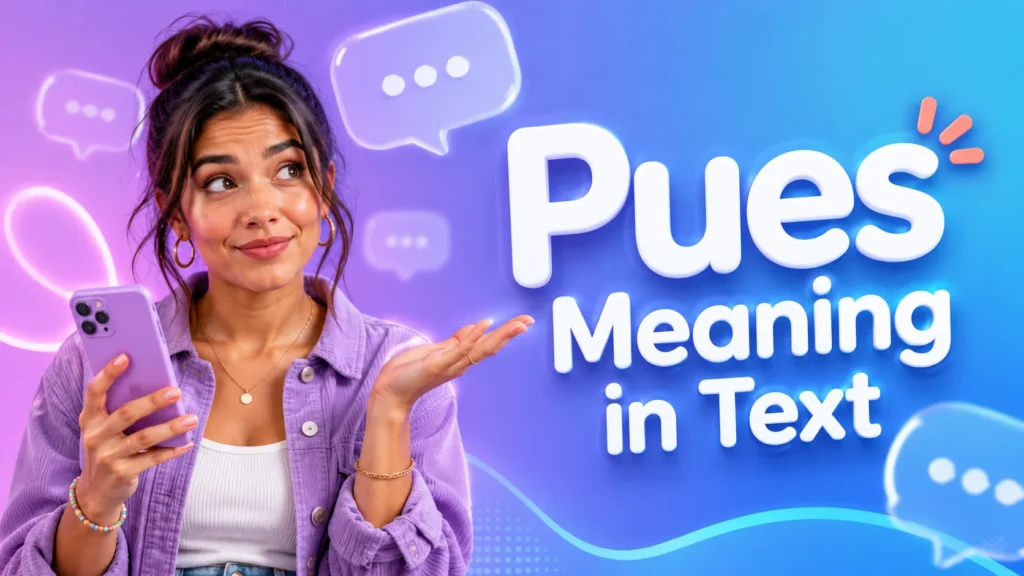
Pues meaning in text is usually “well,” “then,” “so,” or “because,” depending on the sentence and the speaker’s region. It is a common Spanish word used to introduce an answer, explain a reason, show hesitation, or add emphasis.
When someone texts “pues” by itself, it often sounds like:
- “Well…”
- “So…”
- “Then…”
- “I mean…”
- “Okay, then.”
- “What else can I say?”
Unlike texting acronyms such as LOL or IDK, pues is a real Spanish word, not an abbreviation. Its emotional meaning depends heavily on placement, punctuation, and context.
For example, “Pues sí” usually means “Well, yes” or “Yeah, I suppose so.” Meanwhile, “Hazlo, pues” can mean “Do it, then.”
People search for the meaning because a literal one-word translation does not work in every conversation. However, Pues may express agreement in one message and impatience in another.
Pues Meaning in Text – Quick Explanation
Pues is a flexible Spanish connector and conversational filler. Its most common English equivalents are “well,” “so,” “then,” “because,” and “in that case.”
Here is a quick breakdown:
- At the beginning: Often means “well” or “so.”
- At the end: Often means “then” or adds emphasis.
- Before a reason: Can mean “because” or “since.”
- By itself: May show hesitation, uncertainty, or mild resignation.
- With sí or no: Softens or strengthens agreement and disagreement.
- In casual regional slang: May function like “okay,” “right,” or “of course.”
Examples include:
“Pues no sé.”
“Well, I don’t know.”
“Vamos, pues.”
“Let’s go, then.”
“No fui, pues estaba enfermo.”
“I didn’t go because I was sick.”
The intended meaning is clearer when you read the entire sentence instead of translating pues alone.
What Does “Pues…” Mean With Dots?
When someone writes “pues…”, the ellipsis often shows hesitation, awkwardness, disappointment, or uncertainty.
For example:
“¿Todavía quieres salir conmigo?”
“Pues…”
Translation:
“Do you still want to go out with me?”
“Well…”
The unfinished response may suggest that the sender does not know what to say or is reluctant to give a direct answer.
Origin and Background of Pues
Pues comes from Spanish and has a long history as a linking word. It developed from the Latin word post, associated with the ideas of “after,” “later,” or “then.”
Over time, its grammatical and conversational functions expanded. Modern speakers use it not only to connect ideas but also to manage the emotional flow of a conversation.
In formal Spanish, pues can introduce a reason or result. In everyday speech, it frequently works as a discourse marker—a word that organises conversation without always adding a direct factual meaning.
English speakers do something similar with words such as:
- Well
- So
- Anyway
- Actually
- I mean
- You know
- Then
For example, the “well” in “Well, I’m not sure” does not describe something being done well. It signals hesitation and prepares the listener for an uncertain answer.
Pues performs the same conversational job in many Spanish messages.
How Texting Changed Its Tone
In spoken Spanish, facial expressions and voice make the meaning easier to understand. Texting removes those clues, so punctuation and emojis become more important.
Compare these messages:
- Pues sí. — Calm agreement or reluctant acceptance
- Pues sí! — Confident or enthusiastic agreement
- Pues sí 😂 — Amused agreement
- Pues sí… — Hesitant, resigned, or disappointed agreement
- PUES SÍ — Strong emphasis, frustration, or excitement
The basic words remain the same, but their emotional energy changes.
Real-Life Conversations Using Pues
The following conversations show how pues works across WhatsApp, Instagram, TikTok, and ordinary text messages.
WhatsApp: Hesitation
Person A: ¿Vas a venir a la fiesta esta noche?
(Are you coming to the party tonight?)
Person B: Pues… no sé. Estoy muy cansada.
(Well… I don’t know. I’m very tired.)
Person A: Está bien. Descansa si lo necesitas.
(That’s okay. Rest if you need to.)
Here, pues creates a pause before an uncertain answer. It tells the reader that Person B is thinking or feels slightly uncomfortable.
Instagram DM: Friendly Agreement
Person A: Esa foto quedó increíble.
(That picture turned out amazing.)
Person B: Pues sí, tuvimos buena luz 😂
(Well, yes, we had good lighting.)
Person A: Y una buena fotógrafa.
(And a good photographer.)
The expression “pues sí” sounds relaxed and playful. The laughing emoji prevents it from appearing arrogant.
TikTok Comments: Emphatic Reaction
Creator: Dicen que esta canción ya pasó de moda.
(They say this song is already outdated.)
Commenter: Pues a mí todavía me encanta.
(Well, I still love it.)
The commenter uses pues to introduce a contrasting personal opinion. It gives the reply a confident “well, as for me” tone.
Text Message: Mild Impatience
Person A: No sé si debería llamarlo.
(I don’t know whether I should call him.)
Person B: Llámalo, pues.
(Call him, then.)
Person A: Está bien, lo haré.
(Okay, I’ll do it.)
Placed at the end, pues adds emphasis. Depending on the relationship, the response may sound encouraging or slightly impatient.
Emotional and Psychological Meaning of Pues
Pues often reveals how the speaker feels about giving an answer. It may create space before disagreement, reduce the sharpness of a response, or communicate that the answer should be obvious.
A direct “no” can sound abrupt. “Pues no” may feel closer to “Well, no,” which gives the speaker a moment to introduce disagreement.
At other times, pues strengthens a response:
“Pues claro.”
This can mean “Well, of course,” “Of course,” or “Obviously.” It may sound warm and reassuring or mildly irritated, depending on tone.
Emotions Pues Can Communicate
Pues may express:
- Hesitation
- Resignation
- Agreement
- Disagreement
- Confidence
- Mild annoyance
- Surprise
- Acceptance
- Impatience
- Thoughtfulness
Imagine asking a friend whether they enjoyed meeting your new partner. They reply, “Pues… es interesante.”
The literal translation is “Well… he is interesting.” Yet the pause before “interesting” may suggest uncertainty or polite criticism. The sender may be avoiding a harsher opinion.
This example shows why emotional context matters. The dictionary meaning alone cannot explain the full message.
How Pues Is Used in Different Contexts
Pues at the Beginning of a Message
At the beginning, pues commonly means “well” or “so.” It introduces a thought, answer, decision, or reaction.
Examples:
- “Pues no sé.” — “Well, I don’t know.”
- “Pues vamos.” — “Well, let’s go.”
- “Pues dime.” — “Well, tell me.”
- “Pues qué bien.” — “Well, that’s great.”
- “Pues yo no estoy de acuerdo.” — “Well, I disagree.”
This placement often helps the message sound more conversational.
Pues at the End of a Message
At the end, pues often corresponds to “then” or adds emotional emphasis.
Examples:
- “Ven, pues.” — “Come, then.”
- “Hazlo, pues.” — “Do it, then.”
- “Dime, pues.” — “Tell me, then.”
- “Vamos, pues.” — “Let’s go, then.”
End-position pues is especially common in several Latin American regions. The tone may be encouraging, insistent, impatient, or affectionate.
Pues Meaning “Because”
In some sentences, pues introduces an explanation and means “because,” “since,” or “as.”
Example:
“Me quedé en casa, pues estaba lloviendo.”
Translation:
“I stayed home because it was raining.”
This use is more structured and may appear in written or formal Spanish. In casual speech, many speakers would use “porque” instead.
Pues Meaning “Therefore”
Pues can connect a cause with its result, giving it a meaning similar to “therefore,” “so,” or “in that case.”
Example:
“No tienes tiempo; déjalo, pues, para mañana.”
Translation:
“You don’t have time; leave it until tomorrow, then.”
The surrounding sentence determines whether pues introduces a reason or a conclusion.
With Friends and Romantic Partners
Among close friends or partners, pues may sound teasing, soft, or affectionate:
“Ven a verme, pues 🥺”
“Come see me, then.”
The pleading emoji makes the request emotionally gentle.
Without an emoji, the same sentence could sound more demanding:
“Ven a verme, pues.”
Personal communication habits make a major difference.
In Professional Communication
Pues is a normal Spanish word, so it is not automatically unprofessional. Still, highly conversational uses may sound too casual in formal writing.
In a professional setting, it can be used to explain a reason:
“La reunión se pospuso, pues faltaban varios documentos.”
However, conversational phrases such as “pues nada” or “hazlo, pues” may feel too relaxed or abrupt in an email to a client or manager.
When Not to Use Pues
Avoid relying on pues when the reader needs a precise explanation. Because the word has several functions, it can create confusion for beginner Spanish speakers.
It may be unsuitable:
- When giving urgent instructions
- In legal or technical writing requiring precision
- When translating word for word into English
- In a serious apology without further explanation
- When the message could already sound impatient
- When speaking to someone unfamiliar with regional Spanish
- When a clearer connector such as porque is needed
- When communicating across different Spanish dialects
Watch for an Impatient Tone
A command followed by pues may sound impatient:
“Responde, pues.”
“Answer, then.”
Among friends, it might be harmless encouragement. During an argument, it can sound like pressure.
If you want to sound polite, provide more context:
“Cuando puedas, respóndeme, por favor.”
“Please reply when you can.”
Do Not Translate It Literally Every Time
Replacing every pues with the same English word creates unnatural translations. Sometimes “well” fits, while “then,” “because,” or no English word at all may sound better.
For example:
“Pues sí, tienes razón.”
Possible translation:
“Yeah, you’re right.”
Although pues appears in Spanish, translating it as “well” is optional because English does not always need an equivalent filler word.
Common Misunderstandings About Pues
Pues Does Not Have One Fixed Translation
The biggest mistake is assuming that pues always means “well.” Its function changes based on sentence position and context.
It Is Not a Texting Acronym
Pues is a complete Spanish word. It is not formed from the first letters of a longer phrase.
It Does Not Always Show Annoyance
Messages such as “pues sí” or “vamos, pues” may sound annoyed in some situations, but they can also be friendly, confident, or completely neutral.
“Pos” Is Usually an Informal Version
Some speakers pronounce or type pues as “pos.” This is highly informal and reflects casual regional speech.
For example:
“Pos no sé.”
This means approximately:
“Well, I don’t know.”
The spelling may be humorous, rural, colloquial, or regionally natural.
“Ps” Can Represent Pues
In extremely casual messages, some Spanish speakers shorten pues to “ps.”
Example:
“Ps sí.”
This usually means:
“Well, yes.”
However, ps can have other meanings in different languages and communities, so context remains important.
Pues Compared With Similar Spanish Expressions
| Expression | Common English meaning | Typical function | Example |
|---|---|---|---|
| Pues | Well, so, then, because | Introduces, connects, or emphasises | “Pues no sé.” |
| Bueno | Well, okay, good | Starts an answer or signals acceptance | “Bueno, está bien.” |
| Entonces | Then, so | Shows time or consequence | “Entonces, ¿vamos?” |
| Porque | Because | Gives a direct reason | “No fui porque llovía.” |
| Así que | So, therefore | Introduces a result | “Llovía, así que me quedé.” |
| O sea | I mean, in other words | Clarifies or reformulates | “O sea, no quieres ir.” |
| Claro | Of course, clearly | Expresses agreement or certainty | “Claro que sí.” |
| Vale | Okay, all right | Shows acceptance, especially in Spain | “Vale, nos vemos.” |
| Bueno, pues | Well then | Introduces a conclusion or transition | “Bueno, pues vámonos.” |
| En fin | Anyway, in short | Ends or redirects a thought | “En fin, ya veremos.” |
| Ya que | Since, because | Introduces a reason | “Ya que estás aquí, ayúdame.” |
| Por eso | That is why | States a result | “Por eso no fui.” |
Key Insight
Pues is more flexible than most similar expressions. It can introduce an idea like “bueno,” show a conclusion like “entonces,” or give a reason like “porque.”
Common Variations and Types of Pues
1. Pues Sí
“Pues sí” means “well, yes,” “yeah,” or “that’s true.” It may express agreement, acceptance, or resignation.
2. Pues No
“Pues no” means “well, no.” It can introduce disagreement or a negative answer without sounding as sudden as “no” alone.
3. Pues Claro
“Pues claro” means “well, of course” or simply “of course.” It may sound reassuring, obvious, or slightly impatient.
4. Pues Bueno
“Pues bueno” resembles “well then” or “okay, then.” It often helps the speaker accept a situation and move forward.
5. Bueno, Pues
“Bueno, pues” may introduce a decision, transition, or conclusion:
“Bueno, pues nos vamos.”
“Well then, we’re leaving.”
6. Pues Nada
“Pues nada” has no perfect literal translation. It may mean “well, anyway,” “so, that’s it,” or “nothing else, then.”
It often closes a topic or signals resignation.
7. Pues Eso
“Pues eso” means approximately “so, that’s it,” “exactly,” or “that’s what I mean.” It refers back to something already explained.
8. Pues Ya
Depending on the region, “pues ya” can mean “well, that’s settled,” “okay, then,” or “that’s enough.”
9. Pues Qué Bien
This means “well, that’s great.” It can be sincere or sarcastic depending on punctuation and context.
10. Pues Qué Mal
This means “well, that’s unfortunate” or “that’s too bad.” It expresses disappointment or sympathy.
11. Pos
“Pos” is a highly informal pronunciation and spelling of pues. It is common in casual speech and humorous writing in some regions.
12. Ps
“Ps” is an abbreviated texting form of pues. It may save time, but it is less clear for people unfamiliar with Spanish chat language.
How to Respond When Someone Uses Pues
Your response should match the phrase following pues, not the word alone.
If They Say “Pues Sí”
Possible replies include:
- “Exacto.” — “Exactly.”
- “Me alegra que estemos de acuerdo.” — “I’m glad we agree.”
- “Eso pensaba.” — “That’s what I thought.”
- “Entonces, está decidido.” — “Then it’s decided.”
If They Say “Pues No”
You could respond:
- “Está bien.” — “That’s okay.”
- “¿Por qué no?” — “Why not?”
- “Entiendo.” — “I understand.”
- “No pasa nada.” — “No problem.”
If They Write “Pues…”
The sender may be hesitating. Gentle replies include:
- “Puedes decírmelo.” — “You can tell me.”
- “¿Qué pasa?” — “What’s wrong?”
- “Tómate tu tiempo.” — “Take your time.”
- “Sé sincero conmigo.” — “Be honest with me.”
Funny Replies
- “¿Pues qué?” — “Well, what?”
- “No me dejes con el ‘pues…’ 😂” — “Don’t leave me with just ‘well…’”
- “Ese ‘pues’ suena sospechoso.” — “That ‘well’ sounds suspicious.”
- “Ahora tienes que terminar la frase.” — “Now you have to finish the sentence.”
Mature Replies
- “No estoy seguro de entender tu tono.” — “I’m not sure I understand your tone.”
- “¿Puedes explicarlo con más claridad?” — “Can you explain it more clearly?”
- “Quiero asegurarme de no malinterpretarte.” — “I want to make sure I don’t misunderstand you.”
Asking for clarification is better than assuming that a short message is rude.
Regional and Cultural Usage of Pues
Spain
In Spain, pues frequently introduces answers, conclusions, and changes of topic. Phrases such as “pues nada,” “pues eso,” and “bueno, pues” are common in everyday conversation.
“Vale” may also appear alongside it:
“Pues vale.”
“Okay, then.”
Depending on tone, this can express normal acceptance or mild annoyance.
Mexico
Mexican Spanish uses pues in explanations, responses, and informal emphasis. The colloquial pronunciation “pos” may appear in speech, memes, and casual messages.
Examples include:
- “Pues sí.”
- “Pues qué te digo.”
- “Ándale, pues.”
- “Pos no sé.”
“Ándale, pues” can express agreement, encouragement, or farewell depending on context.
Central America and the Caribbean
Pues is widely understood, although its frequency and preferred position vary. Some speakers place it naturally at the end of statements to reinforce the message.
Regional vocabulary surrounding pues may change its emotional effect, so familiarity with the speaker’s dialect helps.
Colombia, Venezuela, Ecuador, and Peru
End-position pues is particularly noticeable in parts of Latin America:
“Dime, pues.”
“Tell me, then.”
“Vamos, pues.”
“Let’s go, then.”
Depending on the speaker’s delivery, this may sound friendly, persuasive, impatient, or simply natural.
Global Internet Usage
Bilingual users often place pues inside an English sentence:
- “Pues, I don’t know.”
- “I told him no, pues.”
- “Pues yes, obviously.”
- “Okay pues, let’s go.”
This language mixing is common in multicultural online spaces. It may express cultural identity as well as meaning.
Generational Differences
Older speakers use pues naturally as a standard Spanish connector. Younger users may shorten it to “ps,” exaggerate it for humour, or combine it with reaction emojis.
Gen Z users might write:
“Ps sí 😂”
Millennials may be more likely to use the complete spelling, although individual and regional habits matter more than age.
Is Pues Safe for Kids?
Yes. Pues is an ordinary Spanish word with no inherently offensive or adult meaning.
Children learning Spanish should understand that it has several uses and cannot always be translated with one English word. They should also learn that commands ending in pues may sound impatient in certain situations.
Frequently Asked Questions About Pues
What does pues mean in texting?
In texting, pues commonly means “well,” “so,” “then,” or “because.” Its correct interpretation depends on where it appears in the sentence.
What does “pues sí” mean?
“Pues sí” means “well, yes,” “yeah,” “that’s true,” or “I suppose so.” Tone determines whether it expresses enthusiasm, simple agreement, or reluctant acceptance.
What does “pues no” mean?
“Pues no” means “well, no.” It may introduce disagreement, disappointment, or a negative answer.
What does it mean when someone replies only “pues”?
A reply containing only “pues” may show hesitation, surprise, uncertainty, or an invitation for the other person to continue. The previous message provides the best clue.
Does pues mean “because”?
Yes, pues can mean “because” or “since” when it introduces a reason. In casual conversation, porque is usually the clearer and more direct choice.
Is “pos” the same as “pues”?
“Pos” is an informal pronunciation and spelling of pues used in some Spanish-speaking communities. It has a casual or regional tone and is unsuitable for most formal writing.
Is pues rude?
Pues is not inherently rude. However, phrases such as “hazlo, pues” or “responde, pues” may sound impatient if used during an argument.
Conclusion
The pues meaning in text cannot be captured by one English translation. It usually means “well,” “so,” “then,” “because,” or “in that case,” depending on its position and purpose.
At the beginning of a message, it often introduces a thought: “Pues no sé” means “Well, I don’t know.” At the end, it can add emphasis: “Dime, pues” means “Tell me, then.”
Punctuation adds another emotional layer. “Pues sí!” sounds confident, while “pues sí…” can suggest hesitation or resignation. Regional differences also influence whether the word feels neutral, affectionate, humorous, or impatient.
Instead of translating pues automatically, read the complete sentence and notice the emotional situation. Once you recognize its role in conversation, this small Spanish word becomes much easier to understand and use confidently.