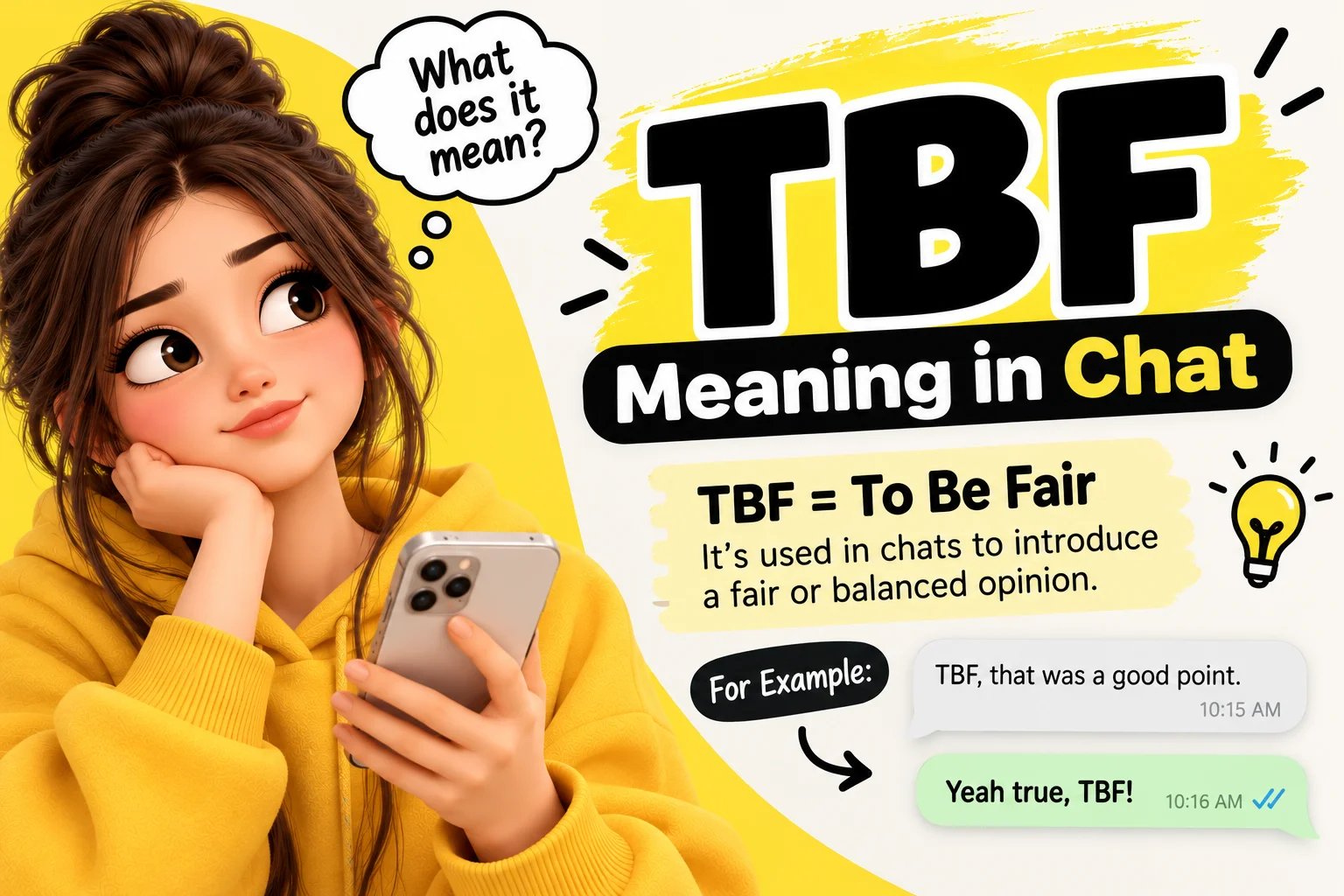

TBF usually means “to be fair” in texting and online chat. When someone writes “TBF,” they’re usually adding a fair or balanced point to a conversation, often after criticizing someone or acknowledging another side of an argument.
What Does TBF Mean in Text?
TBF is an abbreviation for “to be fair.” It is commonly used when someone wants to introduce a reasonable point, correction, or qualification.
For example:
A: The restaurant was really slow last night.
B: TBF, they were packed.
Here, B isn’t necessarily disagreeing with A. Instead, they’re pointing out something that should be considered before judging the situation.
TBF can appear at the beginning, middle, or end of a message:
- “TBF, I understand why she did it.”
- “He was late, tbf.”
- “I didn’t like the movie, but tbf, the acting was good.”
The abbreviation often signals that the writer is trying to make the conversation more balanced.
Is TBF an Acronym or Abbreviation?
TBF is generally treated as an initialism or texting abbreviation for “to be fair.”
Each letter represents a word:
- T = To
- B = Be
- F = Fair
People normally read it as the phrase “to be fair” rather than pronouncing the individual letters aloud.
READ MORE: WRU Meaning in Chat — What Does WRU Mean?
How People Use TBF in Real Chats
TBF often appears when someone changes direction slightly after making a strong statement.
Imagine a friend says:
“That was such a bad decision.”
You might respond:
“TBF, they didn’t have much choice.”
You’re not necessarily defending the decision completely. You’re simply adding information that makes the situation less one-sided.
This makes TBF particularly useful in casual debates, conversations about friends, reviews, disagreements, and everyday opinions.
TBF in Different Texting Situations
In SMS, iMessage, and WhatsApp
TBF works naturally in ordinary text messages:
“TBF, you did warn me.”
It can introduce a quick qualification without requiring a long explanation.
In Instagram, Snapchat, and Discord DMs
You may also see tbf in private conversations and group chats.
“tbf that was kinda funny 😂”
Lowercase is especially natural in casual digital conversations.
Capitalization
These forms normally have the same meaning:
- TBF
- tbf
- Tbf
Capitalization doesn’t create a separate definition. It mainly changes the visual style of the message.
What Tone Does TBF Have?
TBF isn’t automatically positive or negative. Its tone depends on what follows it.
TBF in a Funny Conversation
A: I spent $30 on snacks and ate them all in an hour.
B: TBF, you were hungry.
A: That’s the nicest way anyone has ever defended me.
B: I’m basically your lawyer.
TBF in a Sarcastic Conversation
A: He finally replied after two days.
B: TBF, he probably needed time to type “lol.”
A: Exactly. Such dedication.
B: A true professional.
TBF in a Playful Conversation
A: You always steal my fries.
B: TBF, your fries taste better.
A: They’re literally the same fries.
B: Not when they’re yours.
TBF in a Serious Conversation
A: I don’t think the manager handled that well.
B: TBF, she was dealing with three problems at once.
A: That’s true. I hadn’t considered that.
B: Still, she could’ve communicated better.
10 Real Chat Examples With TBF
1. Between Friends
A: I can’t believe you forgot my birthday.
B: TBF, you never told me the date.
A: I definitely did.
B: Then I owe you an apology 😂
2. Talking About a Movie
A: The movie was boring.
B: TBF, it was supposed to be slow-paced.
A: I know, but it felt really long.
B: Fair enough.
3. With a Sibling
A: Mom’s going to be mad that you broke the vase.
B: TBF, the dog knocked it over.
A: You were holding it.
B: Okay, maybe partly my fault.
4. About School
A: That exam was impossible.
B: TBF, the teacher gave us a whole week to study.
A: I studied the night before.
B: That explains a lot.
5. Workplace Chat
A: The project took forever.
B: TBF, the requirements changed twice.
A: That’s true.
B: At least we finished it.
6. Relationship Conversation
A: You think I overreacted?
B: TBF, I can understand why you were upset.
A: But I probably could’ve handled it better.
B: Maybe, but your feelings were understandable.
7. Group Chat
A: Nobody wanted to go out tonight.
B: TBF, it’s freezing outside.
A: Still would’ve been fun.
B: Next weekend?
8. Talking About Food
A: That restaurant wasn’t worth the money.
B: TBF, the portions were huge.
A: True, but the service was slow.
B: Can’t argue with that.
9. After an Argument
A: I think you were being unfair to him.
B: TBF, I was already annoyed.
A: I could tell.
B: I should’ve waited before responding.
10. Casual DM
A: You said you’d be here at 7.
B: I know 😭
A: It’s 7:45.
B: TBF, traffic was awful.
How Does TBF Work Grammatically?
TBF behaves differently from ordinary words because it represents a complete phrase.
The original expression “to be fair” is commonly used as a discourse marker. It helps introduce a qualification or another perspective.
TBF can appear:
At the beginning:
“TBF, I don’t think he meant it.”
In the middle:
“I was annoyed, but tbf, she apologized.”
At the end:
“It wasn’t that bad, tbf.”
It can also function as a standalone response:
A: “Was I too harsh?”
B: “TBF…”
Although a complete sentence is usually more natural after it.
Does TBF Mean “To Be Honest”?
No. TBF means “to be fair,” while TBH means “to be honest.”
The two can sometimes appear in similar conversations, but they perform different jobs.
TBF introduces a fair or balancing consideration.
“TBF, he did apologize.”
TBH signals honesty or personal opinion.
“TBH, I didn’t like it.”
TBF vs. Related Texting Terms
| Term | Meaning | Usage Context | Tone | Popularity | Confusion Risk |
|---|---|---|---|---|---|
| TBF | To be fair | Adding another side or qualification | Balanced/casual | Common | Low |
| TBH | To be honest | Giving an honest opinion | Direct/casual | Common | Medium |
| IMO | In my opinion | Expressing a personal view | Casual | Common | Low |
| IMHO | In my humble opinion | Giving an opinion | Casual | Common | Low |
| FR | For real | Agreement or emphasis | Casual | Common | Medium |
| TFTI | Thanks for the invite | Usually sarcastic reaction to being excluded | Humorous/sarcastic | Common | Medium |
Unlike TBH, which emphasizes honesty, TBF emphasizes fairness or balance.
Who Uses TBF?
TBF is most useful in informal digital communication. People who are comfortable with online abbreviations may use it in texts, DMs, group chats, and casual workplace messaging.
Gen Z and Millennials
Both Gen Z and Millennials can recognize and use TBF. However, texting habits vary from person to person. Some people prefer abbreviations such as tbf, while others simply type the complete phrase “to be fair.”
A lowercase tbf often blends naturally into fast-moving conversations:
“tbf I would’ve done the same”
Older or more formal communicators may be more likely to write the full phrase.
Regional Usage
TBF is widely understandable in English-language internet communication, but there isn’t a reliable basis for treating it as exclusive to one English-speaking country.
Where Did TBF Come From?
TBF belongs to the wider family of internet and texting abbreviations that shorten common English expressions.
The full phrase “to be fair” existed long before texting. Digital communication simply gave users a convenient shorthand for a phrase that appears frequently in informal discussion.
Unlike newer slang that develops around a particular meme or social-media trend, TBF is better understood as a practical abbreviation of an already established English expression.
Is TBF Rude?
TBF isn’t inherently rude or offensive.
In fact, it can make a disagreement sound more balanced because it acknowledges another point of view.
However, tone matters.
Compare:
“TBF, you were wrong.”
with:
“TBF, I can understand why you reacted that way.”
The first can sound blunt or argumentative. The second sounds more conciliatory.
Is TBF Appropriate at Work?
TBF can be understood in casual workplace messaging, particularly between colleagues who regularly use informal chat.
For formal emails, reports, academic work, or communication with clients, it’s better to write “to be fair” rather than using the abbreviation.
How Should You Reply to TBF?
Your response depends on whether you agree with the point being made.
Funny Reply
“Okay, counselor, make your case 😂”
Serious Reply
“That’s fair. I hadn’t considered that part.”
Flirty Reply
“TBF, you always know how to win an argument with me.”
Neutral Reply
“Yeah, that’s a good point.”
You don’t have to agree with everything after TBF. The phrase simply signals that the person is introducing another consideration.
A Real-World Observation About TBF
TBF has a useful role in texting because it lets someone soften or rebalance a statement without writing a long explanation. A person can criticize something and then add “tbf” before acknowledging a reason in its favor. That makes the abbreviation especially useful in conversations where people are disagreeing but still want to recognize that the situation isn’t completely one-sided.
Frequently Asked Questions
What does TBF mean in texting?
TBF means “to be fair.” People use it when they want to add a reasonable point or acknowledge another side of a situation. It often appears before an explanation that qualifies what someone has just said.
Is TBF positive or negative?
TBF is neither inherently positive nor negative. Its meaning depends on the statement that follows it. It can be used to defend someone, soften criticism, acknowledge a problem, or simply provide additional context.
Is it rude to reply with TBF in a text?
No, TBF isn’t inherently rude. However, it can sound dismissive if someone uses it to immediately contradict another person’s feelings. The surrounding words and tone determine how the message is received.
What’s the difference between TBF and TBH?
TBF means “to be fair,” while TBH means “to be honest.” TBF usually introduces a balancing point or another perspective. TBH generally introduces a direct personal opinion or honest statement.
What’s the difference between texting TBF and saying “to be fair” out loud?
The meaning is essentially identical. TBF is simply a shortened written version of the phrase. When speaking, people normally say “to be fair” rather than pronouncing the individual letters.
Does TBF mean the same thing in a group chat?
Yes. TBF generally retains the meaning “to be fair” in group chats. Someone might use it to acknowledge another person’s argument or add context to an ongoing discussion.
Can I use TBF in a professional message?
You can use it in a very casual workplace chat if the communication style allows abbreviations. For formal emails, reports, applications, or academic writing, spell out “to be fair” instead.
Can TBF be used by itself?
It can appear by itself, particularly as a brief reaction, but it usually introduces another statement. For example, someone might respond “TBF…” before explaining why they think another person has a valid point.
Conclusion
TBF means “to be fair” in text and chat. It’s an informal abbreviation used to introduce another perspective, qualify a statement, or acknowledge something that should be considered.
Quick usage tips
- Use TBF when adding a balancing point.
- Use tbf for a relaxed texting style.
- Use it before an explanation or qualification.
- Use “to be fair” instead in formal writing.
Common mistakes
- Don’t confuse TBF with TBH.
- Don’t assume TBF means the person completely disagrees with you.
- Don’t treat TBF as automatically sarcastic.
- Don’t use it as formal academic or business language.
When to use TBF
TBF works well in casual texts, DMs, group chats, and informal conversations. In formal communication, spelling out “to be fair” is clearer and more appropriate.