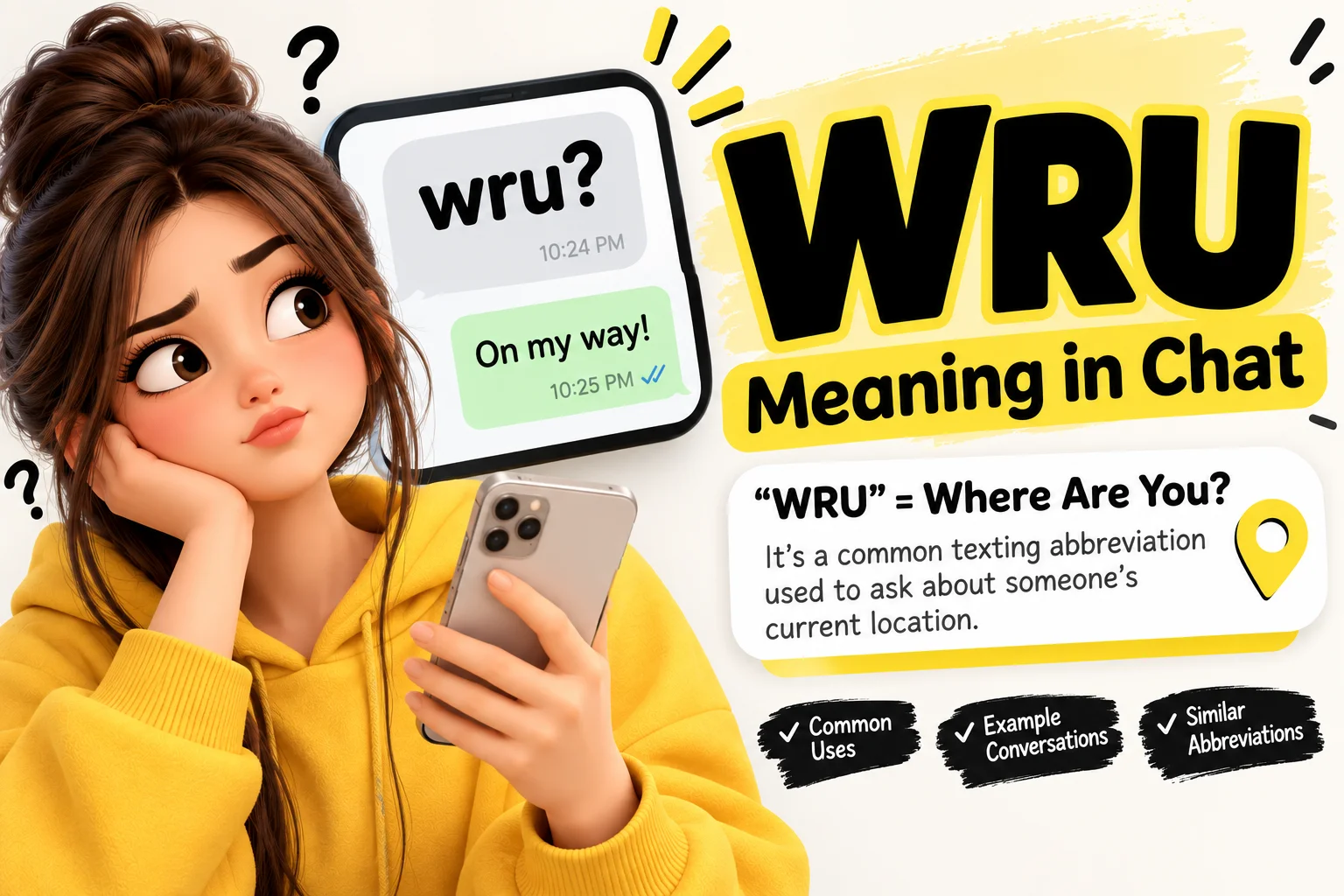

WRU usually means “Where are you?” in chat and texting. When someone texts you “WRU?”, they’re asking about your current location or where you are at that moment. It’s an informal abbreviation commonly used to make a quick question shorter.
What Does WRU Mean in Chat?
WRU is a texting abbreviation, not a traditional acronym. It shortens the phrase “Where are you?” by using the first letters or sounds of the words:
- W = Where
- R = are
- U = you
For example:
Friend: WRU?
You: I’m almost there.
The person is simply asking where you are.
In some conversations, WRU can also carry the meaning “Where are you at?”, although “Where are you?” is the standard expansion.
Why Do People Use WRU?
WRU saves time when someone wants a quick response. It works especially well when two people are trying to meet, checking whether someone has arrived, or simply asking where the other person is.
Unlike some slang terms, WRU doesn’t usually add a special emotional meaning by itself. The surrounding conversation determines whether it sounds casual, impatient, playful, or concerned.
READ MORE: ILYK Meaning in Text — What Does ILYK Mean?
WRU on Different Messaging Platforms
WRU can appear in several forms of text-based communication.
SMS, iMessage, and WhatsApp
These are natural places to see WRU because the abbreviation works as a very short texting question.
“Hey, WRU?”
“WRU? We’re waiting.”
Instagram, Snapchat, and Discord DMs
WRU can also appear in private messages and group chats when someone wants to know another person’s location.
Capitalization isn’t important. You might see:
- WRU?
- wru?
- Wru?
They generally mean the same thing.
How WRU Changes With Tone
The basic meaning stays the same, but the situation can change how the message feels.
Funny
A friend might use WRU after waiting around for you.
A: WRU?
B: Physically? At home. Spiritually? On vacation.
A: 😂 We were supposed to leave 20 minutes ago.
B: Okay okay, I’m coming.
Sarcastic
Someone might use it jokingly when they already know where you are.
A: WRU?
B: Literally sitting next to you.
A: Just checking.
B: You could’ve looked up. 😂
Playful
WRU can be part of casual teasing.
A: wru 👀
B: Why? You miss me?
A: Maybe.
B: Then come find me.
Serious
In an urgent situation, WRU can be a direct request for someone’s location.
A: WRU?
B: I’m still at the station.
A: Stay there. I’ll come get you.
B: Okay.
10 Real Chat Examples Using WRU
1. Friends
A: WRU?
B: At the coffee shop.
A: Inside or outside?
B: Outside near the entrance.
2. Dating
A: Hey, wru?
B: Driving home.
A: Text me when you get there.
B: Will do.
3. Siblings
A: WRU
B: At Mom’s house.
A: Can you bring my charger?
B: Yeah.
4. Coworkers
A: WRU? The meeting started.
B: I’m in the lobby.
A: Come upstairs when you can.
B: On my way.
5. Parents
A: WRU?
B: I’m with Sara.
A: Okay. What time will you be home?
B: Around 9.
6. Group of friends
A: wru guys?
B: We’re outside the restaurant.
A: Coming now.
B: Hurry 😂
7. Someone you’re meeting
A: WRU?
B: Two blocks away.
A: Perfect.
B: See you in five.
8. Casual DM
A: Wru today?
B: Mostly at home. Why?
A: Thought you might want coffee.
B: I’m in.
9. After a missed call
A: WRU? I called you twice.
B: Sorry, I was in class.
A: No worries. Call me later.
B: Sure.
10. Checking on someone
A: WRU?
B: Still at work.
A: Everything okay?
B: Yeah, just finishing something.
WRU Grammar and Language Role
WRU functions as a texting abbreviation for a question.
It normally appears:
- At the beginning of a message: “WRU?”
- As a standalone reply or question
- In lowercase or uppercase
- In highly informal communication
Because WRU represents an entire question, it can stand alone:
“WRU?”
You wouldn’t normally use it in formal writing. It would be inappropriate in a professional email, academic assignment, or formal letter.
Does Capitalization Change the Meaning?
Usually, no.
WRU?, wru?, and Wru? all communicate essentially the same question.
However, WRU? may look slightly more direct because of the capitalization, while wru? can feel more relaxed and casual.
How Should You Reply to WRU?
Your response depends on the situation.
Funny Reply
“Currently fighting traffic 😭”
Serious Reply
“I’m at the office. I’ll be home around 7.”
Flirty Reply
“Why, are you looking for me? 👀”
Neutral Reply
“I’m at home. What’s up?”
The safest response is simply to answer the location question if you’re comfortable sharing your location.
WRU vs. Similar Texting Terms
| Term | Meaning | Usage Context | Tone | Popularity | Confusion Risk |
|---|---|---|---|---|---|
| WRU | Where are you? | Asking someone’s location | Casual | Common | Low |
| WYA | Where you at? | Asking where someone is | Very casual | Common | Low |
| WYD | What are you doing? | Asking what someone is doing | Casual | Common | Medium |
| HRU | How are you? | Asking about someone’s well-being | Casual | Common | Medium |
| BRB | Be right back | Temporarily leaving a chat | Casual | Common | Low |
| WBU | What about you? | Returning a question | Casual | Common | Low |
The most important distinction is between WRU and WYD. WRU asks about location, while WYD asks about activity.
Who Uses WRU?
WRU belongs to informal digital communication, particularly short messages between people who already have some conversational context.
Gen Z vs. Millennials
Both younger and older internet users may recognize texting abbreviations such as WRU. However, individual texting habits vary considerably by age, social group, and communication style, so age alone doesn’t determine whether someone uses it.
Younger texters may favor lowercase forms such as “wru?”, while another person may simply write “where are you?” because it’s clearer and only slightly longer.
Regional Usage
WRU is understandable in English-language texting, but individual preferences differ between users and regions. It should not be treated as a uniquely American, British, or Australian expression without stronger evidence.
Where Did WRU Come From?
WRU belongs to the broader tradition of internet and mobile-text abbreviations that shorten common phrases for faster communication.
Its structure is straightforward: “where” → W, “are” → R, and “you” → U. This style of shortening became familiar through early SMS and online chat culture, where users often compressed phrases to save time and characters.
There is no need to attribute WRU to a specific TikTok trend or modern meme. It fits the older texting shorthand tradition.
Is WRU Rude or Offensive?
No. WRU is not inherently rude or offensive.
The tone depends on the context.
For example:
“wru? ❤️”
can sound friendly or affectionate.
But:
“WRU???!!”
could sound impatient, especially if someone has been waiting.
Is WRU Appropriate at Work?
It depends on the relationship. With a close coworker in an informal workplace chat, it may be understood. However, when messaging a manager, client, teacher, or other formal contact, writing “Where are you?” is usually clearer and more professional.
A Real-World Observation About WRU
One interesting thing about WRU is that it asks for place rather than activity. That’s why it often appears when two people are coordinating in real time: meeting somewhere, finding a friend in a crowd, checking whether someone has arrived, or deciding where to go next. A three-letter message can therefore function almost like a location check-in request.
Frequently Asked Questions
What does WRU mean in texting?
WRU means “Where are you?” in texting and online chat. It is an informal abbreviation used to ask someone about their current location. The person may be checking where you are because they want to meet you, find you, or simply know your whereabouts.
Is it rude to reply with just WRU in a text?
WRU itself isn’t rude. However, a very short message can sometimes sound blunt depending on your relationship and punctuation. Adding context, an emoji, or a friendly phrase can make it feel warmer.
What’s the difference between texting WRU and saying “where are you” out loud?
There is no major difference in the basic meaning. WRU is simply a shortened written form designed for quick digital communication. When speaking, people normally say the complete phrase rather than pronouncing the letters as WRU.
Does WRU mean the same thing in a group chat and a 1-on-1 text?
Generally, yes. In both settings, WRU normally asks where someone is. In a group chat, the intended person may need to be identified from the conversation because several people can see the message.
Is WRU the same as WYA?
They are very similar. WRU means “Where are you?”, while WYA generally means “Where you at?” Both ask about someone’s location and are informal.
What is the difference between WRU and WYD?
WRU asks where you are, while WYD asks what you are doing. For example, “WRU?” could receive “at home,” while “WYD?” could receive “watching TV.”
Can WRU be written in lowercase?
Yes. wru and WRU generally have the same meaning. Lowercase texting often gives the message a more casual appearance.
Can I use WRU in a professional message?
It’s better to avoid it in formal professional communication. Write “Where are you?” instead, especially when communicating with a manager, client, teacher, or someone you don’t know well.
Conclusion
WRU means “Where are you?” in chat and texting. It’s a short, informal abbreviation used when someone wants to know another person’s location.
Quick usage tips
- Use WRU? for casual texting.
- Use wru? when you want a relaxed texting style.
- Use it when asking about someone’s location.
- Write the full phrase in formal communication.
Common mistakes
- Don’t confuse WRU with WYD.
- Don’t assume WRU automatically sounds rude.
- Don’t use it in formal writing when clarity matters.
- Don’t assume it asks what someone is doing; it primarily asks where they are.
When to use it
Use WRU with friends, family, partners, and other people you regularly text. Avoid it when a more professional or explicit style would be appropriate.