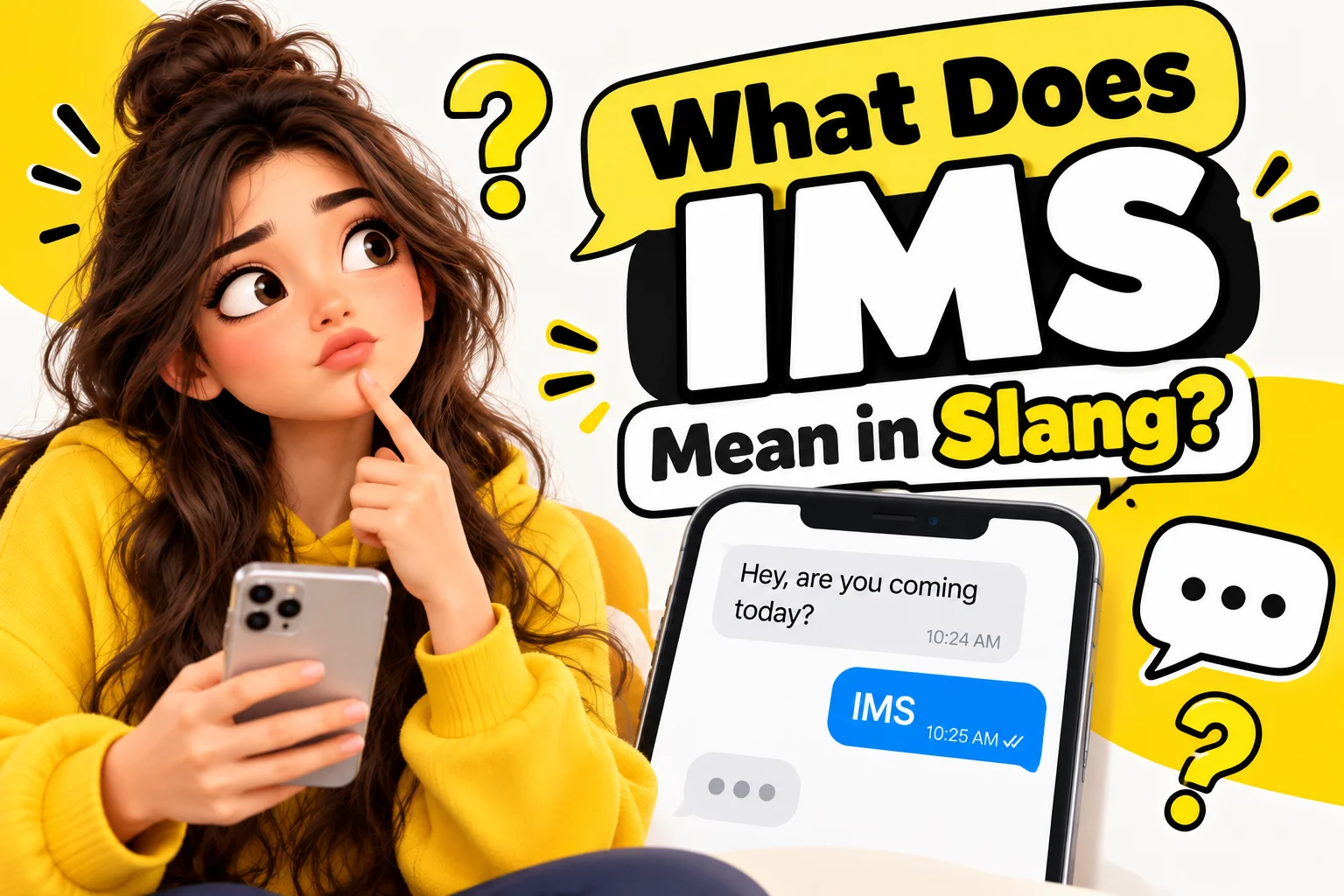

IMS usually means “I’m sorry” in casual texting and online slang. When someone sends you “ims,” they are generally giving a quick apology, such as after forgetting something, replying late, or making a mistake. However, IMS is an uncommon abbreviation, so context matters because it can have other meanings in different conversations.
What Does IMS Mean in Slang?
In casual texting, IMS can mean “I’m sorry” or “I am sorry.”
It works as a short apology:
“ims, I forgot to call you.”
This means:
“I’m sorry, I forgot to call you.”
Unlike very common abbreviations such as LOL, IDK, or BRB, IMS is not universally recognized. Some slang references list other interpretations, including “If Memory Serves” and “I Must Say.”
So if someone sends only “IMS” without any context, you should look at the surrounding conversation before deciding what they mean.
READ MORE: TMW Meaning in Text — What Does TMW Mean?
Is IMS an Acronym or Abbreviation?
For texting purposes, IMS is best treated as an informal abbreviation or initialism.
When it means “I’m sorry,” the letters correspond roughly to:
- I = I
- M = ’m
- S = sorry
It is designed to shorten an ordinary phrase rather than create a completely new slang word.
The Main Slang Meaning: “I’m Sorry”
The most relevant meaning when you’re specifically asking about IMS in texting slang is “I’m sorry.” Multiple current texting references identify this as a texting use.
People might use it when:
- They forgot to do something.
- They replied late.
- They made a small mistake.
- They said something insensitive.
- They missed a call.
- They want to acknowledge a mistake quickly.
For example:
“ims I didn’t see your message.”
means:
“I’m sorry, I didn’t see your message.”
The abbreviation can make an apology feel quick and casual, but the actual seriousness comes from the rest of the message.
Other Possible Meanings of IMS
IMS can have other meanings, but they should not automatically be assumed when you see it in a text.
“If Memory Serves”
Some slang references list IMS = “If Memory Serves.” This meaning makes sense when someone is trying to recall information.
For example:
“IMS, we met in college.”
Here, the sender could mean:
“If memory serves, we met in college.”
“I Must Say”
Some online slang sources also list IMS as “I Must Say.” This can introduce an opinion or observation.
For example:
“IMS, that was actually a great movie.”
In this context, an apology clearly would not make sense.
Because these alternatives are less straightforward, the surrounding sentence is essential.
How IMS Works in Real Text Conversations
IMS behaves differently from many slang terms because it often appears at the beginning of a sentence when it means “I’m sorry.”
For example:
“ims I completely forgot.”
It can also appear before an explanation:
“ims, I was busy all day.”
Or as part of a longer apology:
“ims for not answering earlier.”
It can even stand alone:
“IMS.”
But a standalone IMS is more ambiguous because the recipient has less context.
Lowercase vs. Uppercase
You may see:
- ims
- IMS
- Ims
These generally do not represent different meanings.
Lowercase “ims” feels more natural in casual texting. Uppercase “IMS” may simply reflect someone’s typing style, automatic capitalization, or emphasis.
IMS in Different Tones
Funny IMS
A: You ate the last slice of pizza.
B: I was hungry 😭
A: You didn’t even ask.
B: ims 😂 I panicked.
Sarcastic IMS
A: You forgot my birthday again.
B: Wait…
A: Seriously?
B: IMS, my calendar betrayed me.
Playful IMS
A: You stole my hoodie.
B: Borrowed it.
A: Without asking?
B: IMS 😭 I’m keeping it though.
Serious IMS
A: What you said yesterday really hurt me.
B: You’re right.
A: I didn’t expect that from you.
B: IMS. I shouldn’t have said it.
These examples show why IMS alone does not tell you how sincere an apology is. The surrounding words provide the emotional context.
10 Real Text Examples of IMS
1. Friend
A: You said you’d call me last night.
B: I know.
A: You disappeared.
B: ims, I fell asleep.
2. Partner
A: Are you still coming?
B: I’m running late.
A: How late?
B: ims, probably another 20 minutes.
3. Sibling
A: Did you take my charger?
B: Maybe.
A: I need it.
B: IMS 😂 I’ll bring it back.
4. Coworker
A: Did you send the document?
B: Not yet.
A: We need it today.
B: IMS, I’ll send it shortly.
5. Classmate
A: Did you get my notes?
B: No, I didn’t see them.
A: I sent them yesterday.
B: ims, check your other chat.
6. Parent
A: Why didn’t you call when you arrived?
B: I forgot.
A: I was worried.
B: IMS, I’ll call next time.
7. Friend after an argument
A: I didn’t like what you said.
B: I understand.
A: It wasn’t fair.
B: IMS. I was frustrated.
8. Casual DM
A: You never replied 😂
B: I saw it and forgot.
A: Wow.
B: ims 😭
9. Group chat
A: Who changed the meeting time?
B: I did.
A: Without telling everyone?
B: ims, I thought everyone knew.
10. Making plans
A: Are you free tonight?
B: No, sorry.
A: Tomorrow?
B: IMS, I already made plans.
How to Reply to IMS
Your response should match the situation.
Funny reply
“Accepted 😂 but you’re buying coffee.”
Serious reply
“I appreciate you apologizing. I just want us to communicate better.”
Flirty reply
“Hmm, apology accepted… maybe 😉”
Neutral reply
“No worries. It’s okay.”
If you’re unsure what IMS means, don’t guess. You can simply ask:
“What do you mean by IMS?”
That is especially useful because the abbreviation is relatively uncommon.
Is IMS Rude?
No, IMS is not inherently rude or offensive.
When it means “I’m sorry,” it is normally an apology. However, a three-letter apology can sometimes feel too brief if the situation is serious.
Compare:
“ims.”
with:
“I’m really sorry. I shouldn’t have spoken to you like that.”
The second message communicates considerably more accountability.
For a minor mistake, IMS may be perfectly fine. For a serious disagreement, relationship problem, workplace issue, or meaningful apology, spelling out “I’m sorry” is usually clearer.
Where Is IMS Used?
IMS can appear in casual digital conversations, including:
SMS and iMessage
“ims for the late reply”
“ims I forgot”
Instagram DMs
“ims 😭 I didn’t mean that”
Snapchat
“ims lol”
Discord
It may appear in casual private messages or group conversations, although users may also encounter IMS as a technical term depending on the server or discussion topic.
There is no strong evidence that IMS belongs exclusively to one social platform. It is better understood as an occasional texting abbreviation rather than platform-specific slang.
Who Uses IMS?
There is not enough reliable evidence to assign IMS exclusively to Gen Z, Millennials, or a particular region.
You may encounter it among people who use texting abbreviations, but its relatively uncommon status means many people may prefer simply writing “sorry” or “I’m sorry.”
That distinction matters. If someone does not recognize IMS, that does not necessarily mean they are unfamiliar with texting slang. IMS simply isn’t as standardized as abbreviations such as LOL, BTW, or IDK.
Where Did IMS Come From?
There is no reliably documented single origin or inventor for the slang use of IMS meaning “I’m sorry.”
The abbreviation fits the broader practice of shortening common phrases in digital communication. Current references document its use as a texting shorthand, but they do not establish a clear moment when one person or platform created it.
It is therefore better to avoid claims that IMS originated specifically on TikTok, Snapchat, or another modern platform.
There is also an important distinction between slang IMS and technical IMS. In telecommunications, IMS commonly means “IP Multimedia Subsystem,” which is an entirely different term.
IMS vs. Other Apology Slang
| Term | Meaning | Usage Context | Tone | Popularity | Confusion Risk |
|---|---|---|---|---|---|
| IMS | I’m sorry | Casual texting | Casual | Low | High |
| Sry | Sorry | Texting/DMs | Casual | High | Low |
| SRY | Sorry | Texting | Casual | High | Low |
| My bad | My mistake | Casual conversation | Casual | High | Low |
| MB | My bad | Texting/gaming | Casual | Medium | Medium |
| Sorry | Apology | All contexts | Neutral | Very high | Very low |
The main difference is recognition. “Sorry” and “sry” are much easier for most readers to understand than IMS.
Is IMS Appropriate for School or Work?
For casual communication with a friend or classmate, IMS can be acceptable if both people understand it.
For formal communication, avoid it.
Instead of:
“IMS, I couldn’t send the report.”
write:
“I’m sorry, but I couldn’t send the report.”
This is especially important when communicating with a professor, manager, client, customer, or other professional contact.
Frequently Asked Questions
What does IMS mean in slang?
IMS most commonly means “I’m sorry” when used as casual texting slang. It is an informal abbreviation for a quick apology. Because IMS is relatively uncommon, the surrounding message should always be considered before deciding what the sender intended.
What does IMS mean in a text message?
In a text message, IMS can mean “I’m sorry.” For example, “ims I forgot” means “I’m sorry, I forgot.” However, IMS can have other meanings, so context matters.
Is IMS the same as I’m sorry?
When IMS is being used as texting slang, yes. It can function as a shortened version of “I’m sorry” or “I am sorry.” It is less universally recognized than simply writing “sorry.”
Is it rude to reply with just IMS?
Not necessarily. For a small mistake, “ims” can be a perfectly casual apology. In a serious situation, however, replying with only three letters may seem too brief or dismissive.
What does IMS mean if someone sends it after an argument?
If IMS appears after an argument or disagreement, “I’m sorry” is a likely interpretation. Look at the rest of the message to determine whether the person is genuinely apologizing or simply trying to end the conversation.
What’s the difference between IMS and SRY?
Both can communicate an apology in texting. SRY is much more recognizable because it is a direct shortening of “sorry.” IMS is less common and therefore more likely to confuse the recipient.
Can IMS mean something other than “I’m sorry”?
Yes. Some slang references list “If Memory Serves” and “I Must Say” as possible interpretations. Outside slang, IMS has many technical and organizational meanings, including IP Multimedia Subsystem.
Does IMS mean the same thing in a group chat and private message?
Not necessarily. The abbreviation itself does not change automatically, but context can. In a casual group chat following a mistake, “IMS” may mean “I’m sorry,” while a technical discussion could use IMS for an entirely different concept.
Final Takeaway
If someone sends you “IMS” in a casual text, the safest slang interpretation is usually “I’m sorry.” It is an informal, relatively uncommon abbreviation used to apologize quickly.
However, don’t treat IMS as having one guaranteed meaning. “If Memory Serves” and “I Must Say” are also documented possibilities, while technical conversations can use IMS for completely unrelated terms.
Quick usage tips
- Use IMS only with people who understand your texting style.
- Use “I’m sorry” when an apology needs to sound clear or sincere.
- Check the surrounding sentence before interpreting IMS.
- Don’t assume every capitalized IMS is slang.
Common mistakes
- Assuming IMS always means “I’m sorry.”
- Using IMS in formal emails.
- Treating it as a universally recognized abbreviation.
- Confusing slang IMS with technical uses of IMS.
When to use it: Casual texts, DMs, and informal conversations where the meaning is clear.
When to avoid it: Formal communication, serious apologies, professional messages, and situations where the recipient may not know the abbreviation.