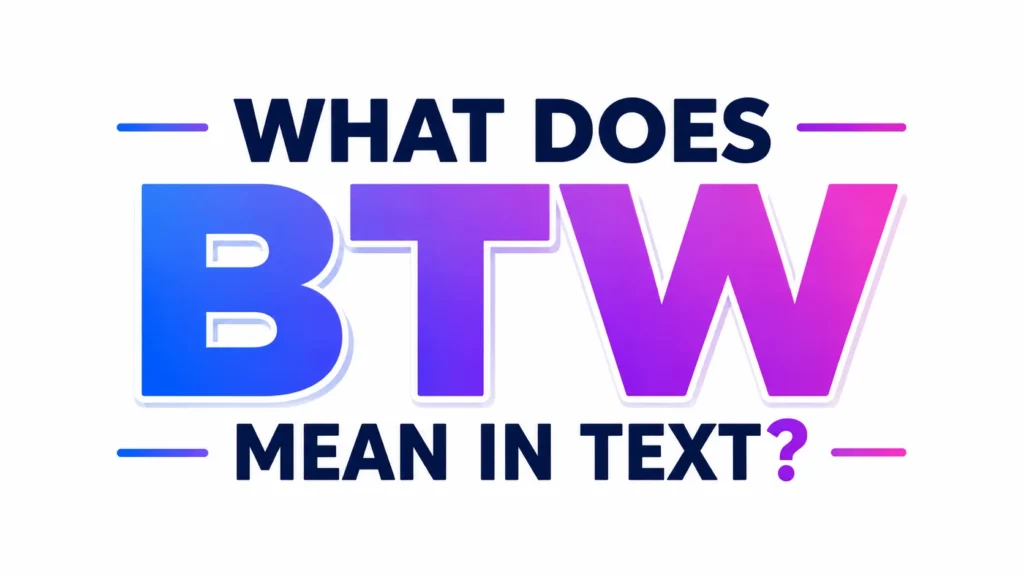
In modern digital conversations, short forms have become a natural part of how people communicate. One of the most commonly used expressions you’ll see in chats, comments, and social media posts is “btw.”
If you’ve ever paused while reading a message and wondered what btw mean in text, you’re not alone. Many people come across it daily but are unsure about its exact purpose or how to respond to it correctly.
“BTW” is simple on the surface, yet it carries subtle social meaning. It helps people shift topics smoothly, add extra thoughts, or casually insert information without sounding formal or heavy.
Understanding it isn’t just about decoding letters—it’s about understanding how modern communication works in fast, emotional, and conversational digital spaces.
What BTW Mean in Text – Quick Meaning
Clear Definition
“BTW” stands for “by the way.” It is used when someone wants to add extra information or shift the topic slightly in a conversation.
It usually appears in informal texting, messaging apps, and social media comments.
Simple Explanation
- Used to add extra thoughts
- Introduces a side comment
- Helps change topic smoothly without sounding abrupt
Common Examples
- “BTW, I saw your post yesterday—it was amazing.”
- “I’m coming late tonight btw.”
- “BTW, did you finish the assignment?”
In all cases, it acts like a conversational bridge between ideas.
Origin & Background
Where It Came From
“By the way” has been part of English language for centuries, used in spoken and written communication. As digital messaging evolved, people naturally shortened it into “BTW” for speed and convenience.
Cultural Influence
The rise of texting culture in the early 2000s (SMS era) pushed users to create abbreviations for common phrases. “BTW” became one of the earliest and most widely accepted shortcuts.
Social Media Impact
Platforms like Facebook, Twitter (now X), Instagram, and TikTok helped standardize it globally. Today, even people who don’t speak English fluently recognize “BTW” as internet vocabulary.
How It Evolved
Originally formal in tone, “by the way” became casual through texting. Now, “BTW” is not just a shortcut—it carries a relaxed, conversational vibe that feels natural in digital interactions.
Real-Life Conversations (MANDATORY)
WhatsApp Conversation
Person A:
“I finished the report early.”
Person B:
“Great job btw, can you send it to me?”
Instagram DM
Person A:
“Loved your new reel!”
Person B:
“Thanks btw I posted another one today.”
TikTok Comments
User 1:
“This recipe is actually so easy!”
User 2:
“btw you can also add garlic for extra flavor.”
Text Message
Person A:
“I’m not coming today.”
Person B:
“Okay, btw are you okay?”
These examples show how naturally “btw” blends into everyday communication without changing the tone of conversation.
Emotional & Psychological Meaning
What Emotion It Expresses
“BTW” often reflects a casual, relaxed, and friendly tone. It softens communication and prevents messages from feeling too direct or abrupt.
Why People Use It
People use “btw” because:
- It makes conversation flow naturally
- It feels less formal than full sentences
- It helps add thoughts quickly without breaking rhythm
What It Reveals About Modern Communication
The use of “btw” shows how digital communication values:
- Speed over structure
- Emotion over grammar perfection
- Flow over formality
Personal-Style Scenario
Imagine a friend texting you after a long day:
“Had a busy day btw I missed your call”
Even though the message is simple, “btw” softens the tone, making it feel more conversational and less rigid.
Usage in Different Contexts
Social Media
Used in captions, comments, or replies:
- Adds extra thoughts
- Engages audience casually
Friends & Relationships
Very common in personal chats:
- “BTW I miss you”
- “BTW let’s meet tomorrow”
It feels natural and emotionally light.
Work / Professional Settings
Used carefully:
- “BTW, please review the updated file”
It works in informal workplace chats but not in formal emails.
Casual vs Serious Tone
- Casual: Frequent and natural
- Serious: Limited usage to avoid sounding unprofessional
When NOT to Use It
In Formal Writing
Avoid using “btw” in:
- Academic essays
- Business reports
- Official emails
In Sensitive Conversations
It can feel too casual in emotional or serious situations:
- Medical updates
- Legal discussions
- Conflict resolution
Cultural Sensitivity
Not all cultures interpret abbreviations the same way. In formal cultures, using “btw” might be seen as careless or disrespectful in professional communication.
Common Misunderstandings
What People Get Wrong
Some think “btw” changes the topic completely. In reality, it only adds side information.
Tone Confusion
Depending on context, “btw” can feel:
- Friendly
- Neutral
- Slightly dismissive (if overused)
Literal vs Figurative Meaning
It does not literally mean “changing subject.” It simply adds extra detail.
Comparison Table
| Term | Meaning | Tone | Usage |
|---|---|---|---|
| BTW | By the way | Casual | Adding extra info |
| FYI | For your information | Neutral/Formal | Sharing important info |
| PS | Postscript | Semi-formal | Added note in writing |
| Anyway | Topic shift | Casual | Moving conversation forward |
| Speaking of which | Connected idea | Natural | Linking related topics |
Key Insight
“BTW” is the most casual and flexible among these expressions, making it ideal for everyday digital conversations where flow matters more than structure.
Variations / Types
1. BTW (All Caps)
Used for emphasis in messages.
2. btw (Lowercase)
Most common casual form.
3. btw…
Adds hesitation or softer tone.
4. oh btw
Used when remembering something suddenly.
5. btw tho
Adds casual emphasis or contrast.
6. btw lol
Adds humor or lightness.
7. BTW:
Often used before introducing new information.
8. btw btw
Used jokingly or for emphasis.
9. by the way
Full formal version of the abbreviation.
10. btw (ending)
Placed at the end of a sentence for casual flow.
How to Respond When Someone Uses It
Casual Replies
- “Oh nice!”
- “Got it 👍”
Funny Replies
- “Oh btw expert spotted 😄”
- “You always have btw energy lol”
Mature Replies
- “Thanks for letting me know.”
- “That’s helpful, appreciate it.”
Respectful Replies
- “Understood, thanks for the update.”
- “Noted, I’ll keep that in mind.”
Regional & Cultural Usage
Western Culture
Very common in everyday texting. Used freely in casual communication.
Asian Culture
Popular among younger generations, especially on social media and messaging apps. Still avoided in formal settings.
Middle Eastern Culture
Used widely in digital communication among youth, but formal writing remains traditional.
Global Internet Usage
“BTW” is universally recognized across platforms like Instagram, TikTok, WhatsApp, and Discord.
Generational Differences
- Gen Z: Uses it frequently and naturally
- Millennials: Comfortable but more selective
- Older generations: May still prefer full phrase “by the way”
Is It Safe for Kids?
Yes, “btw” is completely safe. It is simply a harmless abbreviation with no offensive or inappropriate meaning.
However, children should still learn when to use full language in school or formal communication to maintain writing skills.
FAQs
What does btw mean in text messages?
“BTW” means “by the way,” used to add extra information in a conversation.
Is btw formal or informal?
It is informal and best suited for casual conversations.
Can I use btw in emails?
Yes, but only in informal or internal messages, not formal emails.
Does btw change the topic?
Not fully. It adds extra information or slightly shifts focus.
Is btw rude?
No, it is not rude. Tone depends on context.
What is the full form of btw?
The full form is “by the way.”
Why do people use btw instead of writing full words?
Because it is faster, easier, and fits modern texting habits.
Conclusion
Understanding what btw mean in text helps you navigate modern communication more confidently. It is a small abbreviation, but it plays a big role in making conversations smoother, faster, and more natural.
Whether you see it in a casual chat, social media comment, or friendly message, “btw” is simply a way of adding thoughts without interrupting the flow.
As digital language continues to evolve, expressions like this reflect how people prefer simplicity, speed, and emotional connection in communication.
Using it naturally can make your messages feel more relatable—but knowing when to avoid it shows true communication awareness.