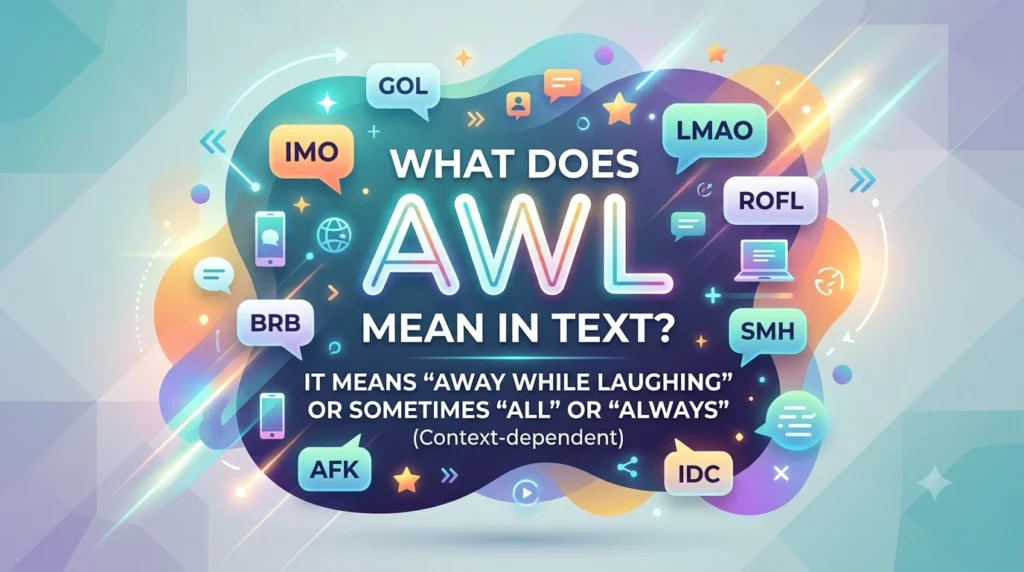
Digital communication moves at a breakneck pace. One day you are mastering standard text abbreviations, and the next day, a new three-letter acronym pops up in your direct messages that leaves you scratching your head. If you have recently stared at your phone wondering what does awl mean in text, you are certainly not alone. Language is evolving rapidly, and keeping up can feel like a full-time job.
Understanding modern text slang is about more than just decoding letters. It is about grasping the subtle emotional undertones that shape our daily digital interactions. When someone drops a specific acronym into your chat, they are signaling a mood, an attitude, or a shared cultural moment. Missing that context can completely change the dynamic of your conversation.
This comprehensive guide will break down the exact meanings of this trending term. We will explore its origins, deep dive into real-life conversational examples, and examine the psychological layers behind its usage. By the end of this article, you will feel completely confident navigating this slang in any digital space.
The Digital Language Shift: Why We Search for Text Meanings
We live in an era where brevity is everything. Screens are small, attention spans are short, and typing out full sentences can sometimes feel incredibly tedious. Because of this, modern shorthand has transformed from a simple time-saving tool into a rich, nuanced dialect used by millions worldwide.
The Complexity of Modern Acronyms
Many people search for these terms because a single acronym can hold multiple definitions depending on who is sending it. Context dictates everything in digital spaces. A phrase used by a teenager on TikTok might mean something entirely different when typed by a colleague in a casual project management channel.
Overcoming Text-Based Misunderstandings
Text messages completely lack vocal tone, facial expressions, and body language. This absence of physical cues makes digital communication a minefield for misunderstandings. Learning the exact definition and emotional weight of trending terms helps close this communication gap, ensuring your replies always hit the right note.
What Does AWL Mean in Text – Quick Meaning
In the vast majority of casual text conversations and social media feeds, AWL is a phonetic acronym that stands for “Always With Love.” It functions as a warm, affectionate sign-off or an expression of unwavering emotional support between close friends, family members, or romantic partners.
Core Definitions at a Glance
- Primary Meaning: Always With Love (Used for affection, support, and deep care).
- Secondary Meaning: Awful (Used as a phonetic shortening in casual, fast-paced typing).
- Alternative Context: Academic Word List (Strictly used in educational or linguistic discussions).
Real-Life Text Examples
“Happy birthday to my favorite human! AWL ❤️”
“Don’t stress about the interview tomorrow, you are going to crush it. AWL!”
“That movie was awl, please do not waste your money on a ticket.”
Origin & Background of the Term
The evolution of text slang is rarely linear. Most acronyms start in niche online communities before exploding into mainstream internet culture, heavily influenced by shifting platform dynamics and generational trends.
Where It Came From
The phrase “Always With Love” has been used as a traditional sign-off in handwritten letters and postcards for decades. However, its transition into the digital acronym format gained traction as messaging platforms implemented character limits. Users naturally sought ways to compress deeply affectionate sentiments into quick, punchy keystrokes.
Cultural Influence and Social Media Impact
Image-heavy and video-centric platforms like Instagram and TikTok have played a massive role in popularizing this term. Influencers and content creators frequently use it in their captions and comment sections to foster a sense of intimate community with their followers. It transforms a standard interaction into something deeply personal.
How the Meaning Evolved
Initially, the acronym was reserved strictly for deeply romantic or familial relationships. Over the last few years, the younger generation has broadened its application. Today, it is commonly used among casual friends as a generalized marker of positive vibes, emotional solidarity, and digital warmth.
Real-Life Conversations
To truly understand how this slang functions in daily life, it helps to see it deployed across different platforms. Here are four realistic scenarios that showcase the term in action.
WhatsApp Group Chat
Person A: I am feeling incredibly overwhelmed with finals week approaching. I don’t think I have enough time to study everything.
Person B: Take a deep breath. You’ve worked so hard all semester. We can set up a study session tonight to help you review. AWL, we got this!
Instagram DM
Person A: Thank you so much for sending those flowers for my graduation! They absolutely brightened up my entire week.
Person B: Of course! I am so incredibly proud of you and everything you have accomplished. AWL ✨
TikTok Comments
Person A: Just posted a raw video talking about my mental health journey this year. It was terrifying to share but so necessary.
Person B: Thank you for being so vulnerable and brave. Sending you the biggest hug. AWL!
SMS Text Message
Person A: Hey, I just landed safely. The flight had some pretty intense turbulence but everything is fine now.
Person B: Oh thank goodness, I was worrying! Get some rest at the hotel and text me tomorrow. AWL.
Emotional & Psychological Meaning
Behind every piece of internet slang lies a distinct psychological driver. Human beings possess an innate desire to connect, and shorthand allows us to communicate complex emotional states instantly.
What Emotion It Expresses
Using this acronym signals a high level of emotional vulnerability and psychological safety. It is a digital reassurance that says, “No matter what is happening in the chaotic digital world, my feelings of care toward you remain completely unchanged.” It injects genuine warmth into cold, digital screens.
Why People Choose Slang Over Full Words
Typing out full sentimental phrases can sometimes feel overly formal or intensely heavy in a casual chat environment. Shortening the phrase softens the delivery. It allows the sender to express deep affection without making the conversation feel overwhelmingly serious or dramatic.
What It Reveals About Modern Communication
Our reliance on these terms shows that modern communication is becoming increasingly efficient yet emotionally expressive. We are adapting our language to maintain deep, meaningful human connections despite the rapid, transactional nature of modern digital tools.
A Personal Scenario
Imagine receiving a text from a childhood friend right before you walk onto a stage to give a presentation. A message reading “Good luck, AWL” takes less than two seconds to read, yet it instantly floods you with a sense of comfort, familiarity, and support when you need it most.
Usage in Different Contexts
Navigating when to use specific slang requires an understanding of social boundaries. A phrase that builds a bond in one environment might create confusion or awkwardness in another.
Social Media Spaces
On platforms like TikTok, Instagram, and X, this term is highly effective for building community. It can be dropped into comment sections, added to public bios, or used in captions to express gratitude to an audience, creating an approachable and compassionate online persona.
Friends & Relationships
This is the absolute sweet spot for the acronym. It serves as an excellent way to wrap up a late-night conversation, check in on a partner during a busy workday, or offer quick comfort to a friend who is navigating a difficult life transition.
Work and Professional Settings
Avoid using this term in professional environments. Sending this acronym to a supervisor, client, or corporate colleague on Slack or email is highly inappropriate. In a professional context, it can easily be misinterpreted as overly intimate or completely unprofessional, disrupting workplace boundaries.
Casual vs. Serious Tone
The term adapts beautifully to different emotional registers. In casual settings, it acts as a lighthearted, friendly sign-off. In serious contexts—such as offering condolences or supporting someone through grief—it transforms into a powerful, quiet anchor of emotional solidarity.
When NOT to Use It
While digital slang is incredibly versatile, using it in the wrong scenario can lead to social friction, deep misunderstandings, or awkward interactions.
Inappropriate Contexts
Never use this acronym during formal business negotiations, legal correspondence, or academic writing. Additionally, avoid using it with acquaintances you barely know, as the sudden intimacy of the phrase can feel jarring or entirely unearned to the recipient.
Cultural Sensitivity
Internet slang spreads globally, but its interpretation varies wildly depending on cultural backgrounds. Someone unfamiliar with Western text trends might view the acronym as confusing gibberish, completely missing the supportive sentiment you intended to send.
Situations Causing Misunderstanding
If you are using the acronym as a phonetic shortcut for “awful,” ensure the surrounding context makes that entirely clear. Telling a friend “That restaurant was awl” could deeply confuse them if they read it as “That restaurant was always with love.”
Common Misunderstandings
Miscommunications are bound to happen when dealing with three-letter text abbreviations. Let’s clear up the most frequent errors people make with this specific slang.
The Tone Confusion
The biggest issue arises when the receiver interprets the acronym as a lazy brush-off rather than an affectionate sign-off. Because abbreviations shorten text, an untrained reader might think the sender is trying to end the conversation as quickly as possible.
Literal vs. Figurative Meanings
Some users might interpret the acronym literally as a tool—an awl used for piercing holes in leather or wood. While this seems unlikely in a text message, context-free reading can cause older generations or non-native English speakers to take the term literally.
Mixing Up Meanings
[Contextual Misinterpretation]
"The service was awl" -> Sent as "awful" -> Received as "always with love" -> Total Confusion
Comparison Table
To help you perfectly contextualize this term within the broader ecosystem of internet slang, let’s compare it directly to other common expressions.
| Acronym / Slang | Full Meaning | Emotional Tone | Best Context |
| AWL | Always With Love | Warm, supportive, affectionate | Close friends and family |
| LYSM | Love You So Much | High energy, enthusiastic | Best friends, romantic partners |
| ILY | I Love You | Direct, deeply affectionate | Established relationships |
| BRB | Be Right Back | Completely neutral, functional | Quick logistical updates |
| NGL | Not Gonna Lie | Honest, slightly vulnerable | Sharing opinions or confessions |
Key Insight
Choosing the Right Acronym
Select your text abbreviations based entirely on the specific depth of your relationship. While terms like ILY are direct and powerful, AWL offers a softer, highly supportive alternative that perfectly balances affection with a relaxed digital tone.
Variations and Types
Depending on the corner of the internet you find yourself in, this acronym can take on a few distinct variations and secondary meanings.
Always With Love
The primary, most popular iteration used across texting apps to show affection.
Awful (Phonetic)
A lazy typing variation where the letters mirror the spoken sound of something being terrible.
Academic Word List
A specialized educational index used by English language teachers and students worldwide.
Always Walking Lonely
A rare, moody variation used in online subcultures to express feelings of isolation.
As Whole Life
A poetic variation occasionally used in romantic contexts to imply complete devotion.
All Whole Lot
A regional dialect shortcut used to describe a massive quantity of something.
Awesome With Luck
A niche gaming variation used to congratulate a teammate on a lucky, successful play.
Always Within Limits
A technical or boundary-setting phrase used to describe keeping situations under control.
How to Respond When Someone Uses It
Your response strategy depends heavily on how the term was used and what kind of relationship you share with the person who sent it.
Casual Responses
- “Thanks so much, talk to you tomorrow!”
- “You are the absolute best, appreciate you!”
- “Same to you! Have an amazing night.”
Funny Responses
- “Always with love? Wow, I didn’t know you cared about me that much! 😉”
- “Right back at you! Don’t get too sentimental on me now.”
- “AWL received and safely stored in my digital heart.”
Mature Responses
- “Thank you for the kind words, your support genuinely means the world to me right now.”
- “I really value our friendship. Thank you for always being in my corner.”
- “Your message came at the perfect time. Thank you for looking out for me.”
Respectful Responses
- “Thank you so much, I am wishing you the exact same warmth and success.”
- “I truly appreciate your kind thoughts. Sending my best to your family.”
- “Thank you for your continuous kindness and encouraging words.”
Regional & Cultural Usage
The internet might feel like a single global village, but geography and demographics still play an incredibly massive role in how slang is adopted and used.
Western Culture
In the United States, Canada, and the United Kingdom, the term is heavily utilized by younger demographics on visual social media platforms. It is deeply associated with wellness culture, positive mental health advocacy, and casual digital affection.
Asian and Middle Eastern Cultures
In regions where English is a secondary language, this specific acronym is significantly less common. Users in these cultures often prefer using universal emojis—like hearts, stars, or prayer hands—to communicate warmth, avoiding potential alphabet-based confusion entirely.
Global Internet Usage
Within massive,borderless online communities like gaming servers or global fanbases, slang acts as a universal bridge. In these spaces, acronyms are adopted rapidly, cutting through language barriers to create an instant sense of belonging.
Generational Differences
Gen Z vs. Millennials
Gen Z treats terms like this with an effortless, casual fluidity, often dropping them into conversations with acquaintances. Millennials, conversely, tend to reserve highly affectionate acronyms strictly for established, deeply personal relationships.
Is It Safe for Kids?
Parents often worry about the hidden meanings behind the text slang their children use online. Fortunately, this specific acronym is completely safe.
A Safe Digital Environment
The primary definitions—”Always With Love” and “Awful”—carry absolutely no malicious intent, hidden predatory meanings, or explicit undertones. It is a completely harmless piece of internet vocabulary used to share basic human emotions.
Encouraging Open Dialogue
The best way to monitor your child’s digital world is through open, curiosity-driven conversations. Instead of worrying about acronyms, ask them casually what new phrases mean. This builds trust and keeps you connected to their evolving communication styles.
FAQs
What does AWL mean from a guy?
When a guy sends this acronym, it usually indicates a strong desire to show genuine emotional support, affection, and comfort without making the text conversation feel overly heavy or formal.
Is AWL an insult?
No, it is almost never used as an insult. The only exception is if it is being used as a phonetic shortcut for “awful” to describe a bad situation, movie, or meal.
Can I use AWL in a work email?
You should absolutely avoid using this acronym in professional emails. It introduces an inappropriate level of intimacy and casualness that can easily compromise your professional boundaries.
How do you pronounce AWL in conversation?
In the rare instances someone speaks it aloud rather than typing it, it is pronounced phonetically to sound exactly like the word “owl” or the traditional tool “awl.”
What is the difference between AWL and ILY?
ILY stands directly for “I love you,” which carries intense romantic or familial weight. AWL stands for “Always with love,” offering a softer, highly supportive tone perfect for close friendships.
Conclusion
Language is a living, breathing reflection of our shared human experience. As our world continues to shift toward digital-first interactions, the way we express deep affection, solidarity, and care will inevitably continue to transform.
Learning what terms mean allows you to navigate the digital landscape with complete confidence. It helps you avoid awkward communication breakdowns while empowering you to build deeper, more authentic connections with the people who matter most to you.
The next time someone drops this acronym into your messages, you won’t have to guess their intent. You will recognize it instantly for what it is: a genuine, human moment of warmth sent across the digital divide.