If you’ve spent any time texting, chatting on social media, or scrolling through online conversations, you’ve probably come across the abbreviation HBU. It’s one of those short internet expressions that appears everywhere, yet many people still pause for a moment and wonder what it actually means.
The popularity of texting shortcuts has transformed the way people communicate. Instead of typing long sentences, users often prefer quick abbreviations that keep conversations flowing naturally. HBU is one of those everyday terms that helps people engage, show interest, and keep discussions going.
Many people search for “what does HBU mean” because they receive it in a message and aren’t sure how to respond. Others want to understand modern texting culture so they can communicate more confidently online.
The good news is that HBU is simple, friendly, and easy to use once you know what it means.
What Does HBU Mean? – Quick Meaning
Definition of HBU
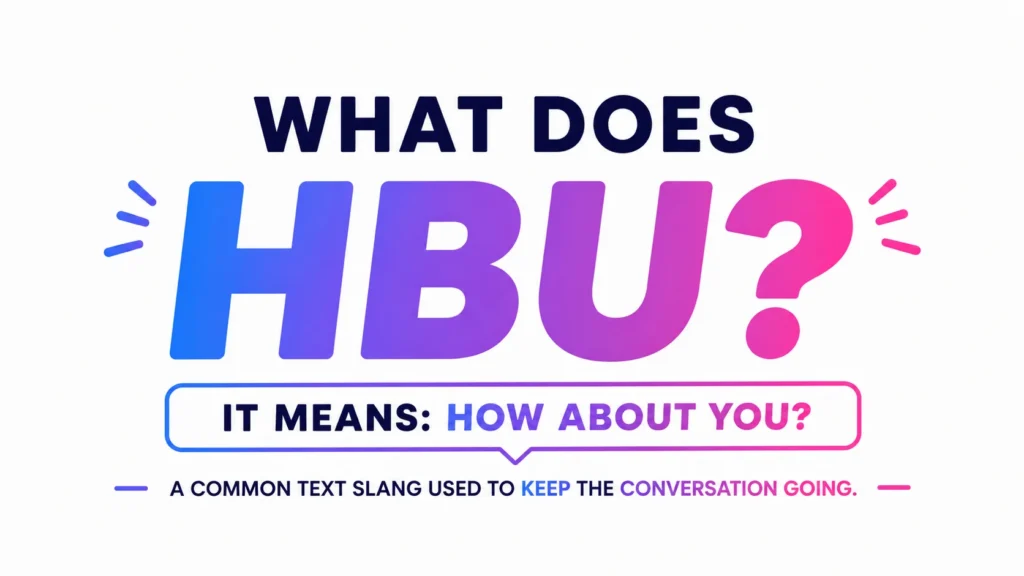
HBU stands for “How About You?”
It is commonly used in text messages, social media chats, online gaming conversations, and direct messages.
People use it after sharing information about themselves and then turning the conversation back to the other person.
Quick Breakdown
- H = How
- B = About
- U = You
The abbreviation helps save time while maintaining a friendly tone.
Examples
“I’m doing pretty well today. HBU?”
“I love traveling during summer. HBU?”
“My weekend was amazing. HBU?”
In each example, the speaker shares something and then invites the other person to participate in the conversation.
Origin & Background
Where Did HBU Come From?
HBU emerged during the early days of internet messaging and mobile texting. As character limits and slower typing methods encouraged shorter communication, people began creating abbreviations for common phrases.
Just as “LOL” became shorthand for laughter and “BRB” meant stepping away briefly, HBU became a convenient way to ask someone about themselves.
Influence of Text Messaging
The rise of SMS messaging played a major role in the popularity of HBU.
Back when text messages had character limits, users looked for ways to communicate efficiently. Short forms became part of digital culture, and many remain popular today.
Social Media Growth
Platforms such as:
- Snapchat
- TikTok
- Facebook Messenger
- Discord
helped spread HBU to millions of users worldwide.
How the Meaning Evolved
Interestingly, the meaning of HBU has remained remarkably consistent over time.
Unlike some internet slang terms that develop multiple interpretations, HBU has continued to mean “How About You?” across generations and platforms.
Real-Life Conversations
WhatsApp Conversation
Person A:
“Just finished my exams and finally feel relaxed.”
Person B:
“That’s awesome! HBU, what are your plans now?”
Person A:
“Probably taking a short vacation.”
Instagram DM Conversation
Person A:
“Your travel photos look amazing.”
Person B:
“Thank you! I had a great time. HBU, have you traveled anywhere recently?”
Person A:
“Not yet, but I’m planning something soon.”
TikTok Comments
Person A:
“This song has been stuck in my head all week.”
Person B:
“Same here! HBU, what’s your favorite part?”
Person A:
“The chorus for sure.”
Text Message Conversation
Person A:
“Had a long day at work.”
Person B:
“Sorry to hear that. I’m relaxing at home. HBU?”
Person A:
“I’m watching a movie and trying to unwind.”
Emotional & Psychological Meaning
More Than a Question
At first glance, HBU seems like a simple question.
However, psychologically, it serves a deeper purpose. It signals interest in another person and encourages balanced communication.
Why People Use It
People naturally enjoy conversations where they feel heard.
When someone says HBU, they’re showing that they want your opinion, feelings, or experience.
Creating Connection
Digital conversations can sometimes feel one-sided.
Using HBU helps create reciprocity by inviting participation.
What It Reveals About Modern Communication
Modern communication values speed, but people still crave connection.
HBU is a perfect example of how a short phrase can communicate curiosity, friendliness, and engagement.
Personal-Style Scenario
Imagine chatting with a friend after a stressful week.
You tell them you’re finally feeling better.
Instead of changing the subject, they respond:
“I’m glad to hear that. HBU, how are things going now?”
That simple question shows they genuinely care, even in a brief text exchange.
Usage in Different Contexts
Social Media
On social platforms, HBU keeps conversations interactive.
Examples:
- “I loved this movie. HBU?”
- “I’m excited for summer. HBU?”
Friends and Relationships
Friends frequently use HBU to keep discussions flowing.
It helps both people share experiences equally.
Examples:
- “I had a great day. HBU?”
- “I’m feeling tired today. HBU?”
Work and Professional Settings
While HBU can appear in casual workplace chats, it is generally less common in formal communication.
Casual:
“I’m working remotely today. HBU?”
Formal:
“How about you?” is usually preferred.
Casual vs Serious Tone
Casual conversations welcome HBU.
Serious discussions often benefit from using the full phrase for clarity and professionalism.
When NOT to Use It
Formal Business Emails
Avoid HBU in:
- Client communications
- Job applications
- Academic writing
- Official reports
Writing out “How about you?” appears more professional.
Sensitive Conversations
In emotional situations, abbreviations may feel too casual.
For example:
Instead of:
“HBU?”
Consider:
“How are you feeling about everything?”
Cross-Cultural Situations
Not everyone understands internet abbreviations.
Using the full phrase can prevent confusion when speaking with people unfamiliar with texting slang.
Situations Requiring Clarity
Formal environments usually benefit from complete sentences rather than shorthand expressions.
Common Misunderstandings
Assuming It Has Multiple Meanings
One common misconception is that HBU has several definitions.
In reality, it almost always means “How About You?”
Confusing It With Other Abbreviations
Some users mistake HBU for:
- HBD (Happy Birthday)
- HBY (How About You)
- HYU (Hit You Up)
Each abbreviation serves a different purpose.
Tone Confusion
Sometimes readers assume HBU sounds cold because it’s abbreviated.
Usually, the opposite is true. It often reflects friendliness and interest.
Literal vs Contextual Meaning
Literally, HBU asks for your opinion or situation.
Contextually, it also signals a desire to continue the conversation.
Comparison Table
| Expression | Meaning | Usage |
|---|---|---|
| HBU | How About You? | Asking for someone’s response |
| HBY | How About You? | Alternative spelling |
| WBU | What About You? | Similar conversational question |
| WYD | What Are You Doing? | Asking about activities |
| IDC | I Don’t Care | Opposite engagement style |
| LMK | Let Me Know | Requesting information |
| BTW | By The Way | Changing topics |
| IDK | I Don’t Know | Expressing uncertainty |
Key Insight
HBU stands out because it encourages two-way communication. Rather than focusing solely on the speaker, it invites the other person into the conversation.
Variations / Types
HBY
Meaning: How About You?
A common alternative spelling.
WBU
Meaning: What About You?
Very similar but slightly more direct.
HBU?
Meaning: How About You?
Question mark adds emphasis.
Hbuuu
Meaning: How About You?
Extra letters create a friendlier tone.
HBU LOL
Meaning: How About You?
Combined with humor.
HBU Though
Meaning: What’s your opinion?
Often used in discussions.
HBU Friend
Meaning: How About You?
More personal and warm.
HBU RN
Meaning: How About You Right Now?
Focuses on the present moment.
HBU Bro
Meaning: How About You?
Casual and conversational.
HBU Bestie
Meaning: How About You?
Popular among close friends.
How to Respond When Someone Uses It
Casual Replies
- “I’m doing great.”
- “Pretty good today.”
- “Just relaxing.”
Funny Replies
- “Running on coffee and hope.”
- “Still surviving somehow.”
- “Trying not to nap at work.”
Mature Replies
- “Things have been busy, but productive.”
- “I’ve been focusing on personal goals lately.”
Respectful Replies
- “Thank you for asking. I’m doing well.”
- “I appreciate that. Things are going smoothly.”
Regional & Cultural Usage
Western Culture
In North America and Europe, HBU is commonly understood among social media users and frequent texters.
Asian Culture
Many young internet users in Asia use HBU, particularly when communicating in English online.
Middle Eastern Culture
The abbreviation appears frequently among bilingual users who combine English internet slang with local languages.
Global Internet Usage
Because English dominates much online communication, HBU has become widely recognized internationally.
Generational Differences
Gen Z
Gen Z uses HBU naturally and often combines it with emojis, memes, and other abbreviations.
Millennials
Millennials also understand HBU but may switch between abbreviations and full phrases depending on context.
Older generations may recognize the phrase less frequently.
Is It Safe for Kids?
Understanding the Context
Yes, HBU is generally safe for kids.
It contains no offensive meaning and is simply a shortened version of “How About You?”
Parents should still encourage children to understand context and audience when using internet slang.
Learning when to use abbreviations and when to communicate formally is an important digital communication skill.
FAQs
What does HBU mean in texting?
HBU stands for “How About You?” and is used to ask someone about their thoughts, feelings, or situation.
What does HBU mean on Snapchat?
On Snapchat, HBU usually means “How About You?” and helps keep conversations going.
Is HBU rude?
No. HBU is generally considered polite and friendly when used appropriately.
Is HBU the same as WBU?
They are very similar. HBU means “How About You?” while WBU means “What About You?”
Can I use HBU in professional emails?
It’s better to use the full phrase “How about you?” in professional communication.
Why do people use HBU?
People use it to save time, keep conversations flowing, and show interest in the other person.
Is HBU still popular?
Yes. HBU remains one of the most commonly used texting abbreviations across many social platforms.
Conclusion
Understanding what HBU means can make online conversations feel much less confusing. While it may look like just three letters, it plays an important role in modern communication by encouraging interaction and showing interest in others.
Whether you’re chatting on WhatsApp, messaging friends on Instagram, commenting on TikTok, or sending a simple text message, HBU helps create balanced and engaging conversations. It reflects one of the most valuable aspects of communication: genuine curiosity about another person’s thoughts and experiences.
Now that you know what HBU means, you can recognize it instantly, respond naturally, and use it confidently whenever a conversation calls for it.