If you’ve ever opened a message, visited a website, or read a social media post and noticed the strange symbol “�”, you’re not alone.
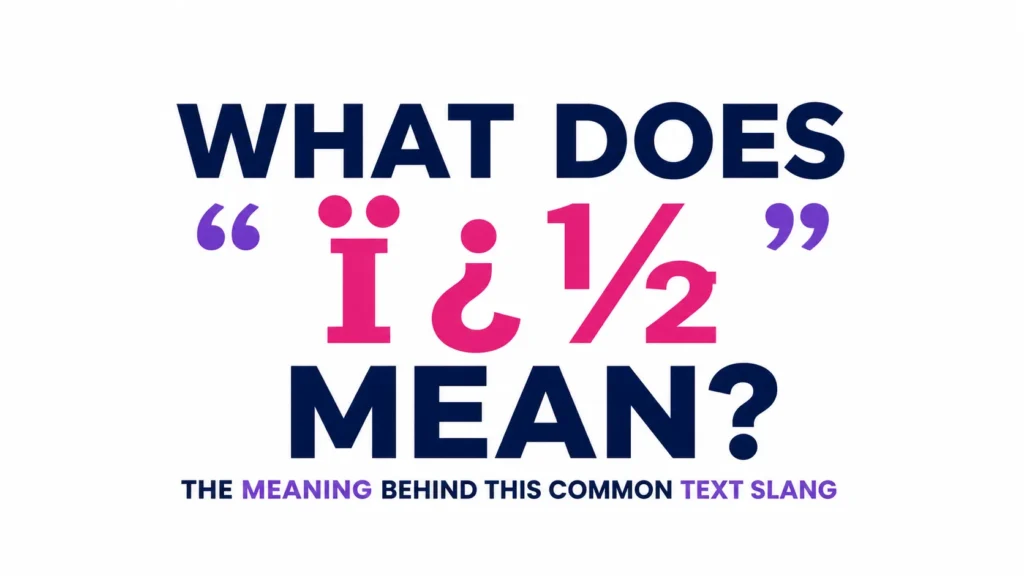
Many people search for “what does � mean” after encountering it in text messages, emails, online articles, or copied content. At first glance, it looks like a random character or perhaps a secret code. In reality, it usually appears because something went wrong when text was displayed.
The confusion comes from the fact that it often shows up unexpectedly. One moment you’re reading a normal sentence, and the next you see a strange symbol replacing a letter, emoji, or special character.
Understanding what this symbol means can help you avoid misunderstandings, troubleshoot text display issues, and better understand how digital communication works behind the scenes.
What Does � Mean? – Quick Meaning
Simple Definition
The symbol “�” is usually not an intentional message or slang term.
Instead, it often appears when a computer, website, app, or device cannot correctly display a character because of an encoding problem.
In simple terms:
- It indicates corrupted or misinterpreted text.
- It often replaces special characters.
- It can appear in emails, websites, PDFs, and messages.
- It is generally a technical display issue rather than a hidden meaning.
Quick Examples
“I love this caf�.”
“Your payment was received � thank you.”
“Happy Birthday � hope you have a great day.”
In these examples, the symbol appeared where another character was supposed to be displayed.
Origin & Background
Where Did It Come From?
The symbol is connected to text encoding systems.
Every letter, number, emoji, and punctuation mark on a computer is stored as digital data. Different systems use different encoding standards to interpret that data.
When one system saves text using one encoding format and another system reads it using a different format, strange characters can appear.
That mismatch often creates symbols like “�”.
The Role of Character Encoding
Before modern Unicode standards became widespread, many countries used different encoding systems.
As the internet expanded globally, compatibility problems became more common.
A character that displayed correctly on one device could appear as nonsense on another.
Social Media Influence
Social media accelerated international communication.
People now use:
- Emojis
- Accented letters
- Multiple languages
- Special symbols
As a result, encoding issues occasionally become visible when content is copied, imported, or shared between platforms.
How Its Meaning Evolved
Years ago, most people assumed the symbol represented an error.
Today, internet users often recognize it immediately as a sign that something went wrong with text formatting.
For some tech-savvy users, seeing it instantly signals an encoding problem.
Real-Life Conversations
WhatsApp Conversation
Person A:
“Did you enjoy the caf� yesterday?”
Person B:
“Why is there a weird symbol in your message?”
Person A:
“I think my keyboard messed up the text.”
Instagram DM
Person A:
“Your caption says � instead of an emoji.”
Person B:
“Seriously? It looked normal when I posted it.”
Person A:
“Instagram probably had a formatting issue.”
TikTok Comments
Person A:
“What does � mean?”
Person B:
“It doesn’t actually mean anything.”
Person A:
“Oh, I thought it was a new trend.”
Text Message
Person A:
“Happy Birthday � wishing you the best!”
Person B:
“What does that symbol mean?”
Person A:
“It was supposed to be a heart emoji.”
Emotional & Psychological Meaning
What Emotion Does It Express?
Technically, it doesn’t express an emotion at all.
However, people often assign emotional meaning when they encounter unfamiliar symbols.
A strange character can create:
- Confusion
- Curiosity
- Frustration
- Concern
Why People Notice It So Quickly
Humans naturally look for patterns.
When a symbol appears unexpectedly, the brain tries to interpret it as meaningful communication.
That is why many users immediately search online for an explanation.
What It Reveals About Modern Communication
Digital communication depends heavily on technology.
A tiny technical error can completely change how a message appears.
This reminds us that communication is not just about words. It’s also about the systems that deliver those words.
Personal-Style Scenario
Imagine receiving a heartfelt message from a friend overseas.
Instead of seeing a heart emoji, you see “�”.
You immediately wonder whether the message was incomplete or corrupted.
Even a small symbol can change how a message feels emotionally.
Usage in Different Contexts
Social Media
On social platforms, the symbol often appears when emojis or special characters fail to load correctly.
Users may mistake it for a trend or secret code.
Friends and Relationships
In personal chats, it usually causes confusion.
Someone may think a message contains hidden meaning when it actually contains a formatting error.
Work and Professional Settings
In business communication, these symbols can make documents appear unprofessional.
Companies often check encoding settings carefully to prevent display issues.
Casual vs Serious Tone
In casual conversations, people usually laugh about it.
In professional environments, it may signal a technical problem that needs correction.
When NOT to Use It
It Is Not Real Slang
Do not intentionally use “�” expecting others to understand a specific meaning.
Most people interpret it as a technical error.
Professional Documents
Avoid submitting documents containing unexpected symbols.
Always proofread before sending important content.
International Communication
Encoding issues become more likely when multiple languages are involved.
Double-check formatting before sharing content globally.
Situations That May Cause Misunderstanding
- Legal documents
- Business contracts
- Academic papers
- Customer communications
In these cases, clarity matters.
Common Misunderstandings
People Think It Is a Secret Symbol
Many users assume it belongs to internet slang.
In reality, it usually does not carry intentional meaning.
It Is Not an Emoji
Although it sometimes replaces emojis, it is not an emoji itself.
It Is Not a Foreign Language Character
Some people believe it belongs to another alphabet.
Most of the time, it simply reflects a display error.
Literal vs Figurative Meaning
Literally, it signals a character encoding issue.
Figuratively, many internet users view it as evidence that technology occasionally gets confused.
Comparison Table
| Expression | Meaning | Usage |
|---|---|---|
| � | Encoding/display error | Technical issue |
| ? | Question mark | Asking questions |
| � | Replacement character | Character decoding failure |
| 🙂 | Happy emoji | Positive emotion |
| ??? | Confusion | Uncertainty |
| LOL | Laughing out loud | Humor |
| BRB | Be right back | Temporary absence |
| IDK | I don’t know | Uncertainty |
Key Insight
The biggest misconception is assuming that “�” is internet slang. Unlike common abbreviations or emojis, it usually represents a technical display problem rather than intentional communication.
Variations / Types
�
Most commonly seen corrupted character sequence.
�
Replacement character indicating decoding failure.
’
Usually appears instead of an apostrophe.
“
Often replaces opening quotation marks.
â€
Often appears when quotation marks fail to display correctly.
é
Typically replaces the accented letter é.
ñ
Usually appears instead of ñ.
—
Can replace an em dash.
•
Often appears instead of bullet points.
Ã
A partial encoding error that commonly appears in copied text.
How to Respond When Someone Uses It
Casual Replies
- “Looks like a formatting issue.”
- “Your text seems broken.”
- “I think a character didn’t load.”
Funny Replies
- “The internet translated your message into alien language.”
- “Your keyboard is speaking in riddles.”
Mature Replies
- “You may want to resend that message.”
- “There seems to be an encoding problem.”
Respectful Replies
- “I noticed a display error in your message.”
- “Could you send that again so I can read it properly?”
Regional & Cultural Usage
Western Culture
Most users recognize it as a technical error.
Asian Culture
It may appear when characters from local languages fail to display properly.
Middle Eastern Culture
Encoding mismatches sometimes occur when Arabic text is transferred between systems.
Global Internet Usage
The symbol is recognized worldwide as a display problem rather than a meaningful phrase.
Generational Differences
Gen Z
More likely to recognize strange symbols from social media experiences.
Millennials
Often associate the symbol with early internet formatting problems.
Is It Safe for Kids?
Understanding the Context
Yes, the symbol itself is safe.
It is not offensive, harmful, or inappropriate.
Children who encounter it can simply be told that it usually appears because a device or website could not display a character correctly.
The main lesson is digital literacy rather than online safety concerns.
FAQs
What does � mean in a text message?
It usually indicates that a character was not displayed correctly because of an encoding issue.
Is � an emoji?
No. It is generally the result of a technical formatting problem.
Why do I see � on websites?
The website and your device may be interpreting text differently.
Is � a secret internet code?
No. It is usually not intended as communication.
Can I remove � from my documents?
Yes. Reformatting text or correcting encoding settings often fixes the issue.
Does � mean someone blocked me?
No. It has no relationship to social media blocks or account restrictions.
Why does � replace emojis?
Sometimes an emoji fails to load correctly and the system displays a replacement symbol instead.
Conclusion
The mystery behind “what does � mean” is far less dramatic than many people expect. Although it may look like a hidden code, secret symbol, or new internet trend, it usually points to a simple encoding or formatting issue.
Even so, its appearance highlights something fascinating about modern communication. Every text, emoji, and symbol depends on complex systems working together perfectly. When those systems disagree, strange characters can appear.
The next time you see “�”, you can confidently recognize it as a display problem rather than a mysterious message. Understanding that distinction makes digital communication a little less confusing and a lot more manageable.