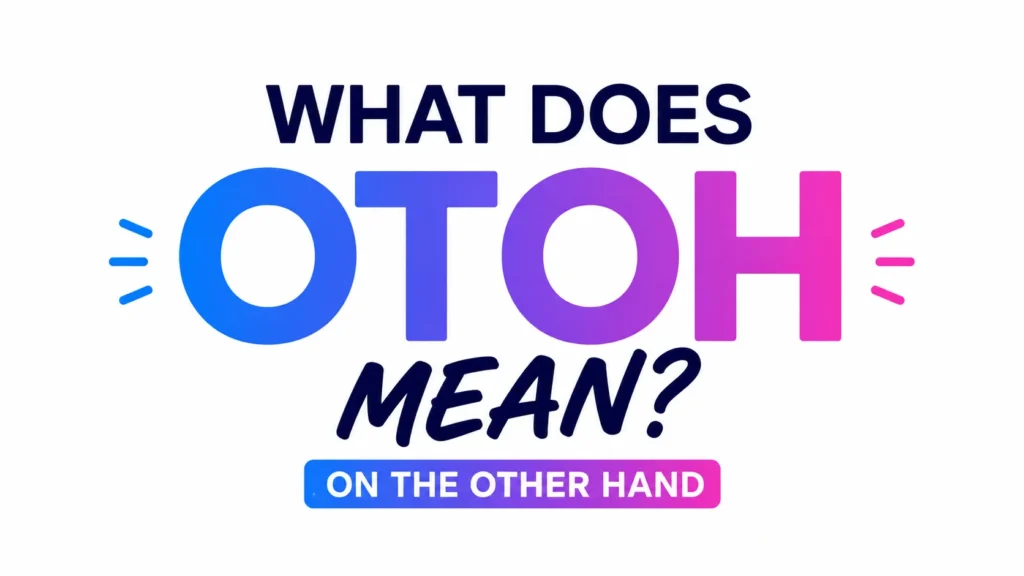
If you’ve spent any time reading text messages, browsing social media, or scrolling through online forums, you’ve probably come across the abbreviation “OTOH.” At first glance, it can look confusing, especially if you’re unfamiliar with internet shorthand.
Many people search for “what does otoh mean” because they encounter it in conversations and aren’t sure whether it’s slang, an acronym, or something entirely different. Understanding it can help you follow discussions more easily and communicate more naturally online.
The good news is that OTOH is actually simple once you know what it stands for. It’s commonly used when someone wants to present another perspective, compare ideas, or introduce an alternative viewpoint.
In this guide, you’ll learn its meaning, origin, emotional significance, real-life examples, cultural usage, and how to respond when someone uses it.
What Does OTOH Mean? – Quick Meaning
Definition
OTOH stands for:
“On The Other Hand.”
It’s a shorthand expression used when presenting a contrasting idea, alternative opinion, or different perspective.
People typically use it in:
- Text messages
- Social media comments
- Online discussions
- Emails
- Forums and chat rooms
Simple Examples
“I love working from home. OTOH, I miss seeing my coworkers.”
“The movie was long. OTOH, the story was amazing.”
“This phone is expensive. OTOH, it has excellent features.”
In each example, OTOH introduces a different side of the situation.
Quick Summary
- Full form: On The Other Hand
- Purpose: Show contrast or another viewpoint
- Tone: Neutral and conversational
- Common online: Yes
Origin & Background
Where Did OTOH Come From?
OTOH emerged during the early days of internet communication.
Before smartphones and unlimited messaging, people often shortened phrases to save time and typing effort. As online communities grew through forums, chat rooms, and instant messaging platforms, abbreviations became a normal part of digital communication.
Expressions such as LOL, BRB, IMO, and OTOH quickly gained popularity.
Cultural Influence
The phrase “on the other hand” has existed in spoken English for centuries.
However, internet culture transformed it into a compact abbreviation that could fit naturally into fast-paced online conversations.
People wanted ways to communicate efficiently while still expressing nuanced thoughts.
OTOH helped achieve exactly that.
Social Media Impact
Social media accelerated its usage.
Platforms like Twitter, Reddit, Instagram, and Facebook encouraged shorter writing styles. Users began adopting abbreviations to fit character limits and maintain quick interactions.
As a result, OTOH became widely recognized among internet users.
How the Meaning Evolved
Its core meaning hasn’t changed much.
What has evolved is where and how people use it. Today, OTOH appears in everything from casual texting to professional online discussions.
It remains one of the clearest ways to signal a different perspective without sounding argumentative.
Real-Life Conversations
WhatsApp Conversation
Person A:
“I finally got a remote job.”
Person B:
“That’s awesome!”
Person A:
“Yeah, OTOH, I won’t get to meet my coworkers in person.”
Instagram DM
Person A:
“Thinking about moving to another city.”
Person B:
“That sounds exciting.”
Person A:
“OTOH, I’d be leaving my family behind.”
TikTok Comments
Person A:
“This trend is hilarious.”
Person B:
“OTOH, some people might find it offensive.”
Text Message
Person A:
“Should I buy the new laptop?”
Person B:
“It looks great. OTOH, your current one still works fine.”
These examples show how naturally OTOH introduces balance into conversations.
Emotional & Psychological Meaning
What Emotion Does It Express?
OTOH usually reflects:
- Thoughtfulness
- Reflection
- Open-mindedness
- Consideration
- Balance
Unlike many internet abbreviations that express excitement or humor, OTOH often signals deeper thinking.
Why People Use It
Modern communication moves quickly.
People want to share opinions while acknowledging that situations aren’t always black and white.
Using OTOH helps show maturity and fairness.
It communicates:
“I understand there’s another side to this.”
What It Reveals About Modern Communication
Digital conversations can sometimes feel overly simplistic.
OTOH allows people to introduce complexity and nuance.
Instead of arguing, users can recognize multiple viewpoints.
That small abbreviation often makes discussions feel more balanced and respectful.
Personal-Style Scenario
Imagine you’re deciding whether to accept a dream job abroad.
You might tell a friend:
“I’m excited about the opportunity. OTOH, leaving my family will be difficult.”
That single phrase reveals emotional conflict while acknowledging both positives and negatives.
Usage in Different Contexts
Social Media
On social media, OTOH is commonly used in debates, discussions, and opinion posts.
Example:
“Streaming services offer convenience. OTOH, subscription costs add up quickly.”
Friends & Relationships
Friends often use OTOH when discussing personal decisions.
Example:
“I want to go on the trip. OTOH, I should probably save money.”
Work and Professional Settings
In professional communication, spelling out “on the other hand” is usually preferred.
However, OTOH may occasionally appear in internal chats among colleagues.
Example:
“Sales increased this quarter. OTOH, operating costs also rose.”
Casual vs Serious Tone
Casual:
“That restaurant is expensive. OTOH, the food is incredible.”
Serious:
“The policy improves efficiency. OTOH, some employees may struggle with the transition.”
The abbreviation works effectively in both settings when used appropriately.
When NOT to Use It
Formal Academic Writing
Avoid OTOH in essays, research papers, and scholarly documents.
Write the complete phrase instead.
Official Business Documents
Professional reports should generally avoid text abbreviations.
Full wording appears more polished.
Conversations with Unfamiliar Audiences
Some people may not recognize the abbreviation.
Using the complete phrase prevents confusion.
Sensitive Discussions
During emotionally charged conversations, abbreviations can appear dismissive.
Writing out your thoughts fully may feel more respectful.
Common Misunderstandings
Assuming It Means Agreement
OTOH does not mean agreement.
It introduces an alternative perspective.
Thinking It Is Negative
Some people assume OTOH signals criticism.
In reality, it simply presents another side.
Confusing It with Other Acronyms
Because internet slang changes rapidly, users sometimes mistake OTOH for unrelated abbreviations.
The meaning remains straightforward: “On The Other Hand.”
Literal vs Figurative Meaning
The phrase doesn’t refer to an actual hand.
It’s an idiomatic expression used to compare viewpoints.
Comparison Table
| Expression | Meaning | Similarity to OTOH |
|---|---|---|
| OTOH | On The Other Hand | Original term |
| IMO | In My Opinion | Shares personal viewpoint |
| TBH | To Be Honest | Expresses honesty |
| However | Introduces contrast | Very similar |
| Conversely | Opposite perspective | Formal equivalent |
| BTW | By The Way | Topic shift, not contrast |
| Nevertheless | Despite previous point | Related but stronger |
| In Contrast | Comparison phrase | Similar purpose |
Key Insight
OTOH is unique because it balances conversations without sounding overly formal. It helps people acknowledge multiple viewpoints while keeping discussions friendly and conversational.
Variations / Types
OTOH
Standard abbreviation for “On The Other Hand.”
On The Other Hand
The complete version used in formal communication.
However
A direct alternative introducing contrast.
Conversely
A more professional alternative.
That Said
Signals another perspective after making a point.
Then Again
Introduces reconsideration.
In Contrast
Highlights differences between ideas.
Nevertheless
Shows contrast despite previous information.
At The Same Time
Balances multiple viewpoints.
On The Flip Side
A casual expression with a similar meaning.
How to Respond When Someone Uses It
Casual Replies
- “That’s a fair point.”
- “I can see both sides.”
- “Good observation.”
Funny Replies
- “My brain agrees with both arguments.”
- “Now you’ve made the decision harder!”
- “Why must life have two sides?”
Mature Replies
- “I appreciate that perspective.”
- “That’s worth considering.”
- “You make a valid point.”
Respectful Replies
- “Thank you for sharing another viewpoint.”
- “I hadn’t thought about it that way.”
- “That’s a helpful perspective.”
Regional & Cultural Usage
Western Culture
OTOH is widely recognized among internet users and professionals familiar with online communication.
Asian Culture
Usage varies depending on English proficiency and exposure to global internet communities.
Many younger users recognize it.
Middle Eastern Culture
English-speaking online communities increasingly understand OTOH, particularly among younger generations.
Global Internet Usage
The abbreviation has become part of international digital culture.
Many users encounter it through social media and online forums.
Generational Differences
Gen Z
More likely to recognize OTOH instantly due to constant exposure to internet language.
Millennials
Generally familiar with OTOH because it was popular during the growth of instant messaging and forums.
Older generations may be less familiar unless they frequently use online platforms.
Is It Safe for Kids?
Understanding the Context
Yes, OTOH is generally safe for kids.
It contains no offensive language, inappropriate meaning, or harmful implications.
It’s simply a communication shortcut used to introduce another perspective.
Parents and educators can view it as a harmless piece of internet vocabulary that encourages balanced thinking.
FAQs
What does OTOH mean in texting?
OTOH means “On The Other Hand.” It introduces a contrasting idea or alternative viewpoint.
Is OTOH considered slang?
Not exactly. It’s an abbreviation rather than traditional slang.
Can OTOH be used professionally?
It can appear in workplace chats, but writing out the full phrase is usually better in formal communication.
Is OTOH popular on social media?
Yes. It frequently appears in discussions, comments, and opinion-based conversations.
What is the opposite of OTOH?
There is no direct opposite, but phrases like “exactly” or “on the same note” continue the same viewpoint rather than introducing contrast.
Why do people use OTOH instead of writing the full phrase?
It saves time and keeps digital conversations concise.
Is OTOH rude?
No. It is generally neutral and respectful when used appropriately.
Conclusion
Understanding what OTOH means can make online conversations much easier to follow. Although it looks unfamiliar at first, the abbreviation simply stands for “On The Other Hand” and helps introduce another perspective.
Its popularity reflects how modern communication values speed without sacrificing meaning. Whether you’re texting friends, commenting on social media, or participating in online discussions, OTOH can help you express balanced thinking in a concise way.
The next time you see OTOH in a message, you’ll immediately recognize that someone is presenting another side of the story. More importantly, you’ll know exactly how to use it confidently yourself.