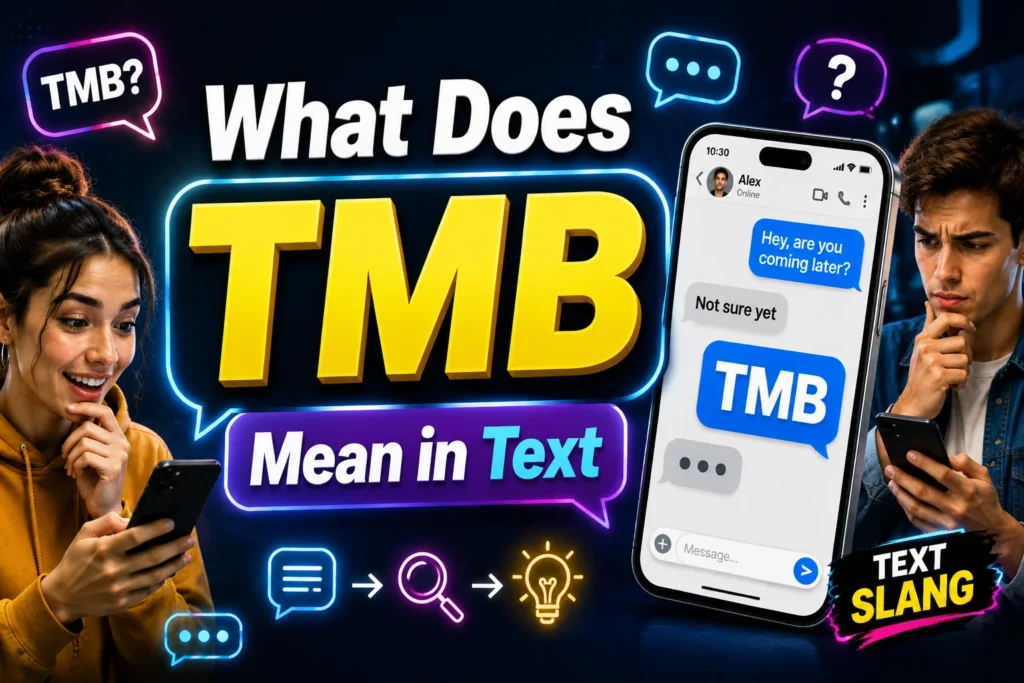
If you have received a message containing “TMB” and wondered what it means, you are not alone. Online conversations are filled with short forms, abbreviations, and slang expressions that can sometimes feel confusing.
The most common meaning of TMB in text is “Text Me Back.” People use it when they want someone to reply to their message later.
For example, if someone writes:
“Busy right now, TMB.”
They are simply saying:
“Text me back when you can.”
Texting language changes quickly because people want faster and easier ways to communicate. Short forms help save time, especially when people are chatting on platforms like WhatsApp, Instagram, Snapchat, TikTok, and other messaging apps.
Many people search for what TMB mean in text because they see it in conversations but are unsure whether it has a hidden meaning, slang meaning, or emotional meaning.
Understanding these abbreviations helps you avoid confusion and communicate more naturally in today’s digital world.
What TMB Mean in Text – Quick Meaning
Clear Definition of TMB
TMB means “Text Me Back” in most texting conversations.
It is an informal abbreviation used when someone wants another person to respond to their message.
The phrase usually shows that:
- Someone wants to continue a conversation
- Someone is waiting for a reply
- Someone wants information or an update
- Someone expects a response later
Unlike formal communication, texting often uses shorter expressions because speed and convenience are important.
Examples of TMB in Text Messages
Example 1:
“Hey, I need your opinion about something. TMB.”
Meaning:
“Hey, I need your opinion. Text me back.”
Example 2:
“I’m going into a meeting. TMB after.”
Meaning:
“I’m busy now. Text me back later.”
Example 3:
“Did you reach home safely? TMB.”
Meaning:
“Let me know by texting me back.”
Why Do People Use TMB?
People use TMB because typing a short abbreviation feels easier and faster.
Instead of writing:
“Please send me a message when you get a chance.”
They can simply write:
“TMB when free.”
It creates a casual and relaxed style of communication.
Origin and Background of TMB
Where Did TMB Come From?
TMB developed from the broader culture of mobile texting.
When text messaging became popular, people started creating shorter versions of common phrases because phones had small keyboards and limited character spaces.
Expressions like:
- LOL (Laugh Out Loud)
- BRB (Be Right Back)
- TTYL (Talk To You Later)
- TMB (Text Me Back)
became part of everyday digital communication.
These abbreviations allowed people to communicate quickly without typing complete sentences.
Cultural Influence on Text Abbreviations
Digital communication has changed how people express themselves.
In traditional writing, complete sentences were considered necessary. In texting culture, shorter expressions became normal.
A message like:
“Hey, TMB ❤️”
can feel warmer and more personal than:
“Please respond to my previous message.”
The shorter version creates a feeling of closeness, especially between friends and family members.
Social Media Impact
Social media platforms increased the popularity of short expressions.
People now communicate through:
- Instagram DMs
- TikTok comments
- Snapchat messages
- WhatsApp chats
- Gaming communities
These platforms encourage quick conversations, making abbreviations easier to spread.
Although TMB is not as famous as LOL or OMG, many people understand it because the meaning is connected directly to texting.
How the Meaning Has Evolved
Originally, texting abbreviations were mainly created for convenience.
Today, they also represent communication style.
A person using TMB may be showing:
- Friendliness
- Interest
- A desire to continue talking
- A casual personality
The meaning is not only about the words. It is also about the relationship between the people using them.
Real-Life Conversations Using TMB
WhatsApp Conversation Example
Person A:
“Hey, are you available tonight?”
Person B:
“Not sure yet. I’m with my family right now.”
Person A:
“No problem, TMB when you know.”
Here, TMB means “Text Me Back” when the person has more information.
The message sounds patient and friendly.
Instagram DM Example
Person A:
“Your photography skills are amazing. Where did you take this picture?”
Person B:
“Thank you! I’ll tell you the location.”
Person A:
“Great, TMB when you remember.”
The person wants a reply but keeps the conversation casual.
TikTok Comment Example
User 1:
“This recipe looks delicious. Can you share the ingredients?”
Creator:
“I’ll post them soon.”
User 1:
“Okay, TMB!”
The commenter is asking the creator to respond with more details.
Text Message Example
Person A:
“I found the documents you were looking for.”
Person B:
“Really? Where were they?”
Person A:
“I’m outside right now. TMB after I get home.”
The abbreviation helps keep the conversation short while promising a future reply.
Emotional and Psychological Meaning of TMB
What Emotion Does TMB Express?
Although TMB is only three letters, it can carry different emotions depending on the situation.
It may express:
- Interest in someone’s response
- Curiosity
- Care and attention
- A wish to stay connected
- A need for information
When a close friend writes “TMB,” it often feels warm.
When someone repeatedly demands a reply, it may feel stressful.
The surrounding words decide the emotional meaning.
Why People Use TMB in Modern Communication
People today manage many conversations at the same time.
Someone may be:
- Studying
- Working
- Traveling
- Watching content online
- Handling personal responsibilities
A short phrase like TMB allows them to communicate quickly without spending extra time typing.
It reflects the fast pace of modern life.
What TMB Reveals About Digital Communication
Modern communication is not only about exchanging information.
It is also about maintaining relationships.
A simple message like:
“Miss talking to you. TMB when free.”
shows that the person values the connection.
The abbreviation becomes a small signal that someone wants the conversation to continue.
Personal-Style Scenario
Imagine messaging an old friend after months of no contact.
You ask:
“Are you free sometime this week? I would love to catch up.”
Your friend replies:
“Definitely. Busy today, but TMB tomorrow.”
The message shows interest and keeps the connection alive.
The short form does not make the conversation less meaningful. The intention behind it creates the emotional value.
Usage of TMB in Different Contexts
TMB on Social Media
On social media, TMB is mostly used casually.
People may use it when they want:
- A reply to a comment
- More information
- A continuation of a conversation
Example:
“Love this outfit! TMB with the brand name.”
The tone is usually friendly.
TMB Between Friends and Relationships
Among friends, couples, and family members, TMB can sound natural.
Examples:
“Call me when you’re free. TMB.”
“I have exciting news. TMB.”
It shows that someone wants attention or conversation.
TMB in Professional Settings
TMB is usually not suitable for formal communication.
In workplaces, emails, or business conversations, clearer phrases are better.
Instead of:
“Please TMB.”
Use:
“Please reply when you have a chance.”
or:
“Could you get back to me when convenient?”
Professional communication should avoid confusion.
Casual vs Serious Tone
The tone depends on how TMB is used.
Casual:
“Hey, TMB when you get time 😊”
Serious:
“Important update. TMB ASAP.”
The same abbreviation can sound friendly or urgent depending on the situation.
When NOT to Use TMB
Although TMB meaning in text is simple and harmless, there are situations where using this abbreviation may not be the best choice.
The right communication style depends on the person, purpose, and environment.
In Formal Communication
Avoid using TMB in professional or official conversations.
Examples where you should not use TMB:
- Job applications
- Emails to employers
- Academic communication
- Customer service messages
- Business discussions
A professional reader may not understand the abbreviation or may consider it too informal.
Instead of:
“Please TMB.”
Write:
“Please reply when you have a chance.”
Clear language creates a stronger impression.
When Talking With Someone New
If you are messaging someone for the first time, avoid assuming they understand texting slang.
A new friend, customer, or online connection may not know what TMB means.
Using complete words helps prevent unnecessary confusion.
During Serious or Emotional Conversations
TMB may feel too short when discussing sensitive topics.
For example:
“I need to discuss something important. TMB.”
This may sound unclear or even careless.
A serious conversation needs more context and emotional understanding.
A better message would be:
“I need to talk about something important. Please reply when you are available.”
Cultural and Language Differences
Not everyone uses internet abbreviations in the same way.
People from different countries, age groups, or communication backgrounds may not recognize TMB.
When communicating across cultures, simple and direct language is often more effective.
Common Misunderstandings About TMB
Thinking TMB Has Only One Meaning
Many people assume every abbreviation has a universal meaning.
However, online language changes depending on:
- Community
- Platform
- Age group
- Conversation topic
In normal texting, TMB usually means “Text Me Back,” but context always matters.
Confusing TMB With Similar Abbreviations
Some people mix up TMB with other common texting shortcuts.
Here is the difference:
- TMB = Text Me Back
- TBH = To Be Honest
- TTYL = Talk To You Later
- BRB = Be Right Back
- BTW = By The Way
Each abbreviation communicates a different idea.
Believing TMB Sounds Rude
Some people think asking someone to text back sounds demanding.
The tone depends on the wording around it.
Friendly:
“Hey, TMB whenever you’re free 😊”
Demanding:
“TMB right now.”
The same abbreviation can create different feelings.
Taking TMB Literally
TMB is not a secret code or hidden internet phrase.
It simply describes an action: sending a text response.
Understanding the situation is more important than focusing only on the abbreviation.
Comparison Table: TMB and Similar Text Expressions
| Expression | Full Meaning | Tone | Common Usage |
|---|---|---|---|
| TMB | Text Me Back | Casual | Asking someone to reply |
| TTYL | Talk To You Later | Friendly | Ending a conversation temporarily |
| BRB | Be Right Back | Casual | Leaving for a short time |
| ASAP | As Soon As Possible | Urgent | Requesting quick action |
| DM Me | Direct Message Me | Informal | Asking for private communication |
| Reply Soon | Respond later | Neutral | General request for response |
| Ignore | No response needed | Casual/Funny | Telling someone not to reply |
| Call Me | Contact me by phone | Direct | Requesting a call |
Key Insight
TMB is different from expressions that end conversations. It shows that someone wants communication to continue and expects a future response. The emotional meaning depends on the relationship and the situation.
Variations and Types of TMB Usage
TMB Later
Meaning: Text me back later.
Used when someone is busy and wants a response at another time.
Example:
“I’m in class. TMB later.”
TMB When Free
Meaning: Reply whenever you have time.
This is a polite and relaxed version.
Example:
“Check this message. TMB when free.”
TMB ASAP
Meaning: Text me back as soon as possible.
This version shows urgency.
Example:
“I need your answer today. TMB ASAP.”
TMB Please
Meaning: A polite request for a reply.
Example:
“Can you confirm the details? TMB please.”
TMB Soon
Meaning: Reply shortly.
Usually used in casual conversations.
Example:
“Let me know what you decide. TMB soon.”
TMB If You Can
Meaning: Reply if it is possible.
This sounds softer and less demanding.
Example:
“Can you help me with this? TMB if you can.”
TMB When You See This
Meaning: Reply after reading the message.
Often used when someone does not expect an immediate answer.
Example:
“TMB when you see this.”
TMB Whenever
Meaning: Respond whenever convenient.
This shows patience.
Example:
“No rush. TMB whenever.”
TMB Me
Meaning: Another way of saying text me back.
This form is less common because the word “me” is already included in the phrase.
TMB ASAP Please
Meaning: A stronger urgent request.
It combines politeness with urgency.
Example:
“Please check the file. TMB ASAP please.”
How to Respond When Someone Uses TMB
Your reply depends on your relationship with the person and the situation.
Casual Replies
For friends and relaxed conversations:
- “Sure, I’ll reply soon.”
- “Got it!”
- “Okay, I’ll text you later.”
- “No worries, talk soon.”
Funny Replies
With close friends, you can use playful responses:
- “My thumbs are preparing a reply 😂”
- “Mission accepted 😄”
- “Reply loading…”
- “Coming back with a legendary answer.”
Mature Replies
For serious conversations:
- “I’ll get back to you when I’m available.”
- “I’ll check and reply shortly.”
- “Thanks for letting me know. I’ll respond soon.”
Respectful Replies
For older people or professional situations:
- “Sure, I’ll respond as soon as possible.”
- “Thank you. I’ll get back to you shortly.”
- “I’ll review it and reply soon.”
Regional and Cultural Usage of TMB
The meaning of TMB in text remains mostly the same worldwide, but the way people use it can change depending on culture, age, and communication habits.
Digital language develops differently in every community. Some people use many abbreviations daily, while others prefer complete sentences.
TMB in Western Culture
In Western countries such as the United States, Canada, the United Kingdom, and Australia, texting abbreviations are widely used in casual conversations.
Young people often use shortcuts when chatting with:
- Friends
- Partners
- Family members
- Online communities
For example:
“Can’t talk now, TMB later.”
A person familiar with texting culture immediately understands that the sender wants a reply later.
In Western digital communication, abbreviations often create a relaxed and friendly tone.
TMB in Asian Culture
In many Asian countries, English-based internet abbreviations are popular among younger generations.
People often mix English shortcuts with their local languages while texting.
A conversation may include:
- Native language words
- English abbreviations
- Social media slang
Younger users who spend time on platforms like Instagram, TikTok, and WhatsApp may understand TMB easily.
Older generations may prefer full sentences because they are less familiar with online slang.
TMB in Middle Eastern Culture
In Middle Eastern online communities, many young users combine English expressions with Arabic, Urdu, Persian, and other languages.
English abbreviations have become common because of global social media influence.
TMB may appear in casual conversations between friends or online contacts.
However, in family, business, or formal conversations, people often choose clearer and more traditional language.
TMB in Global Internet Communication
The internet has created a shared communication style.
Someone from one country can understand a message from another country because common abbreviations spread quickly through:
- Social media
- Online gaming
- Streaming platforms
- Messaging apps
However, not every abbreviation becomes globally popular.
Some expressions become worldwide trends, while others remain limited to certain groups.
TMB is understood by many users, but it is not as universally recognized as LOL, OMG, or BRB.
Generational Differences: Gen Z vs Millennials
Gen Z users often communicate through fast, creative, and constantly changing internet language.
They are more likely to use shortened expressions and adapt new slang quickly.
Millennials also understand texting abbreviations because they experienced the growth of SMS, Facebook, and early social platforms.
Older generations may recognize TMB but use it less frequently.
Communication style depends more on personal habits than age alone.
Is TMB Safe for Kids?
Understanding TMB in Children’s Online Conversations
Yes, TMB is generally safe for kids.
The abbreviation simply means “Text Me Back.” It is not harmful, offensive, or inappropriate by itself.
Children and teenagers may use it while chatting with:
- Friends
- Classmates
- Family members
Why Parents Should Consider Context
Although TMB is harmless, online conversations should always be understood as a whole.
The meaning of any message depends on:
- Who sent it
- Who received it
- What the conversation is about
Parents can help children develop healthy digital habits by encouraging them to:
- Ask about unfamiliar words
- Avoid sharing personal information
- Communicate openly about online experiences
- Be careful with strangers online
The abbreviation itself is not a concern, but responsible online behavior is important.
FAQs About What TMB Mean in Text
What does TMB mean in text messages?
TMB usually means “Text Me Back.” It is used when someone wants another person to reply to their message later.
What does TMB mean on WhatsApp?
On WhatsApp, TMB usually means “Text Me Back.” People use it when they want someone to respond after reading a message.
Is TMB a slang word?
Yes, TMB is considered a casual texting abbreviation rather than a formal word. It is commonly used in online conversations.
Is TMB rude when someone sends it?
No, TMB is not automatically rude. Its tone depends on the surrounding message. “TMB when you can” sounds polite, while “TMB now” sounds more demanding.
What is the difference between TMB and TTYL?
TMB means “Text Me Back,” which asks someone to reply. TTYL means “Talk To You Later,” which usually ends a conversation temporarily.
Can I use TMB in professional communication?
It is better to avoid TMB in professional situations. Formal messages should use complete phrases like “Please reply when convenient.”
Does TMB have other meanings?
In rare cases, TMB may have different meanings in specific communities. In normal texting conversations, “Text Me Back” is the most common meaning.
Conclusion
Understanding what TMB mean in text helps you communicate more confidently in today’s digital world.
The abbreviation usually means “Text Me Back” and is commonly used when someone wants a reply without writing a long sentence.
Although it is only three letters, TMB can express different feelings. Between friends, it can show interest and connection. In serious situations, the surrounding words determine whether it sounds polite, urgent, or impatient.
Texting language continues to evolve as people search for faster and easier ways to communicate. Abbreviations like TMB represent the changing nature of online conversations while keeping human connection at the center.
Using TMB is perfectly fine in casual chats, social media conversations, and friendly messages. The key is knowing your audience and choosing words that make your meaning clear.
Good communication is not only about saying less. It is about making sure the other person understands exactly what you mean.