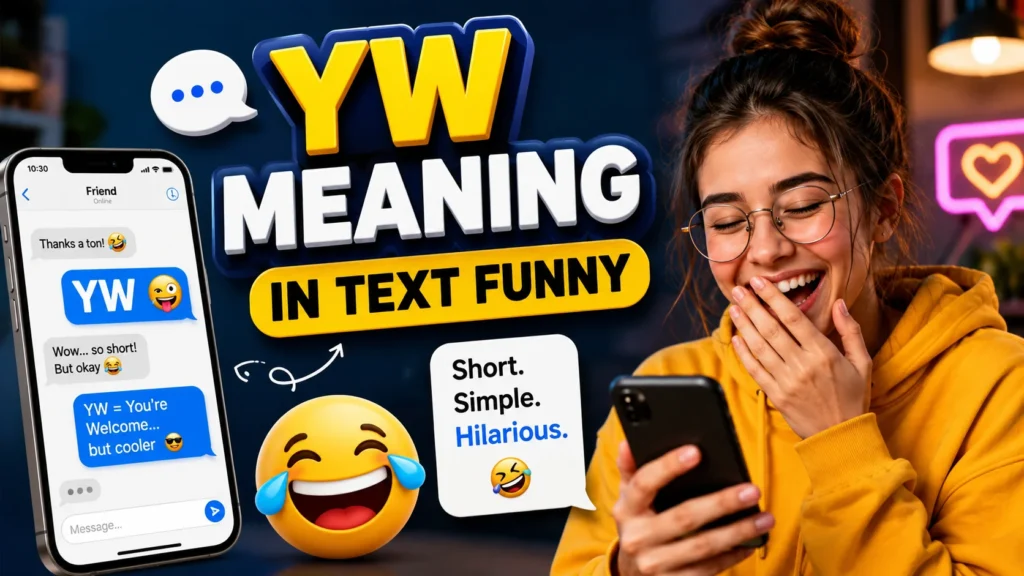
If someone sends you “YW” after you say “thank you,” What does yw meaning in text funny, they’re usually not trying to confuse you. In texting, YW means “you’re welcome.” It’s a quick, casual way to acknowledge someone’s thanks without typing the full phrase.
But here’s where things get interesting: “YW” can sound completely different depending on the conversation. It might feel friendly, funny, dry, sarcastic, or even slightly awkward.
That’s why people often search for “YW meaning in text funny.” They want to know not only what the abbreviation stands for but also how people use it in real conversations.
For example:
You: “Thanks for helping me with my homework!”
Friend: “YW 😂”
That’s simply a casual “you’re welcome.”
In another conversation, however:
You: “Thanks for ruining my surprise 😭”
Friend: “YW 💀”
Now the same two letters can feel playful or sarcastic.
Let’s look at what YW means, why it can be funny, and how to respond naturally.
YW Meaning in Text – Quick Meaning
YW usually means “you’re welcome.”
People use it after someone says:
- “Thanks”
- “Thank you”
- “Tysm”
- “Thanks a lot”
- “I appreciate it”
It’s especially common in texting, social media comments, gaming chats, and direct messages.
Simple Examples
“Thanks for sending me the notes.”
“YW!”
“Tysm for waiting!”
“yw 😂”
“Thanks bro.”
“YW 😎”
The lowercase version “yw” generally feels more relaxed, while “YW” can look slightly more direct.
What Makes YW Funny?
The humor usually comes from context rather than the letters themselves.
Someone might write “YW” after doing something completely ridiculous:
“Thanks for making me laugh during class.”
“YW. I take my job seriously 😂”
Or they might exaggerate the importance of their help:
“Thanks for sending me that meme.”
“YW. I expect an award.”
That playful exaggeration turns an ordinary abbreviation into a joke.
Origin & Background
“YW” comes from the natural shortening of “you’re welcome.”
Texting culture encouraged people to shorten common phrases because quick messages were easier to type. Similar abbreviations include “TY” for “thank you,” “NP” for “no problem,” and “TYSM” for “thank you so much.”
The expression became especially common as texting, instant messaging, online forums, and social media became part of everyday communication.
How Texting Changed the Expression
People rarely need to write complete sentences when chatting with friends.
Instead of:
“You’re welcome. I’m glad I could help you.”
Someone can simply type:
“yw”
The meaning stays clear because the conversation provides the context.
Social Media Influence
On platforms where conversations move quickly, short expressions are convenient.
A creator might reply to a comment with:
“yw 😂”
A friend might respond:
“YW bro”
Someone joking with another person might write:
“YW. I accept payment in snacks.”
The abbreviation itself is simple, but users add humor through emojis, punctuation, exaggeration, and timing.
Real-Life Conversations
WhatsApp Conversation
Person A:
Thanks for sending me the assignment.
Person B:
YW 😂
and,
Person A:
You saved my life.
Person B:
I know. I accept pizza as payment.
Here, “YW” is friendly and casual.
Instagram DM
Person A:
Thanks for recommending that movie!
Person B:
YW 😭
and,
Person A:
I actually loved it.
Person B:
My recommendations never miss.
The humor comes from the confident response that follows “YW.”
TikTok Comments
Person A:
Thanks for explaining this 😂
Person B:
YW 💀
and,
Person A:
Bro really said “my work here is done.”
The abbreviation becomes part of the joke.
Text Messages
Person A:
Thanks for reminding me about the test.
Person B:
YW.
and,
Person A:
Wait… why did you remind me at 11:59 PM?
Person B:
I like keeping things exciting.
Here, “YW” is followed by playful humor.
Emotional & Psychological Meaning
Although YW is only two letters, the tone behind it can tell you something about the relationship between the people chatting.
A simple “yw” can communicate friendliness and familiarity. People often use short forms because they feel comfortable enough not to write formally.
Friendly YW
“yw 😊”
This usually feels warm and polite.
Casual YW
“yw”
This can simply mean “you’re welcome” without adding much emotion.
Funny YW
“YW 😂”
The laughing emoji signals a playful mood.
Sarcastic YW
“YW 💀”
Depending on the conversation, this can mean something like, “Yes, you’re welcome, obviously.”
Tone matters because text doesn’t carry facial expressions or voice.
A Simple Everyday Scenario
Imagine you help a friend find something they lost. They message:
“OMG thanks!!!”
You reply:
“yw 😎”
You aren’t making a serious statement. You’re simply keeping the conversation relaxed.
That tiny abbreviation can make the interaction feel more natural than a formal “You are welcome.”
Usage in Different Contexts
Social Media
“YW” works well in comments and DMs when the conversation is casual.
For example:
“Thanks for sharing this!”
“YW 😂”
It can also work when responding to someone you’ve helped online.
Friends and Relationships
Friends commonly use “yw” because the phrase feels informal and effortless.
You might see:
“Thanks for the notes!”
“yw bro”
Or:
“Thanks for the recommendation.”
“YW 😌”
The surrounding words and emojis establish the tone.
Work and Professional Settings
Be more careful with abbreviations in professional communication.
If a teacher, manager, customer, or colleague says:
“Thank you for your help.”
A complete response such as:
“You’re welcome. Happy to help.”
is usually more appropriate.
“YW” isn’t necessarily rude, but it can look too casual depending on the workplace.
Casual vs. Serious Tone
| Version | Likely Tone |
|---|---|
| You’re welcome. | Polite and clear |
| You’re welcome! | Friendly |
| yw | Very casual |
| YW | Casual and direct |
| yw 😊 | Warm |
| yw 😂 | Playful |
| YW bro | Friendly and informal |
| YW 😎 | Confident/playful |
When NOT to Use It
“YW” isn’t suitable for every situation.
Formal Communication
Avoid it in formal letters, important school messages, professional applications, or serious customer communication.
Instead, write:
“You’re welcome.”
or:
“My pleasure.”
Sensitive Conversations
If someone is discussing something serious, a joking “YW 😂” may feel insensitive.
Tone should match the emotional situation.
When the Meaning Isn’t Clear
If the conversation doesn’t involve thanking someone, “YW” might confuse the reader.
While “you’re welcome” is the dominant meaning, abbreviations can sometimes have different interpretations in different communities.
Context should always guide your interpretation.
Common Misunderstandings
“YW” Is Always Rude
Not necessarily.
A person writing “yw” may simply be typing quickly. Don’t automatically interpret the lowercase style as coldness.
“YW” Always Sounds Funny
No.
The humor depends on context, emojis, punctuation, and the relationship between the people.
“YW” Means “No Problem”
Not exactly.
“YW” directly means “you’re welcome.”
“No problem” is a related response to thanks, but it has a slightly different wording and feel.
Capital Letters Change Everything
Not always.
“YW,” “yw,” and “Yw” usually communicate the same basic idea. The perceived tone depends more on the surrounding conversation.
Comparison Table
| Text Expression | Meaning | Typical Tone |
|---|---|---|
| YW | You’re welcome | Casual |
| yw | You’re welcome | Very casual |
| TY | Thank you | Casual |
| TYSM | Thank you so much | Friendly |
| NP | No problem | Casual |
| Np | No problem | Relaxed |
| Anytime | You’re welcome / happy to help | Warm |
| My pleasure | You’re welcome | Polite |
| DW | Don’t worry | Reassuring |
| Thanks | Expression of gratitude | Neutral |
Key Insight
YW is mainly a short form of “you’re welcome,” but its tone comes from context. Add an emoji, joke, or playful sentence, and the same abbreviation can become funny or sarcastic.
Variations and Types of YW
1. yw
Meaning: You’re welcome.
The lowercase form feels relaxed and effortless.
2. YW
Meaning: You’re welcome.
The capitalized version is slightly more noticeable but still casual.
3. yw 😂
Meaning: You’re welcome, with a playful mood.
The laughing emoji makes the response feel less serious.
4. yw 😭
Meaning: You’re welcome, often with exaggerated humor.
The emoji can signal that something is ridiculously funny or dramatic.
5. YW bro
Meaning: You’re welcome, bro.
This is common between friends who use informal language.
6. yw lol
Meaning: You’re welcome, haha.
“Lol” softens the message and keeps the mood light.
7. YW 😎
Meaning: You’re welcome, with confidence.
It can jokingly suggest, “I know I’m helpful.”
8. YW anytime
Meaning: You’re welcome, and I’m happy to help again.
This sounds warmer than a simple “yw.”
9. YW, obviously
Meaning: You’re welcome, obviously.
This can be playful or sarcastic depending on the relationship.
10. YW 😂 I got you
Meaning: You’re welcome; I’ve got your back.
This sounds friendly and supportive.
How to Respond When Someone Uses It
You don’t always need to respond to “YW.” The conversation can naturally end there.
If you want to continue chatting, though, you have plenty of options.
Casual Replies
- “Haha thanks!”
- “Appreciate you 😂”
- “Anytime!”
- “You’re the best.”
- “Got it 😎”
Funny Replies
- “I’ll remember this historic moment.”
- “Your reward is coming… eventually 😂”
- “I owe you one.”
- “Someone give this person a medal.”
- “YW accepted. Thank you for your service 😂”
Mature Replies
- “I appreciate your help.”
- “Thanks again!”
- “That really helped.”
- “I appreciate it.”
Respectful Replies
- “Thank you!”
- “I really appreciate your help.”
- “That was kind of you.”
- “Thanks, I appreciate it.”
Regional & Cultural Usage
Western Culture
In the United States, Canada, the United Kingdom, Australia, and other English-speaking communities, “yw” is widely understood in informal digital communication.
Friends and younger users may use it frequently.
Asian Culture
English abbreviations such as “yw,” “ty,” and “lol” are also common among people who communicate online in English.
The exact frequency varies by country, age group, and online community.
Middle Eastern Culture
English texting abbreviations are common among many bilingual and multilingual internet users.
Someone may switch between English abbreviations and their local language within the same conversation.
Global Internet Usage
Internet language travels quickly.
A phrase that starts in one online community can become familiar to people around the world through gaming, TikTok, Instagram, YouTube, and messaging platforms.
Gen Z vs. Millennials
Younger users often experiment more with tone, lowercase writing, emojis, memes, and intentionally exaggerated replies.
Millennials may also use “YW,” but individual texting habits vary considerably.
The important point is that typing style isn’t a perfect indicator of emotion or age.
Is It Safe for Kids?
Yes. “YW” is generally a harmless texting abbreviation meaning “you’re welcome.”
It’s commonly used in ordinary conversations between friends, classmates, family members, and online communities.
The important thing is context. Like many internet abbreviations, “YW” can occasionally be used jokingly or sarcastically, so younger users should consider the surrounding conversation rather than assuming every abbreviation has exactly the same tone.
FAQs
What does YW mean in text?
YW usually means “you’re welcome.” People use it as a short, casual response after someone says thank you.
What does YW mean in a funny way?
In a funny conversation, YW can mean “you’re welcome” with a playful or sarcastic tone. Emojis such as 😂, 😭, or 💀 often make the humor clearer.
Is YW rude?
Usually, no. “YW” is generally casual rather than rude. However, it may seem too informal in professional or serious conversations.
What does lowercase yw mean?
Lowercase “yw” normally has the same meaning as “YW.” The lowercase style often makes the message feel more relaxed and conversational.
What should I reply to YW?
You don’t have to reply. If you want to continue the conversation, you can say “haha thanks,” “appreciate you,” “anytime,” or use a playful response.
Does YW mean you’re welcome?
Yes. In everyday texting, YW most commonly stands for “you’re welcome.”
Can YW be sarcastic?
Yes. Context can make “YW” sound sarcastic or teasing. For example, someone might jokingly say “YW 😂” after doing something silly for a friend.
Conclusion
YW meaning in text is usually simple: “you’re welcome.” What makes it interesting is the tone surrounding those two letters.
A plain “yw” can sound casual. “YW 😂” can feel playful. “YW 😎” can sound confidently funny, while “YW, obviously” can become teasing or sarcastic between friends.
The best way to understand the message is to look at the entire conversation, not just the abbreviation.
If someone sends you “YW” after you say thanks, you can normally take it as a friendly “you’re welcome.” When the conversation is playful, feel free to match that energy with a funny response of your own.