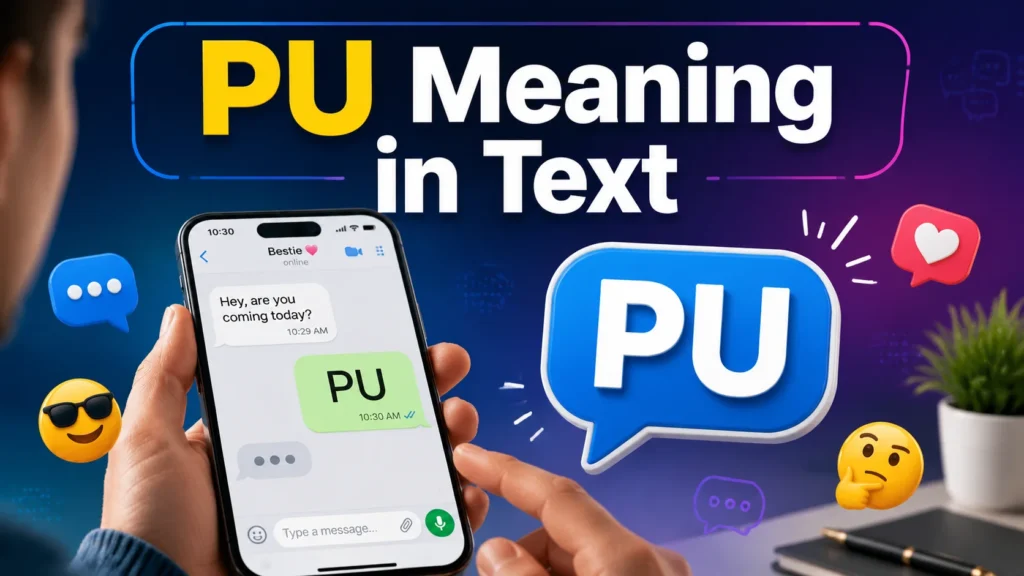
If you have seen someone type “PU” in a text message, social media comment, or online conversation, you may wonder what those two letters mean.
Unlike many internet abbreviations that have one fixed meaning, PU in text can have several meanings depending on the situation.
The most common meaning of PU in texting is “Pick Up.”
People often use PU when talking about answering a phone call, collecting something, or meeting someone.
For example:
“Can you PU the package?”
means:
“Can you pick up the package?”
However, PU can also mean other things in different online communities, such as “Pop Up” or “Phew” in some casual conversations.
People search for “PU meaning in text” because the abbreviation is short and can be confusing without context.
A message between friends, a delivery conversation, and a gaming chat may all use PU differently.
Understanding the situation around the abbreviation is the best way to discover its real meaning.
PU Meaning in Text – Quick Meaning
What Does PU Stand For?
The meaning of PU depends on the conversation.
Common meanings include:
- PU = Pick Up
- PU = Pop Up
- PU = Phew / relief expression (less common)
- PU = Pull Up (arrive or come over)
Most Common Meaning: PU = Pick Up
In everyday texting, PU usually means pick up.
Examples:
“Can you PU my brother?”
Meaning:
“Can you pick up my brother?”
“PU food before coming.”
Meaning:
“Pick up food before coming.”
PU Meaning as “Pull Up”
Among younger users, PU can sometimes mean pull up, which means arriving somewhere.
Example:
“PU at my place later.”
Meaning:
“Come to my place later.”
PU Meaning as “Pop Up”
In some online conversations, PU can refer to something appearing suddenly.
Example:
“A notification PU on my screen.”
Meaning:
“A notification popped up on my screen.”
Why People Use PU Instead of Full Words
Texting culture often uses shorter versions of common phrases.
Typing:
“Can you pick up the phone?”
takes longer than:
“Can you PU?”
Similar examples include:
- BRB = Be Right Back
- BTW = By The Way
- LMK = Let Me Know
- IDK = I Don’t Know
These shortcuts make digital conversations faster.
Origin & Background of PU
Where Did PU Come From?
PU developed from everyday phrases that people frequently use.
“Pick up,” “pull up,” and “pop up” are common expressions in spoken English.
When texting became popular, users began shortening frequently repeated phrases.
Abbreviations like PU became useful because they allowed people to communicate quickly.
Cultural Influence
PU became common through:
- Text messages
- Social media chats
- Online gaming
- Delivery conversations
- Friend groups
The meaning often depends on the community using it.
For example:
A friend may use PU to mean “pull up.”
A family member may use PU to mean “pick up.”
Social Media Impact
Platforms like TikTok, Instagram, Snapchat, and gaming communities helped spread short abbreviations.
Young users often prefer quick messages, especially when making plans.
Example:
“PU when you’re free.”
A friend may understand this as:
“Come over when you’re free.”
Real-Life Conversations
WhatsApp Conversation
Person A:
Can you PU my order from the shop?
Person B:
Sure, I’ll get it after work.
Meaning:
PU means “pick up.”
Instagram DM Conversation
Person A:
Are you coming tonight?
and,
Person B:
Yeah, PU around 8.
Person A:
Okay, see you then.
Meaning:
PU means “pull up” or arrive.
TikTok Comment Conversation
Person A:
My phone keeps showing random messages.
Person B:
A notification just PU.
Meaning:
PU means “popped up.”
Text Message Conversation
Person A:
Can you PU the kids from school?
Person B:
Yes, I’ll be there at 3.
Meaning:
PU means “pick up.”
READ MORE: What TMB Mean in Text? Meaning, Uses & Examples
Emotional & Psychological Meaning of PU
What Emotion Does PU Express?
Unlike emotional slang words, PU is usually a practical abbreviation.
It often communicates:
- Convenience
- Speed
- Planning
- Coordination
People use it because they want to share information quickly.
Why People Use PU
Modern communication often focuses on efficiency.
Instead of writing:
“Can you come and collect this item?”
someone can simply write:
“Can you PU?”
The message becomes shorter while keeping the meaning clear.
How Context Changes Meaning
The same abbreviation can represent different ideas.
Example:
“PU my order.”
means:
“Pick up my order.”
“PU later.”
may mean:
“Pull up later.”
The surrounding words provide the clue.
Personal-Style Scenario
Imagine your friend texts:
“PU at 7?”
If you know they are talking about meeting you, it probably means:
“Pull up at 7?”
But if you were discussing a package, it could mean:
“Pick up at 7?”
The situation decides the meaning.
Usage in Different Contexts
PU on Social Media
On social media platforms like TikTok, Instagram, Snapchat, and Discord, PU is usually understood through context.
Unlike some popular slang abbreviations, PU does not have one universal meaning online.
Common social media uses include:
- Pick Up
- Pull Up
- Pop Up
Examples:
“PU to the event tonight.”
Meaning:
“Come to the event tonight.”
“New update PU on my phone.”
Meaning:
“New update popped up on my phone.”
Because social media conversations are often short, users rely on the surrounding words to understand the meaning.
PU Between Friends and Relationships
Among friends, PU is often used when making plans.
Examples:
“PU at my house after 8.”
Meaning:
“Come over to my house after 8.”
“Can you PU some snacks?”
Meaning:
“Can you pick up some snacks?”
In close friendships, people often use PU because both people already understand the situation.
PU in Professional Settings
PU can be used in professional communication only when the meaning is clear.
For example:
“Please PU the documents from reception.”
may be understandable in a workplace.
However, in formal emails, writing the complete phrase is usually better.
Instead of:
“Can you PU the files?”
Write:
“Can you pick up the files?”
Clear communication prevents confusion.
PU in Different Online Communities
The meaning of PU changes depending on the community.
Delivery or shopping conversations:
PU = Pick Up
Example:
“Can you PU my order?”
Friend groups:
PU = Pull Up
Example:
“PU when you’re nearby.”
Technology conversations:
PU = Pop Up
Example:
“A message PU on my screen.”
Understanding the topic is the easiest way to know the meaning.
When NOT to Use PU
Avoid Using It Without Context
Because PU has multiple meanings, it can confuse people.
Example:
“Can you PU?”
A person may wonder:
- Pick up what?
- Pull up where?
- Pop up what?
Adding more information makes the message clearer.
Better:
“Can you PU my package?”
or:
“Can you PU at my place?”
Avoid It in Formal Communication
In official communication, abbreviations may appear unclear.
Avoid using PU in:
- Business letters
- Formal emails
- Academic writing
Complete words create a more professional impression.
Avoid Using It With People Who Do Not Know Slang
Not everyone understands texting abbreviations.
Older users or people who communicate formally may need the full phrase.
Cultural Sensitivity
Different online communities develop their own meanings.
A phrase that is obvious to one group may confuse another.
Always consider who you are communicating with.
Common Misunderstandings About PU
PU Always Means Pick Up
Many people assume PU only means “pick up.”
While this is the most common meaning, it is not the only one.
Example:
“PU at my place.”
may mean:
“Pull up at my place.”
PU and Pull Up Are Always the Same
Not always.
“Pick up” usually means collecting someone or something.
“Pull up” usually means arriving somewhere.
Examples:
“PU my sister.”
= Pick up my sister.
“PU to my house.”
= Come to my house.
PU Is Only Used Online
PU is also used in everyday communication.
People may say “pick up” or “pull up” verbally, but the abbreviation is mainly used in digital messages.
Everyone Understands PU
Not everyone knows this abbreviation.
Context is necessary, especially with people who are unfamiliar with internet slang.
Comparison Table: PU and Similar Expressions
| Expression | Meaning | Common Usage |
|---|---|---|
| PU | Pick Up / Pull Up / Pop Up | Texting and online chats |
| P/U | Pick Up | Shopping, delivery, transportation |
| Pull Up | Come or arrive | Friends and social plans |
| Pick Up | Collect something/someone | Everyday communication |
| Pop Up | Appear suddenly | Technology and notifications |
| BRB | Be Right Back | Online conversations |
| LMK | Let Me Know | Asking for information |
Key Insight
PU is a context-based abbreviation. Unlike slang words with one clear meaning, PU changes depending on whether the conversation is about plans, transportation, technology, or daily tasks.
Variations and Types of PU Meaning
1. PU as Pick Up
Meaning: Collecting someone or something.
Example:
“Can you PU the package?”
2. PU as Pick Up a Person
Meaning: Giving someone a ride or collecting them.
Example:
“Can you PU me at 6?”
3. PU as Pull Up
Meaning: Arriving at a location.
Example:
“PU when you reach.”
4. PU as Pop Up
Meaning: Something appearing suddenly.
Example:
“A warning message PU.”
5. PU in Delivery Conversations
Meaning: Collecting an order.
Example:
“Your order is ready for PU.”
6. PU in Gaming Communities
Meaning: Sometimes used when talking about joining or arriving.
Example:
“PU at the next match.”
7. PU in Friend Group Chats
Meaning: Usually means coming over or meeting.
Example:
“PU tonight.”
8. PU in Technology Discussions
Meaning: Something appearing on a screen.
Example:
“The error PU again.”
9. PU as a Planning Shortcut
Meaning: Used to organize activities quickly.
Example:
“PU at 5?”
10. PU as General Internet Abbreviation
Meaning: A short form that saves typing time.
Its meaning depends on the conversation.
How to Respond When Someone Uses PU
Casual Replies
If someone says:
“PU at 7?”
You can reply:
- “Sure, see you then.”
- “Okay, I’ll be there.”
- “Sounds good.”
Funny Replies
With friends:
- “Pulling up like a movie scene 😂”
- “On my way 🚗”
- “Give me five minutes.”
Mature Replies
For clear communication:
- “Sure, please confirm the location.”
- “I can pick it up after work.”
- “Let me know the exact time.”
Respectful Replies
If the message is unclear:
- “Do you mean pick up or pull up?”
- “Can you clarify what you mean by PU?”
- “Sure, please share more details.”
Regional & Cultural Usage of PU
Western Culture
In Western online culture, PU is commonly understood through context rather than as a fixed slang word.
People often use it in casual texting for:
- Picking up someone
- Picking up an item
- Arriving somewhere (“pull up”)
Examples:
“Can you PU my order?”
“PU when you get here.”
Among younger users, especially in friend groups, PU may often mean “pull up” when making plans.
Asian Culture
Among younger Asian internet users, PU is recognized through English-based online communication.
It is commonly used in:
- International chats
- Gaming communities
- Social media conversations
- Online shopping discussions
The meaning usually depends on the topic.
For example:
A shopping conversation:
“PU available tomorrow?”
means:
“Pick up available tomorrow?”
A friend conversation:
“PU tonight?”
may mean:
“Come over tonight.”
Middle Eastern Culture
Among younger Middle Eastern users, PU may appear in English-language chats, especially among people who use international social media platforms.
It is mostly used in casual conversations.
Because many people communicate in a mix of languages, the meaning often depends on whether the conversation is about transportation, meetings, or online activities.
Global Internet Usage
PU is used worldwide, but unlike many popular abbreviations, it does not have one universal meaning.
The same two letters can represent different ideas:
- Pick Up
- Pull Up
- Pop Up
The surrounding conversation provides the answer.
Generational Differences
Gen Z:
Gen Z users often understand PU through context because they frequently communicate with short forms and slang.
They may use it for making plans with friends.
Millennials:
Many millennials understand PU, especially for “pick up,” but may use the complete words more often.
Older Generations:
Older users may recognize “pick up” but may not understand PU as a texting abbreviation.
Is PU Safe for Kids?
PU itself is not harmful.
It is simply a short form used in online conversations.
Children may see PU in:
- Family messages
- Friend chats
- Online games
- Social media
The abbreviation is not a safety concern, but children should understand that online communication requires context.
Things Parents Should Teach
Children should learn:
- Ask when an abbreviation is unclear
- Do not meet unknown online people without safety precautions
- Understand the difference between casual slang and respectful communication
- Be careful when sharing personal information
For example:
“PU my bag from school”
is a normal message.
However:
“PU at my location”
from an unknown person online requires caution.
FAQs About PU Meaning in Text
What does PU mean in texting?
PU can have several meanings in texting.
The most common meanings are:
- Pick Up
- Pull Up
- Pop Up
The correct meaning depends on the conversation.
What does PU mean from a girl or guy in text?
If someone texts “PU,” the meaning depends on the situation.
Examples:
“PU my package” = Pick up my package.
“PU at my house” = Come over or pull up.
Does PU mean pick up?
Yes, PU commonly means “pick up.”
Example:
“Can you PU the food?”
means:
“Can you pick up the food?”
What does PU mean on Snapchat?
On Snapchat, PU usually depends on the conversation.
It may mean “pick up” or “pull up” when talking about plans.
What does PU mean on Instagram?
On Instagram messages, PU often means “pull up” when making plans or “pick up” when discussing items.
Is PU a slang word?
PU is considered an abbreviation rather than a traditional slang word.
Its meaning changes based on the situation.
How do I know what PU means?
Look at the words around it.
Examples:
“PU my order” → Pick Up
“PU tonight” → Pull Up
“Notification PU” → Pop Up
Conclusion
The meaning of PU in text depends on the conversation. The most common meaning is “Pick Up,” but it can also mean “Pull Up” or “Pop Up.”
Unlike some texting abbreviations that have one clear definition, PU requires context.
A message from a delivery service may use PU to talk about collecting an order, while a friend may use PU to invite you somewhere.
Understanding internet abbreviations is not just about memorizing meanings. It is about reading the situation, knowing the relationship between people, and recognizing how language changes online.
Whenever you see PU in a message, check the surrounding words before deciding what it means. A little context usually makes the meaning clear.